
The End of Heresy
The Impact of Doublethink in Human History
by
Book Cover & Preview Text
The Standard Model of Cosmology On March 9th 2010 the Horizon programme on BBC Two asked the question “Is Everything We Know About the Universe Wrong?” Science has used mathematics to make predictions of the future – that was how Einstein was able to predict that light bends as it passes close to planets and stars. Cosmology has also used mathematics to run the sequence back and make statements about what happened in the past, right back to the Big Bang. However the Horizon programme stated that built into the Standard Model of Cosmology are theories that don’t make any sense and the problems begin less than one second after creation because the Big Bang explosion should have produced a universe that was “lumpy and messy with patches that were at vastly different temperatures from one area to another [However] in all directions the temperature appears to be almost exactly the same”. An answer to this came with Alan Guth’s Theory of Inflation i.e. that there was an initial period of expansion to allow the temperature to equalize so that inflation would produce a universe that wasn’t lumpy and messy. Guth’s theory had also to postulate that inflation occurred just long enough to equalize the temperature prior to the actual Big Bang. The theory therefore is rather contrived and artificial but it offered an explanation and there was no other theory available. The Standard Model of Cosmology then had to face another problem because gravity does not work as it should. Stars at the outer limits of a galaxy should be travelling more slowly than those nearer the center. We see this in our own solar system with planets such as Jupiter and Saturn moving more slowly than Earth or Venus. However, the outer stars in a galaxy are moving faster than those closer to the centre. This was totally unexpected so cosmologists came up with another contrivance i.e. Dark Matter. Dark Matter is unlike any other kind of matter because it does not emit or reflect light and therefore cannot be observed. Mathematical calculations revealed that in order to explain why gravity does not work as it should, there must be five kilograms of Dark Matter for every kilogram of normal matter, and this matter must be all around us even though we can’t perceive or measure it in any way. This is rather a surprising suggestion bearing in mind that, in rejecting anything spiritual, the sceptics insist that we should only accept evidence that can be objectively measured or observed. Another problem with the Big Bang theory is that immediately after a normal explosion, objects are impelled at phenomenal speed but later on the objects slow down and stop. It was assumed initially that the expansion of the universe would eventually slow down and stop and possibly go into reverse after that. However Edward Hubble in 1928 showed that the universe was not slowing down but rather the reverse - it was accelerating. That doesn’t happen in a normal explosion in which the fastest speeds occur at the beginning. After the initial explosion, deceleration should occur but Hubble showed that the speed was increasing. In order to explain this, the theory of Dark Energy had to be invented. Dark energy causes anti-gravity where distant things are repelled from each other thus causing the continual acceleration. “Dark Energy makes the universe expand and as the universe expands more dark energy is created to fill the gaps - in other words there must be something in nothing. Dark energy is the energy of nothing – taking over more space filled with even more nothingness.” Horizon, BBC Two, Is Everything We know About the Universe Wrong? If you find that difficult to comprehend there are still more problems with the Standard Model of Cosmology because whole clusters of galaxies appear to be moving in an inexplicable way and this has been termed Dark Flow. So far the only explanation for Dark Flow is that there is another Universe outside of our universe which is having a gravitational effect to cause Dark Flow. All in all therefore the Standard Model of Cosmology is so full of inconsistencies that it needs contrived theories added on to explain what should not be occurring and all these add-on theories are unproven. Christianity too has problems in explaining some doctrines such as the Trinity. We cannot know everything and need a balanced approach which accepts for the present, that there are things we do not understand. Our lack of understanding about all the details should not lead us to assume that the universe is completely inexplicable and stop enquiring. Similarly our limited ability to explain theological concepts should not lead us to reject religion or belief in God. Rather we should keep an open mind and consider all the evidence. The scientific method has helped us to understand the universe in which we live by being objective and basing its conclusions on hard evidence but over the last three centuries some scientists have taken on a proselytizing agenda and attempted to make the evidence fit the ideology. They have assumed that with more education, belief will be eradicated from the sensible and intelligent sections of society and they have pursued a doctrinaire agenda which holds religious people in contempt. Royal however, points out that: The alleged war between science and religion, which historians now know is largely fiction, can be maintained only by deliberate misunderstandings. The God That Did Not Fail, Robert Royal
Formats

Book Details
About the Book
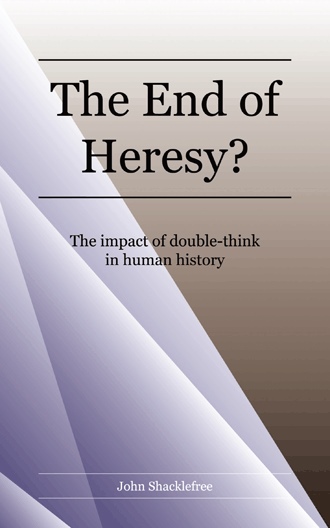
George Orwell’s book ‘Nineteen-Eighty Four’ describes a fictional world in which the manipulation of human thought by the political system has become so pervasive that the people involved in the manipulation do not realize how indoctrinated they have become. Orwell describes doublethink as “the power of holding two contradictory beliefs in one's mind simultaneously, and accepting both of them. ... To tell deliberate lies while genuinely believing in them”. Shacklefree’s book ‘The End of Heresy?’ asks us to consider if doublethink is part of our thinking and whether we are complicit in the process of using reason to justify what we want to believe. Is there such a thing as self-evident truths and if so what part can reason play in helping us to find it? These are the questions raised in Shacklefree’s book and the evidence presented covers a large part of human history from the time of the ancient Greek philosophers up to the present and explores the areas of faith, science and reason. Its pages document the abuse of reason throughout history not only by despots but also by scientists, clerics and modern democratically elected leaders. The book explains how doublethink and newspeak are very much a part of modern democracies and asks us all to consider if we are part of the problem rather than the solution. The book is a call to the normal person to cast off the modern indoctrination branded as freedom and think critically about what our modern day prophets are telling us.
About the Author
John Shacklefree is a democrat with a small ‘d’ who has been disillusioned by the failure of modern democracies to adequately represent the best interests of their citizens. He believes that the freedom of speech which is regarded as the hallmark of a free society has become means by which outrageous views are allowed a voice while the normal person is prosecuted for being politically incorrect. He hopes for the day when the media in general will see their task as being one of informing the public rather than forming public opinion. He is passionate about justice and the dignity of the individual but considers that this cannot occur if the laws of society are based on a flawed philosophy. He wrote this book to encourage people to be sceptical about the indoctrination at the very heart of so called ‘free societies’.