
The Promised Cookie
No Longer Angry Children
by
Book Cover & Preview Text
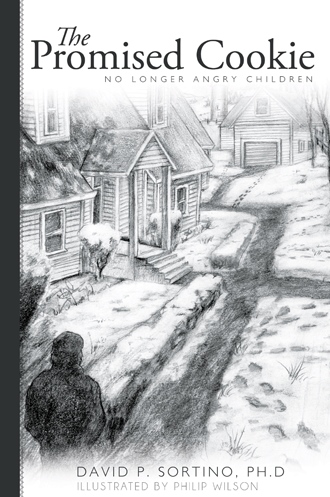
The title of this book, “The Promised Cookie,” evolved from an image I had when I was teaching at C.O.P.E. (Cultural Oppor¬tunities and Programs in Education) a state regional school for exceptional children, ages 11 to 18 years old. A student involved in mastering the art of cookie baking anxiously observed his blistering cookies through an oven window: “I only want the best! The most perfect cookies! Leave the bad ones for the rats.” My students stubbornly refused anything but “the perfect cookies.” “You promised us cookies, not rejects,” a student remarked angrily. Hence, the title, “The Promised Cookie.” The title describes my cooking class of “emotionally disturbed” children/adolescents -- rejected by public school for not being perfect -- the students had been given the clear message that they were not perfect. They did not feel in con¬trol of their own lives, but were attempting to deal with their imperfections. However, I had promised them perfection in the form of a cookie, and they would hold me to my promise. Although I refer frequently to my former students as “disturbed,” “learning disabled,” and “angry,” these labels are worn-out symbols created by adults to describe child¬ren who could not or would not fit into the labels of the public schools’ definition of “normal.” Pinning labels on kids who are “different” is a simplistic approach to a solution. These children, frequently antagonistic, hostile, angry and above all lacking self-esteem, needed to be socialized. In a word, they needed to trust themselves and others. Through years of abuse these children bore the scars of adult anger. During my teaching years at C.O.P.E., I watched these children use this learned anger to survive, which resulted in aggressive, acting-out behavior. Thus, as adults, as authority figures create these labels, the peer group thoughtlessly adopted the adult “suggestion” and then began to regard their fellow students as unlike themselves and therefore different -- and the differences only led to antisocial behaviors. Since the labels are only stumbling blocks thoughtlessly placed in my students’ paths, impeding their physical and emotional progress, I advocate eliminating labels as a primary step in helping youngsters deal with problems. At C.O.P.E., instead of labels, I used the students’ first names as often as possible or referred to them as simply “kids, children, students and adolescents.” This book has been written not just for a specialized audience, but also for every adult who feels the need to develop an intimate, communicative, and understanding “special” relationship with a child or adolescent. If I developed a strong bond with my students, certainly you can do the same with children or adolescents who haven’t experienced major adaptive problems in public school. COPE was successful in helping our students return to public school because our actions were informed by the premise that C.O.P.E. would be based on teaching the academics and social skills simultaneously. This approach freed my students from fear and mistrust, and gave them the ability to believe in themselves and help unblock much of their anger. My final comment has to do with the overall success of my so-called “SED children” and program. Riding on a bus and attending a school with “retards” became my kids (emotionally disturbed) rallying cry for an excuse to vent their anger and violence toward themselves and others. However, it was those “retards” or other handicapped children (autistic, pregnant teens, auditory impaired) that played a major role in the emotional growth of my students. For example, sometime during the course of my students’ and the school’s evolution, a dramatic change took place in my students’ acceptance and tolerance toward those “retards or handicapped” children. In other words, the more they accepted other handicapped children, the more they learned to accept themselves. Moreover, they became highly protective of the “retards” and came to their defense whenever the occasion presented itself. This rise in consciousness carried over to the rest of my students or something akin to the *100 Monkey syndrome. In short, when they returned to their public schools, and they had to face the ridicule from public school students, whose only memories were those of angry, violent “emotionally disturbed” students, our students became leaders and role models for the acceptance and tolerance of others less fortunate. If this book serves its readers, it will succeed in demonstrating that the best methods to reaching emotionally disturbed children are the ones that come from the heart, which are often the most honest, effective and natural to enact.
Formats

Book Details
About the Book
“From beginning to end of the ‘Promised Cookie,’ the characterizations, educational philosophy, and reflection on the strength of the human spirit entrance the reader, causing each of us to reflect on our own roles as “teachers.” David Sortino has created a compelling account of what love and patience can do in the caretaking and education of fellow beings.”
TEACHER, POET, AND PARENT
“David Sortino’s work in Promised Cookie is an affirmation of the possibility of each human recognizing his true potential through the reflection of another loving human being. A must read for all parents and educators.”
PARENT
“A great read about how to reach angry, abused children! When the human spirit is directed toward the child’s higher self their true spirit will appear! I highly recommend this book to teachers, counselors and parents!”
CHILD PSYCHOLOGIST
“Parents of angry children should take note of Dr. Sortino’s story. It proves that every child, no matter the severity of their problems, can be reached.”
MENTAL HEALTH COUNSELOR
“Dr. Sortino demonstrates how teaching at-risk children begins when you attach the child’s social consciousness to education. We can all learn a great deal from this true story.”
MIDDLE SCHOOL TEACHER
“David Sortino demonstrates in The Promised Cookie that being a true educator describes who we are, not what we do. It is an artful dance in which both parties must be willing to give and to receive. This inspirational story has reminded me that every day we, as teachers, parents or guardians, have the opportunity to be an angel for a child. Through The Promised Cookie, Dr. Sortino gives us a glowing invitation to be better.”
PRIMARY GRADE SCHOOL TEACHER