
Searchial Marketing:
How Social Media Drives Search Optimization in Web 3.0
by
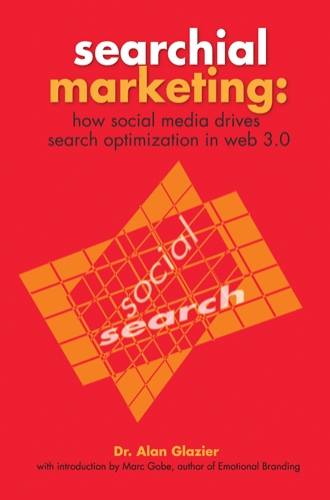
Book Cover & Preview Text
I'm sure at least half of my unsolicited mailings and "push" marketing efforts were glanced at and trashed after I paying a fortune in printing and postage. At best, each contact I was able to reach through traditional marketing had on average a depth of a family of 4 and maybe a few friends. I question whether anyone ever even looked at my yellow page ad. Now, when I have an interesting comment to post on Twitter, it can get proliferated (re-tweeted or RT’d) to hundreds of thousands of people! . . . each new “tweet” is recognized by Google and appears in the top of search engine searches for the keywords and key phrases that describe the products and services I input in the tweet. When I finally understood the power of this new method of marketing, I realized what reason was there NOT to be part of this new “conversation"? It was at this point that my social media efforts took off, and within a year I had built a significant network of thousands of "followers" over several social media tools. “Search engine optimization” is a term used to describe the attempt to show up in searches for words or phrases people use to search for the products or services you are selling ahead of competitors. I think a better term for the public to grasp what you are trying to achieve with this too is “Search Engine Elevation”. How you are “optimized”, or “elevated” through any particular search is due, in large part, to the content you produce and proliferate on the social internet. When I realized what this could do in terms of driving new business through the doors of my brick-and-mortar business, the light bulb went off, and I decided instead of spending money on traditional marketing which was becoming less and less effective as people searched more and more in search engines, I would try to master this new media channel. The evolution of your marketing and advertising efforts will naturally shift towards using new media whether you want it to or not. Delaying the inevitable is harming your organization. Working with new media to market your business will produce results that go straight to your bottom line, cutting your advertising budget as close to nil as you want to go. This is the story of how the social internet is capable of driving customers into your business and how progressive businesses are leveraging it to find new business and decrease marketing expenses. It’s gearing your social efforts towards search engine elevation, or, as I call it, Searchial Marketing. Within today’s internet there are several broad methods you might use to market a business. This book discusses the strategy of social for search engine optimization, for which I coined the term SEARCHIAL. The searchial method provides the most return on investment; by interacting in the grass-roots social space in a calculated manner you cause your web content to float to the top of searches, driving in new business. If you are reading this book, you likely have a website. This makes it likely you have “content” you wrote that exists on the internet. Search engines have software referred to as “Bots” or “spiders” that are “sent out” across the web regularly. The job of these bots is to “read” content and assign levels of importance, or “relevance” to websites and blogs based on keywords and key phrases found in the content. For instance, if your content regularly mentions the keyword “optical,” the bots award you a certain numerical value that equates to the “importance” for searches that include the keyword “optical”. If you have the word “optical” linked to other sites that mention the keyword “optical” and they link to you, then your content earns a higher numerical value, thus your content assigned a higher importance, score for your content than sites that do not. Google uses the term “relevance” to describe the importance of content for particular keywords or key phrases. The relevance of a website and/or blog is determined by many things, but mostly by how much up-to-date relevant content is published in a given area of expertise and how many other websites, blogs, forums and directories reference the blog or website by linking their content to it. When a “Bot” finds a site that is: • Regularly updated with content that is keyword-specific to a given search • Links to other highly relevant sites within the same specialty • Is modern in its technology (incorporates online forms, videos etc.) and • Participates in certain social media efforts … the bot assigns a higher grade to that site than it would to a similar site in a similar area of expertise without these qualities. This higher grade helps the content get placed higher in the search engine listings when an internet user searches for the keyword the bot recognized and rewarded it for. In essence, the more “relevant” your website for any specific search term, the higher up you will appear in search engines when people in your geographic location are searching for your services in their area. I refer to the process of modifying your content to improve search as “Search Engine Elevation”. Eventually, you show up higher in a Google search for “optical” than your local competitors and are “found” more by people in your area searching for “optical” products. This is the most direct value proposition for using social media for your business – getting “found” more frequently than your competitors when people are looking for the goods or services you offer. The Bots can be your friends or your enemies and are extremely powerful; I sometimes refer to them jokingly as the “bot gods”; respect the bot gods, you may even want to pray to them, because the bots show their love by increasing your position in search engines and there is a direct correlation to where you are found in an organic search and business revenue.
Formats

Book Details
About the Book
The “buzz” surrounding social media focuses on how business can build relationships by participating in the online “conversation”. When it works, social media relationship building is often labor and time intensive with a return on investment that is often hard to measure. Not many people understand that social media campaigns can be orchestrated to build relationships and drive in new business at a much greater rate than using the relationship aspect of social media alone provides. When I discovered this, relationship building became the least compelling part of the picture. “Searchial” is a phrase I created to describe the method of interacting within the strange new world of social media while elevating your profile in internet searches for the products and services you offer. This book teaches do-it-yourself methods of implementing a “searchial” media campaign. It demonstrates the added value of practicing “searchial media” instead of just “social media”. Social tools have the power to drive new business into your organization not only through communicating and relationship building, but by coincidentally causing your listing in search engines to rank higher in searches for keywords and key phrases people are using to find the products and services you offer in a specific geographical area or worldwide. The term “Searchial” reflects the realization that my time and effort were best spent driving new patients into my medical practice using social tools to improve our position in Google, Bing and other search engines, not just building and strengthening existing relationships. This book can be applied to and used as a guide within any industry at any stage of the new media marketing game. Appendices contain information specific to social media and search elevation in the medical profession, specifically small medical business, hospital and clinic and pharmaceutical companies.