
Society in a Market Economy
by
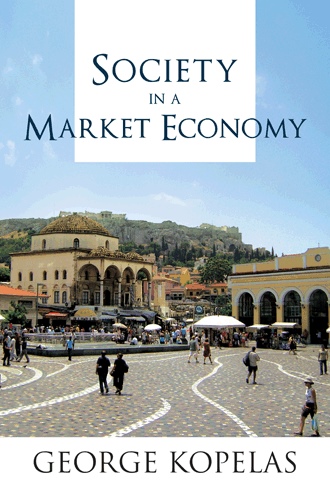
Book Cover & Preview Text
SOCIETY AND INDIVIDUALS
The true value of people and things is revealed during their absence
Society is an aggregate of individuals bound together by location, history, trade, common ownership, joy or sorrow. From the point of view of a scientist, any individual in relation to society is nothing more than a word in a book, a digit in a number, a line in a drawing, a tree in a forest, or a star in the sky. Certain individuals may be very different from the others, or more important to society but no individual can determine the existence or the course of a society as an individual. On the contrary, society can determine not only the life styles and roles of individuals but also the very existence of any member. No individual is precluded from the hazards of local crime, political terror, bad medical care and public transport (the lives of airplane passengers are determined by pilots, airtraffic controllers and maintenance workers).
The study of human history has revealed the existence of thousands of men who have made a significant contribution to the development of civilization. From a mathematical point of view each individual is a real number, positive or negative, small or large but always a definite number while society is the infinity.
Similarly, from a physical point of view man is a star while society is a galaxy. Man is a cloud in the sky, a cell in the body of a society, a small part of a grand total.
So far, all individuals have had a definitive life span not exceeding that of a few generations while societies such as nations have existed for thousands of years. Millions died during the Second World War in an effort to keep the existing societies intact while no society has ever endangered itself for the survival of any single member, even for its absolute ruler. "The King is dead, long live the King!" All societies praise the heros returning from the battle-field but no society praises, or even tolerates a despot or tyrant for long. The car as a whole is more important than any of its components.
SOCIETY IN A MARKET ECONOMY
Nothing against society may be just or right
Every society as a whole functions without regard to the will of any single member (no king can rule over his subjects without some popular consent). Nevertheless, from time to time certain individuals in dominant positions lay down the rules of conduct that regulate public life and business activity (i.e. a constitution). In the end, a set of laws will regulate all aspects of life until the population decides for a different system. Thus, in 1789 the French people revolted against the feudal system with the view to establish a democracy, whereas in 1917 the Russian people revolted against the tsar and his court to establish a socialist state. Both revolutions imposed severe restrictions on hereditary rights. Political rights were detached from property rights while all large real estates were confiscated (became public property). In the eyes of the law, all people became equal irrespective of their social background, occupation, education or financial position.
It has already become common property that the rights of people are determined by the relative strength of social groups with competing interests. In democratic societies the political rights are equally distributed (one man, one vote). Equality, however, is not extended to property rights. The distribution of property rights is left on the operation of market forces rather than on social considerations. Even today, more than 200 years after the French Revolution, most people in
Formats

Book Details
About the Book
This book is a product of broad scientific knowledge. Written in simple English, it can be fully understood even by the common man who has no particular education. After a comprehensive analysis of the market economy, the book demonstrates the only way to a less autocratic and more prosperous society. The value of a good book is much higher than its selling price.
About the Author
He is a Greek cosmopolitan who was born in Athens in 1954 but studied business studies in London at the City of London Polytechnic (1974-78). He worked for National Westminster Bank (1981-94) in various positions and ever since with numerous foreign firms as a business consultant. As a descendant of prominent political activists who played a crucial role in the wars for the liberation of Greece from the Ottoman Empire (1821-29) and The Third Reich (1941-44) he was able to study thoroughly the political aspects of private enterprise and its effects on modern society.