
The Best of the Bargain
Lincoln In Western New York
by
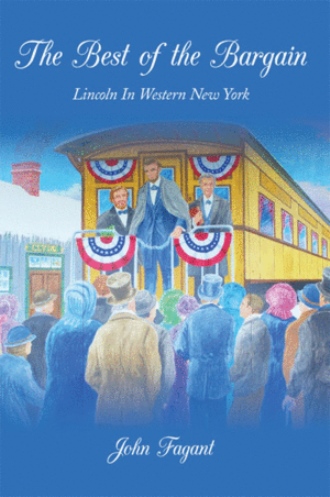
Book Cover & Preview Text
The Exchange St. Depot
Preparations for an Event:
The early morning sunshine had melted the snow from the previous night. The temperature had risen to just above freezing. It looked like it would be an ideal winter day; at least as best as you can expect in February. There was only one problem with it. The sunshine and the melted snow brought about muddy roads. Some of them were impassable muddy roads. The “streets … were as slushy and unclean as paved thoroughfares well can be.” Nevertheless, today would be an eventful day for the city. Activity began early in the morning. Flags began to rise on the flagpoles and in front of the buildings. As the morning progressed, other decorations appeared. Building fronts were now covered with “tri-colored drapery”. An array of flags, both large and small, were appearing in countless places all over the city, “until Buffalo had put on the most gala look that she had worn for many a month.” By late morning, people had begun to gather “more thickly than usual,” especially at the street corners. By early afternoon, the crowds rapidly increased. The city inhabitants were now stopping their work and the country folks were arriving in great numbers, coming in from the rest of the county. There was a holiday excitement in the air. Amongst the crowd there was a “prevailing anticipation of something memorable and important in occurrence.” Today, Saturday, February 16, 1861, the President-elect, Abraham Lincoln, was coming to town.
“When the looked for hour of the President's coming had arrived, the crowd, the bustle, the excitement which all day had grown, was at a climax which we think it perfectly safe to say never has been equaled in Buffalo. Packed upon the walks, clustered upon the roofs, crowded at the windows … heaped and overflowing everywhere within view of the route of the expected procession, such a swarming of humanity … we never before saw in our Queen City. Within and around the depot on Exchange street the press was of course the greatest. There the crowd was absolutely fearful in its magnitude and in the excitement under which it swayed as under a tempest.”1
The Arrival:
At precisely 4:30 PM, the cannon of Major Wiedrich's Artillery Company on Michigan Street broadcast the arrival of the train. The wildest cheering greeted its appearance, “cheering that began with the multitude away down the track … gathering volume as it rolled up to the Depot.”2 The Depot was the Exchange Street Station. The original structure built in the late 1840's was no more than a shed with one track. The 1861 building was the second one and the first built by the New York Central. Although much larger than the original, it was still a bit too cramped for the crowd of this day.
A Cleveland reporter on the train described the scene as they approached the city. “We began to see crowds of people standing near the railroad when the train was a mile out of Buffalo. As we advanced the crowds thickened and shouts from thousands of throats and the loud booming of cannon were heard. The crowd filled open freight cars on the track, stood in solid masses on car tops, filled windows and every conceivable standing place from which to see. In the neighborhood of the depot the throng was very dense, and within they were packed so closely they could only move in masses of hundreds.”
The crowd inside the depot, estimated to be at least 10,000, struggled to get a better view of the rear car of the train, which contained the President-elect.
Formats

Book Details
About the Book
A twelve day inaugural journey by President-elect Abraham Lincoln in 1861 took him through
During his stay in the region,
With a nearly out-of-control yet enthusiastic public, a pickpocket's heaven, and even the occasional snowball, the
About the Author
John Fagant is a member of Preservation Buffalo Niagara, Old Fort Niagara Association and the Buffalo & Erie County Historical Society. He has written several articles on