
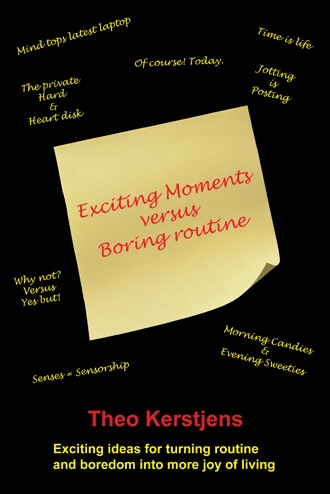
Exciting Moments versus Boring routine
Exciting ideas for turning routine and boredom into more joy of living
by
Book Cover & Preview Text
When Mr. and Mrs. High Aspirations turn into Mr. and Mrs. “As Usual”
It is common knowledge that in spite of good intentions, in most cases the blush is off the rose of human passion in only a few years. Daily life, with its habits, work stress, and the drag of personal responsibilities, can easily become an invariable routine, devoid of beauty and inspiration. Routine is an invisible virus that slowly and silently insinuates itself into our lives and nurtures itself on our complacent or defeatist attitudes and thoughts. If unattended to, the virus gets under our skin and circulates to our hearts and minds, convincing us that we are helpless against its power and leaving emotional scars. Lethargy in human relationships needs immediate treatment before it transforms itself into a deeply-rooted sense of dissatisfaction. If we are aware from the very beginning what is happening to us, we can consciously protect ourselves from the deadening of our emotions by taking the right measures to keep love alive. However, if the routine reaches the contagious stage and both people are affected, what can be done? Give in to temptation of thinking that the ring feels too tight on one's finger? Not at all! Nothing is as lost as it appears to be in a moment of desperation. Let's talk about how to bring excitement back to our relationships, starting with the dinner table. It might be that a little salt and pepper is all that is needed to set things right again.
Around, at, on, and under the table
Let's take a couple of moments to reflect about the act and art of eating and the time and attention that should be given to it. One of the worst errors we make when we eat is not dedicating the attention and time the meal deserves. Doctors, nutritionists, cooks, and lifestyle specialists are always telling us that we should eat slowly in a relaxing atmosphere and be consciousness of enjoying every bite, because eating is an act of love for ourselves. Eating is a highly sensorial celebration for both our bodies and our minds. Devouring a good meal in record time is, first of all, an offence to the person who dedicated time, skill, and personal effort in preparing it. Secondly, it deprives us of an essential pleasure. Eating too quickly is also a form of self-punishment, as it is likely to leave us emotionally unsatisfied and can provoke indigestion. Voltaire described the yin and yang of food when he said: "Nothing would be more tiresome than eating and drinking if God had not made them a pleasure as well as a necessity”.
It doesn't make sense to pack a lot of less important gatherings into our day only to end up not having time to sit down and enjoy what should be our number one pleasure. We could learn a lot from societies that have highly developed gastronomic cultures and consider eating a form of art. In these cultures, people have a social and culinary-oriented attitude toward time management and demand time to enjoy and share the principal meals of the day as a natural part of their schedules. It's no coincidence that these societies enjoy high levels of family and social cohesion and high coefficients of life satisfaction.
The Slow Food movement embraces the concept of eating healthy local products and preserving both traditional methods of preparing and cooking food and the traditional custom of making every meal a celebration. Founded in the 1980s by Italian Carlo Petrini as a protest against fast food, it has become an international organization dedicated to preserving and promoting unique regional products and reviving the almost forgotten tradition of fully savoring a well prepared meal. Who amongst us would refute the assertion that a simmering casserole made with fresh, regional products is tastier, healthier, and more satisfying than fast food?
What's on the table (and who is around it) at meal time can be a barometer of our quality of life. Taking time out to eat well is a way of reawakening and training our senses and sharing quality time with friends and loved ones. I personally believe that sitting down at the table together is a crucial element in establishing and maintaining relationships, particularly private and family relationships. Not investing the time or having an interest in sharing a meal with people is not investing the time or having an interest in maintaining a relevant level of personal involvement with them. Topics that are not discussed and solved around the table will be difficult to solve elsewhere.
The table is an intimate social space in many cultures around the world. It is the stage for high drama, confrontation, and celebration and is one of the best places to make a deal. Clasping hands across a table or engaging in a little game of footsy under the table has solidified many new flirtations and awakened the dying embers of many fading passions. Let's give the table the place of honor and the time it deserves and make it the largest and richest buffet of exciting moments on Earth. There is no better spot to toast proposals for new adventures and relive happy memories with those you love.
Formats

Book Details
About the Book
Give New Wings to your mind.
"How is everything today? The most invariable answer is “As usual, Thank you”. These are only two of the many “usual” platitudes we routinely exchange every day. This typical social interaction is, at the same time, an expression of our profound boredom. Routine and boredom are progressively undermining our society. We suffer from an excessively accelerated lifestyle, a stifling conformity in school and the workplace, and a progressive loss of direct, person-to-person communications. From early childhood on, we struggle to balance the pressure of society's demands with our inner needs. Very often happiness and fulfillment seem like far off, even impossible, goals to us. Have you ever felt that you were not getting enough out of life? Does the daily routine get you down? Do you lack inspiration and suffer from boredom? If you have answered yes to any of the above questions, this is the book for you. Author Theo Kerstjens provides a step-by-step guide to how to beat the routine, transform moments of boredom into exciting experiences, and add more joy to your life.
About the Author
Theo Kerstjens has been a true flying Dutchmen since childhood.
As an international communications professional, he has logged in over four million miles around the globe. Both personally and professionally, he has overcome the seeming inevitability of boring “as usual” routines, and has become an expert in ways of injecting new inspirations and aspirations into one's professional and personal lives.
A passionate diver into the daily lives of thousands of people from diverse cultures and traditions, his experiences have made him aware that he has enjoyed a privileged balance between his professional career and his personal life that many people he has dealt with did not have.
Helping others to achieve this balance and find more joy in life was the inspiration for this book. It is the author's personal contribution to the fight against routine and boredom and an essential guide for readers who truly desire to transform their boring “as usual” moments into more exciting and unique moments to live and to enjoy.