
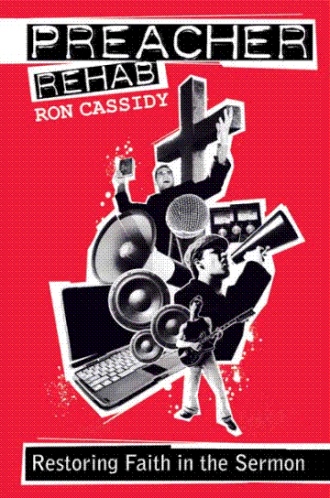
Preacher Rehab
Restoring Faith in the Sermon
by
Book Cover & Preview Text
The Vicar was excited. The Bishop was due to come to preach and preside the next day. Alongside the natural pleasure of having the Bishop there was a certain sense of relief that for once he would not need to prepare a sermon. Then came the news he dreaded. The Bishop had flu and would not be coming after all. So the Vicar did what all self-respecting Vicars would do in such circumstances - and told the Curate he would have to preach instead. As the young man stood up in the pulpit he felt his inadequacy at filling the Bishop's shoes. The congregation's sense of disappointment was almost palpable. Nervously and self-deprecatingly he began, “I am sorry I am not the Bishop. I know I am no more than a substitute, just like the cardboard filling in for that broken pane of glass.” At the end of the service the churchwardens, seeking to be helpful as all churchwardens do, reassured the curate, “you were no substitute piece of cardboard in the window; you were a real pain !” Sadly this story reflects the impact that many sermons have on congregations today. While they may not actually be caused physical pain, they will nevertheless regard many sermons as things to be endured rather than enjoyed. Preacher Rehab is born out of a strong desire for more people to become involved in the privilege of the ministry of preaching, and for those already involved to aspire to become more effective in that ministry. It has sprung from more than forty years of preaching to Anglican congregations in Lancashire in various situations, from inner-city Liverpool, urban Bolton, semi-rural Mossley and suburban Manchester. This time has had many highs and lows, but through them all has continued the conviction that some of God's most effective works are accomplished by effective Spirit-inspired preaching.
It has to be said, in the words of the Preacher of Ecclesiastes (more or less) that of the making of books on preaching there is apparently no end. Look at any typical bibliography attached to a standard book on preaching and you will find no shortage of excellent treatises on this particular subject. It is a well ploughed field, so much so that any prospective writer such as myself has to begin with an attempt at justifying the exercise itself. So what makes this book different ? Why should the aspiring preacher choose it in preference to other worthy writings ? For one thing, it has a very clear and closely defined setting in life. Look more closely at the above-mentioned bibliographies and you will discover that not many are written in the context of the English Church scene. Many are written by American authors with assumptions about the social and religious context of preaching that simply do not hold true for contemporary English society. Fewer books still are written from within the Church of England setting and which discuss preaching in the Church of England. Why is this important ? It is important because, unlike the non-liturgical or semi-liturgical settings that many of these books assume, within the Church of England liturgy the sermon has to vie with other elements for time and prominence. In many churches, what often passes for worship is perceived as simply a prelude or build-up to the preaching of the Word. The sermon is effectively the central if not the sole substantial element of the service. Within the Anglican set up however such prominence for the sermon cannot be taken for granted, and it's importance is not self-evident. There is the need therefore to set out the proper context for the sermon within the worship of the Church. Many other works on preaching nod in the direction of worship but do not the develop the theme in any detail. This perceived deficiency I attempt to make up. What also is very noticeable is that many of the works on preaching are written by academics, people involved in one institution or another teaching homiletics. I am certainly not saying that such people do not have a valuable preaching ministry. Many do, or at least have had distinguished preaching ministries in the past. I do not wish to detract from their work in any way, and in my book I make many positive and grateful comments on the things they have written. However, it is a passionate concern that preaching is a discipline that cannot be learned in the classroom. It must be learned “on the job”, preaching to real people in real-life situations - and getting very real and forceful feedback ! Preacher Rehab therefore is written out of a marriage between academic theology (I have a Ph.D. in New Testament Studies) and practical pastoral practice (forty years as an Anglican parish priest). I believe this is one area where it is possible to have feet in two camps, so that pastoral practice is founded, as it should be, on sound theology. The marriage may go through rocky times on occasions, but hopefully the bond remains strong. It is also true that preaching is a very individual thing. While every preacher operates in accordance with the same general principles, he or she brings much of his or her unique self to the delivery of a sermon. It could be said that there are as many different styles of preaching as there are preachers. It follows by extension that every book on preaching will be different, and reflect the individual approach of its author. While therefore I gladly acknowledge the contributions of others, using Stephen Wright's phrase “standing on the shoulders of giants” the book is very much my book, representing an individual approach to preaching that is not merely a condensation of the work of others. Certainly, no-one else should be blamed for its deficiencies ! I should offer one word of explanation and apology in advance to my sisters in the ordained ministry. I decided at a quite early stage that it would soon become tiresome and unwieldy to write “he and she” every time I wished to use the personal pronoun for the preacher. My use of “he” therefore wholeheartedly includes women priests and preachers. I am reminded of a speaker at the Keswick Convention once who explained “every time I say `brethren' I embrace the ladies” ! Incidentally, for that same reason I have included no separate section in the book for “women in the pulpit”, believing that the principles espoused apply equally to preachers of both genders. My short hand therefore in no way implies any lack of respect, and I hope therefore the book will for that reason not be passed over by female preachers. In short, this book is a personal testimony to the importance and fruitfulness of preaching, and stems out of a real concern for the standard of preaching in the Church of England today. This concern originated when, whilst recuperating from an operation, I had the all-too-rare opportunity of listening on a regular basis to sermons, rather than delivering them. The concern has grown since, having retired from full-time ministry, I have had further opportunities of being on the receiving end of preachers. If I had any hair left, it would frequently have stood on end, or been torn out by now ! Instead of complaining to the Bishop, I have attempted to do something about it. I hope therefore all readers will find something somewhere in the book that will be of value and will enrich them as they engage in the greatest calling anyone can have. RON CASSIDY Manchester
Formats

Book Details
About the Book
In this book Ron Cassidy faces squarely and honestly the things that in our contemporary society make life hard for the preacher, and which cause some to speculate that traditional preaching may well now have had its day. He goes on nevertheless to argue that preaching, if done well, is still an effective means of Christian communication. The hope is that this book will excite and encourage preachers to realise the full potential for spiritual power that is available from the pulpit. The book is both theoretical and practical. It is based on sound theology, as all pastoral practice should be, but also goes on to deal with the nuts and bolts of preparing and delivering the sermon. Whereas many books deal with either the theological or the practical aspects of preaching, this book attempts to combine both spheres. The author believes passionately that preaching cannot be taught in the academy alone. It is the archetypal subject for "on the job" learning, as both preacher and congregation travel along together on their spiritual journey.
About the Author
Ordained in 1968, Ron Cassidy recently retired after 40 years in the Anglican Ministry, serving several parishes in Lancashire. In retirement Ron lives in Manchester and still preaches regularly. Ron is also a member of the Cambridge-based Tyndale Fellowship for Biblical and Theological Research.