
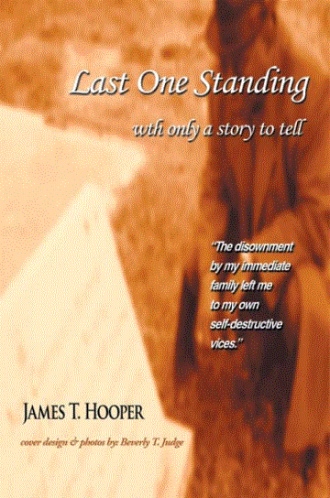
Last One Standing
With only a story to tell
by
Book Cover & Preview Text
It’s Saturday morning and as I opened my eyes, I noticed the sun was just beginning to appear from the eastern skies. This was the best time to get up and move around. People that resided in Florida knew that during the summer months it wouldn’t be long before the morning rays from the sun would demand that you turn on the air conditioners if you had one. Those like my family without air conditioners knew that they only had a short time to get things done indoors before the rising heat inside the house would force any unnecessary movement to slow, if not come to a complete stop.
I slept with my younger brother Michael. Sometimes I believed he wet our bed out of meanness. This was one of those mornings so I was going into the bathroom to clean up. I knew this was going to be a repeat of all the other Saturdays that I could remember. My mother could win mother of the century if that contest was conducted on Saturday morning. She could also win drunk of the century if the contest was held late Saturday night after she returned home from partying. This behavior had been going on for years. She would come in from partying, drunk and smelling of urine. Then like clockwork, she would call us all into the living room to make her weekly announcement. Telling us that she wouldn’t be with us much longer and how important it was that we came together as siblings. More importantly, was why we should love and support one another. All of this knowledge and wisdom while in another one of her weekly drunken stupors. This went on week after week with the same ending; her falling asleep in the middle of her speech. As I was on my way to the bathroom, I thought my oldest brother Tom had said something to me. Since I didn’t hear what he said, I asked him if he was talking to me, he said "No, dummy". Everybody in the house thought that was so funny. I went on into the bathroom. When I came out, they were eating breakfast in the dinning room. I knew there was no sense in attempting to get a plate of food because it always turned out the same. My mother would say something to embarrass me in front of everybody and I would end up with my feelings hurt and walking out of the house. If I didn’t bother them while they were eating and having fun, she would leave something out for me to eat, which I had to pay for by cleaning the kitchen afterwards.
It was Saturday again and I really didn’t want to be there this night when she came in from her partying. The previous Saturday was the last drunken stupor play I would ever attend. This time when my brother called out to me that mama was calling me, I said, "Don’t call me in there again until she is dead!" After I uttered those words, everybody in the house developed a hatred for me that was so intense it appeared that smoke was coming out of their ears. After breakfast they all gathered in the living room to watch cartoons, I was never welcomed. I went out to the backyard and began playing marbles by myself. Not being part of their world, no longer seemed to bother me. I would just pretend that I was an only child, that seemed to get me through any intentional torment my mother and siblings threw at me. Hours had passed and it had become so hot outside that I couldn’t take the heat anymore. I went back into the house. As I was going to the bedroom I heard them talking about what they were going to eat for lunch. I left the bedroom door cracked so that I could hear them. "Mama lets get some Church’s fried chicken today", Tom said. "Okay", my mother responded. She then instructed Tom to make a list of the pieces of chicken they wanted. As Joyce and Michael were giving Tom there orders, I over heard Joyce say, "Tom, get Peewee a big piece of chicken so that we can split his". Tom said, "Oh yeah, that’s a good idea"! I don’t know what happened to me, but I became so angry. Maybe I had spent too much time playing marbles in the sun. We had a television and washing machine that were coin operated. I made my decision. This was the day that I was leaving this evil place and the money in those machines would finance my departure. By the time my mother had gotten back with the chicken, it had become so hot inside the house that they had all gathered on the front porch. I found a screwdriver and busted opened both television and washing machine. I know they heard all the noises that I was creating trying to get the money out of those machines and I didn’t care. With my pockets full of change from those machines, I walked out onto the front porch where they all were. A couple of my brother’s friends had come up and were on the porch. I was going to give them a piece of my mind, walk off the porch and into my new life at age eleven. I sat down on the steps and before I could say anything, everything went black. What they did to me after that made me want revenge, and the act of carrying out that revenge would lead me down a path of self-destruction of seemingly no return. You are about to find out why - out of all Peewee has experienced - he would still be, "The last one Standing with only a story to tell"
Formats

Book Details
About the Book
A life once lost struggling to be found. A childhood of sadness and emotional trauma is evident as the author delves deep into the psychic of his soul, and the memoirs of his past; to be whole, to understand, to move forward into a life of hope and prosperity. Due to the gravity of life, falling down is easier than climbing up. The skeletons in his closet are evolving from evil to good; some what like from the cocoon comes the butterfly. God has put the good within him and it is striving to get out of bondage and thrive forever; to help rather than to hurt,to build up rather than to tear down, to love rather than to hate. As you read this book, brace yourself for tumultuous episodes and terminology. Look beyond that, to feel the pain of the victims and the perpetrators. Rebecca Judge, Mental Health Professional
About the Author
James Hooper is a man who has lived many lives in just over a half century. He writes this book in an effort to understand himself and to reveal the pain and devastation of a child who was rejected by his family. He hopes to help keep any other young person from following a similar path as he chose. Being disassociated from his biological family at a young age, he found family within the group that would accept him. The measuring stick that he used to judge right from wrong was not developed in a normal family structure but rather in the streets.
James now holds a master's degree in World Religion with bachelor's degree in Political Science. While on the journey of revisiting his past, he uncovered a lot of facts that helped him understand some of the contributing factors that caused his life to take the path it did. In writing this book he had anticipated an overwhelming therapeutic effect, but found instead that it stirred up buried feelings. In the book he speaks of Peewee (which is his nick name) in the abstract, as if it is a different entity from himself. This was James' attempt to make his evil deeds someone else's fault
.
Exposing his life to the public is not in any way intended to condone or glorify such behavior. He felt it important for any person, group, or organization to better understand the streets, the truth had to be told. The story is true and the situations are real. In spite of it all, the author expresses a desire and ability to show others that it is never too late to look within and find ones self. "Happy is the man that findeth wisdom, and the man that getteth understanding". [Proverbs 3:13]