
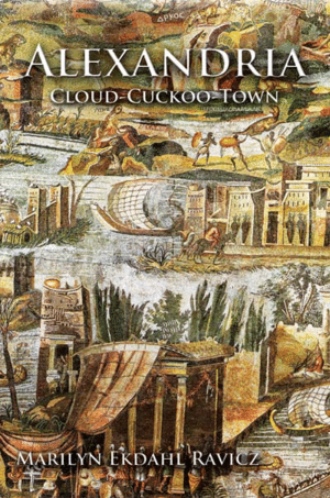
Alexandria
Cloud-Cuckoo-Town
by
Book Cover & Preview Text
prologue: the scene is set
It was because of that message.
It was because of that damn message from Alexandria! It forced our memories to hover between poetic illusions of justice and the hard edges of memory. It was a message that revealed how deeply we had embalmed the past before our arrival in Askelon. It now immersed us in an orgy of petty remembrances.
Yes, our past is prologue to our present.
Yes, that message spurred us on. Yet I still marvel why we agreed so readily to wait patiently on a rocky hill above Askelon’s harbor staring at the sea below. Why indeed? A long history of events and decisions shaped our days in Alexandria. Or did simple friendship fire the energy behind why Artemisia and I sit wallowing in remembrances: memories of the rich smell of burning olive wood; of the languorous, erotic scents of perfumes; of wavery, ragged quartertone songs; of elegant chambers in great palaces; of the elegant buildings that house the world’s greatest learning center. In short, of Alexandria, our city of shared memories.
We lean against each other to study the blue-green waves breaking against the curving mole below. Silent. We are uneasy. Why? Because we are waiting for Cleopatra. That is why. It takes more than memory to tell the whole story and explain how the brush-strokes of remembrance can paint pictures that enchant one moment and create grief the next.
Our memories drift backwards but our questions, like mental arrows, point to the future.
As a sun sinks and tints the waves a rhythmic green and purple, my memory stretches back to before I was a doctor; to before I met Artemisia in Athens; and to before I met Cleopatra in Alexandria. In retrospect those events seem fated; but then seemed to allow more choice than fate.
As for the gods, forget them. I’m an empirical man. Loving and focused on what I see and feel, I’m restless around waving arms and chanted liturgies on parade.
But how the world has changed! Or has it? The roots of change germinate quickly in the rich soil of our troubled world. The times were (still are) a crazyquilt of patterns stitched together by wars, trading and the interplay of different philosophies and religions over daily affairs.
Cleopatra is coming to visit us. She sent that damn message which said: I need to see my old friends for the last time and tell them of my final plans.
That is the problem. Around Cleopatra there are always problems. What of Alexandria? What of Egypt? What of her grown children? I am – well, I’m old now. Artemisia and I left the problems of Egypt to retire in Askelon. What could she want with us now? I refuse to be her diplomat-physician-spy again! And what is meant by for the last time?
I’m rethinking life and writing my memoirs as I promised Artemisia, and we’re quite happy. Freer and happier than… Will her coming to see old friends for the last time change our lives again? With Cleopatra one never knows.
That is the damn problem.
Artemisia pokes me in the ribs and points: “I see her ships now. Look over there!”
Although my eyes are dim now and shaded under the absurd straw hat Artemisia wove for me, I see them: three ships nearing the mole and harbor. A bireme followed by two small libernians. Their sails are blue and white. So Egyptian! And Cleopatra’s bireme glints with fresh paint. So she hasn’t changed that much, has she? I heard her days as a Museion scholar changed her – at least somewhat. Since Antony’s death she remains celibate. We track the ships carefully.
I stand and stretch. Artemisia grabs my hand and tugs, “Come on, Freckles.”
No point in reluctance. We sidle down the rocky incline toward the harbor, holding hands and careful not to slip on slick pebbles or clumps of damp grass. We chose to meet her alone and without servants. Nobody else knows about her visit. I’m not a fool. After all, she’s still Cleopatra VII, even if she no longer occupies the throne as ‘Queen of Kings.’ Her power is inborn and nurtured. She has it still. The glittering scales of royalty can’t be shed in one season.
We wait along a rock wall, hands shading our eyes against the low sun. Sailors scramble about shouting raucous orders. The air smells heavily of sea, fish, rope and rotting wood. The convoy libernians fall behind, but Cleopatra’s craft nudges in and anchors along the best dock in Askelon’s harbor. Walnut-brown slaves in loincloths crowd around the bireme waving their arms, calling for work. What would they do if they knew? Porters swing their empty twine tumplines in high circles seeking coppers for conveying baggage or finding transport. I see one importuning our Queen now, but she points to her own servants and smiles.
“There she is, standing tall under the prow,” Artemisia announces excitedly. She loves Cleopatra in spite of the crises caused when serving her. I glance sideways at Artemesia affectionately as she claps her hands like a young maiden. Her midnight nest of hair is streaked with silver now. Stars in the black of night for me. She is tall for an Egyptian and still slim, although occasional limb-stiffness limits some physical chores. We have servants, but Artemisia loves performing two – no three tasks: raising herbs for cooking or healing; caring for those in need; and loving me. How grandly fortunate I am. She saves me from living only in my head.
I see Cleopatra clearly now. She stands elegant and alone, although – I notice gratefully – dressed in pale blue linen and not her usual transparent, pleated tunics. Her hair is covered with an orange, gauzy scarf. One end flutters in the breeze. She wears a single pair of gold bangles, and their flash sparks memories of jeweled collars, crowns of inlaid royal serpents, jewel-encrusted earrings and enough gold bracelets to sink a ship.
Formats


Book Details
About the Book
NA
About the Author
Marilyn Ekdahl Ravicz, a retired Cultural Anthropologist, lives in