
Deserted Ocean
A Social History of Depletion
by
Book Cover & Preview Text
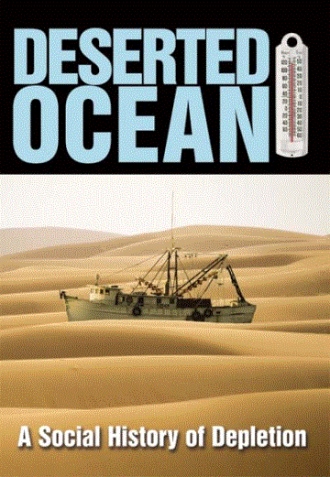
We go to the seashore to enjoy the tranquility of the waves lapping upon the beach, or perhaps to see the birds swirling overhead, or to be with thousands of others drawn to the sun and sand. To the observer standing on the shore, casting an eye toward the water, the ocean looks much like it would have at year 1000 AD. The waves still roll upon the beach. But if we could examine below the surface and list what we found in waters of Massachusetts – say in an area of one square mile - what would we find? Would what we found reassure us that all is well in the North Atlantic?
If we did our survey diligently, counting and evaluating everything, we would tabulate several schools of small fish such as dogfish (a type of shark) or bluefish, perhaps a few juveniles of codfish, haddock, or pollock, small lobsters in abundance, perhaps a few thousand herring, and several jellyfish. We would also see an ocean bottom nearly as smooth as a highway, perhaps a lot or only a little plastic, and probably we would see subsurface algae that fishermen refer to as “slime.”
Let us also imagine we had an assessment of the same area at year 1000 AD. This must be an imaginary census because systematic records of coastal ecosystems chronicle less than the last 100 years. We are left to construct our picture of the early ocean by inference, drawing upon the status when Massachusetts' waters were first fished by those of European descent (around 1625).
How would the two assessments differ? Many of us, knowing the oceans are diminished, might expect the current list to be reveal somewhere between one-half to one-tenth what it was 1000 years ago. But the real comparison is outside our imagination: the earlier assessment would reveal 98-100 times the top fishes (codfish, haddock, halibut, and pollock) than are present in today’s assessment.
At year 1000, we might have seen a few giant codfish weighing up to 200 pounds. Hardly any person alive today, including the fisherman, has ever seen a codfish in the North Atlantic over 40 pounds. The average now is approximately 10 pounds. If our area had historically included halibut, our census might have counted monsters weighing up to 800 pounds; today we would likely not count even a single halibut. We would have counted many lobsters weighing up to 20 pounds and the average would have been over four pounds. We might have counted several sea turtles. The early characterization would likely have included huge herring and/or mackerel, in shoals perhaps numbering in the hundreds of millions.
If we had been able to photograph the bottom 1000 years ago, and compared it with a photo taken today, we would see a vast difference. A lush, diverse bottom, full of plant life and ledges and rocks and hiding places and underwater hills and valleys is today smoothed to a mostly plant-less highway. Many of the sponges, mussels, hydrozoans (animals that appear plant-like but are carnivorous and feed on minute crustaceans), bryozoans (tiny colonial animals that generally build stony skeletons), and temperate corals that formed important habitat are substantially diminished. They have been replaced by fragments of rope, fishing nets, plastic bags, tires, fishing line, and city trash. Trawlers have dragged over the same bottom as often as three times a month over the last 60 years. (Virtually every part of the continental shelf in New England, save for a few protected areas, or areas that are almost entirely rock, is bottom-trawled at least twice each year.)
Added to this coastal ecosystem transformation are effects from runoff of fertilizers, animal wastes, sewage, storm waters, detergents, drugs and metabolites of drugs, pesticides, plastics, engine oil, gasoline, paint (dumped into storm sewers), sunscreen, and chemicals leached from asphalt; this cocktail is toxic to fish nurseries and many plant and coral species.
Although thousands of ocean species have dwindled, jellyfish around the world are thriving, and invading waters new to them. With few remaining turtles, sharks, tuna, swordfish, or other natural predators, jellyfish populations have exploded. Zooplankton (small, usually microscopic animals such as protozoans) is retreating toward the poles as ocean temperatures rise. For phytoplankton (small, usually microscopic plants such as algae), there is a shift away from diatoms to dinoflagellates (one-celled, aquatic organisms that have two dissimilar flagella). Dinoflagellates sometimes bloom in concentrations of more than a million cells per milliliter. Some species produce neurotoxins, which in such quantities kill fish and accumulate in filter feeders such as shellfish. “Red tides” in the New England area are caused by a dinoflagellate known as Alexandrium fundyense, and there is an increasing frequency of harmful algal blooms. Such blooms have not only killed shellfish and fish, but also dolphins, porpoises, and even whales.
How could the North Atlantic have been transformed from an abundant state to one where the species of highest value for consumption are decimated? In the next chapter we shall begin to define the process by which the North Atlantic, the first ocean to be purged of its riches, lost 99+ percent of its top fishes and many of its great whales. The focus of the book is on fishing and whaling because these activities were the earliest causes of decline in the North Atlantic.
We shall see that the transformation from now unimaginable whaling and fishing riches i
Formats

Book Details