
Living Creole and Speaking it Fluently
by
Book Cover & Preview Text
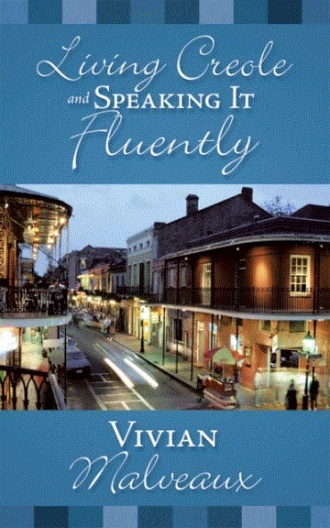
As a native of
I did not know that I was Creole until I became a teenager. My Grandmother always spoke Creole to me and I would answer in English; she did not approve. As I got older I learned to appreciate the fact that I knew a second language. In her honor I am including a Creole Dictionary and I hope she knows that I did. Also, I have done this because Creole is said to be a dying language. I hope others can learn with this easy to learn Dictionary and accompanying CD.
My primary objective for writing this book is for the preservation of Creole culture and language, which has long been ignored and rarely acknowledged in spite of its uniqueness. “There is no state in the union, hardly any spot of like size on the globe where the man of color has lived so intensely, made so much progress, been of such historical importance (as in Louisiana) and yet about so little is known.” (Alice Dunbar Nelson).
In spite of much literature written on the subject, many are unaware of the contributions that the Creoles made to
After the Haitian revolt, some of the Haitian Creoles were brought to
Cajuns were exiled from Nova Scotia by the British Government, and many of them settled in South Louisiana and have shared the French, Catholic heritage with Creoles. They speak different French dialects. Ironically, both Cajun and Creole languages are on the endangered list, since the older Generations are passing away. The younger generation seems to have ignored that part of their culture in order to fit in with the mainstream.
Formats

Book Details
About the Book
This is an important book, because many people, even Creoles know little or nothing about the history of the Creoles. Their history began in the year 1719 when the first cargo of slaves were brought to the
At first these people were called (Les gens de couleur libre) the free people of color, after the Civil War they were called the free Creoles of color, and shortened to just Creoles. In the 1800s they had their own idenity that was neither black or white, not slave or completely free.
“There is no state in the union, hardly any spot of like size on the globe where the man of color has lived so intensely, made so much progress, been of such historical importance as in Louisiana, and yet about so little is known (Alice Dunbar Nelson).
About the Author
She lost her mom when she was only four. After a few years her Father moved to
She spent most of her time in the Library at school while the other kids played games and did things that she wasn’t interested in. She was asked several times to write love letters for them to their love interest, than when thay said, “that was exactly what I would have said”, She was surprised, but it felt good. She always got A’s in reading. Perhaps she was not knowingly training to write. Several times she got caught reading a book instead of doing the job at hand and was admonished. She writes with honesty and humor.