
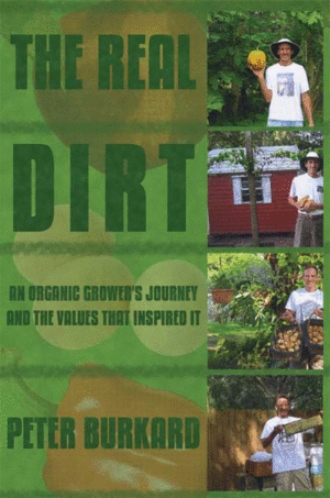
The Real Dirt
An Organic Grower's Journey and the Values That Inspired It
by
Book Cover & Preview Text
PREFACE In a society that is increasingly drifting away from knowledge of and participation in the natural foundations of our existence, what leads someone to row against the current and willingly, indeed passionately, plunge themselves into those rhythms of the soil, the seasons, rebirth and decay, windfalls and crop failures, to pursue a much simpler form of wealth that few of their countrymen can grasp or relate to anymore? What powerful force leads such a person to reject their culture’s version of what goals to pursue or how to be happy? And, once they’ve done so, what happens and how do they achieve their aberrant dreams? Is there happiness without an endless stream of thoughtless consumption? How is our health--mental, physical, and spiritual-- tied to the soil and what we can nurture from it? How is a nation’s health tied to that soil and the earth’s ability to sustain us? This is the story of a life seemingly out of place in modern-day America, of a baby boomer who felt the call of the 70’s back-to-theland movement and acted on it, never to sell out those values. It is the story of a simple but quite functional niche, carved out of a combination of sheer imagination and solid convictions about what was not acceptable. Th e chronological life story is interspersed with essays on a wide array of critical issues of the day, from climate change xiv to human conflict to the loss of farmland, and even to the meaning of life. Another wonderful addition are the numerous well-chosen, thought-provoking quotes from luminaries past and present whom the author admires. The author has been at the forefront of the now-burgeoning local and organic food movements for over three decades. He has provided a significant share of his family’s food intake from small pieces of rural, suburban, and urbanized American land and loved doing it. He possesses the knowledge and conviction that places him above fad and fashion, pursuing his food-providing craft and love of the earth regardless of what the society around him may think of his atypical lifestyle. While local food and farmers’ markets are all the rage now, the author’s life has revolved around such things for over thirty-five years. In fact, this is not an overtly odd lifestyle. Other than the clearly more agrarian, productive purpose of his landscape, there is nothing glaringly “counter-culture” apparent at first glance. One aim of this book is to show that growing one’s own food or otherwise establishing a closer bond with our life-support system is something anyone can do and be glad they did. As our culture comes to grips with its unsustainability, folks are hungry for ways to do their part to turn that around. They merely need to be inspired to make those changes and will come to quickly realize that they are healthier and happier for doing so. The environmental and health benefits flow seamlessly as one move towards greater self-sufficiency, less waste, greater resourcefulness, less consumption, and healthier, tastier ways of eating. This lifestyle even has its own healthy outdoor exercise
program built-in. It simply never feels like sacrifice; quite the contrary. This is not a how-to book, though it contains bits of how-to information based on lengthy experience. It is not a complete biography, though it contains considerable information about the author‘s life. And it is not purely philosophical, yet does focus often on such themes. The aim is to provide a happy balance of the three, so as to best interest, inform, and inspire the reader.
Formats

Book Details
About the Book
This book calls for a return to the fundamental American values which our society today seems to desperately need to rediscover: frugal living, resourcefulness, the Golden Rule, and growing one's own food. A memoir is used as the context into which is woven inspirational wisdom, food growing how-to, and marvelous quotes from luminaries the author admires. Dreaming of a simpler but happier life, while longing to leave the world better than you found it? Here is the inspiration to do all of that.
About the Author
Peter Burkard felt the call of the back-to-the-land movement in the 1970's and has devoted himself to food growing and living closer to the Earth ever since. In 2009, he will be honored for being the only vendor at the Sarasota Farmers' Market to have been there the entire thirty years of its existence. Besides the decades of market gardening experience, he is formally educated in agriculture, graduating from the University of Florida in 1976. He seeks to spread his values and knowledge so as to help make the human impact on the planet more peaceful, sustainable, and just.