
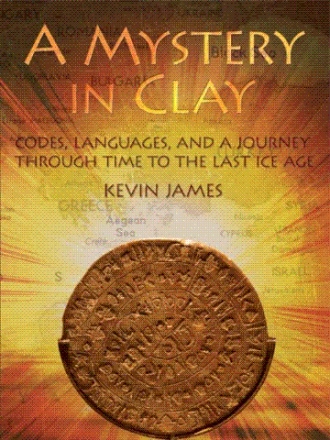
A Mystery in Clay
Codes, Languages, and a Journey Through Time To the Last Ice Age
by
Book Cover & Preview Text
Around thirteen thousand years ago, in south central Asia, there lived a small group of people who spoke a strange language that was put together by combining syllables. As small as this group of people was (At least by modern standards), it may have constituted one of the main local groupings of all of the human beings alive on the planet at that time. What could not have been guessed at though, was that this group of peoples would be alive at exactly the right place, and exactly the right time for their descendants to multiply exponentially, and go on to colonize much of the Afro-Asiatic cradle of all future civilizations during the great human population recovery at the end of the last ice age.
While hard evidence from the period of time between the end of the Pleistocene, and the end of the Younger Dryas is often lacking or hard to come by, the hints that this may have happened lies hidden in the structure of many of our world’s largest language families, many of which appear to be the direct descendents of that one language spoken thirteen thousand years ago.
Thirteen thousand years ago, life was hard. The planet was still wracked by terrible cold, and new evidence from North America indicates that the cold of our last ice age may have been amplified further at this time by the dust thrown up by an asteroid impact somewhere on the Canadian ice sheet. Mankind however had developed a successful answer to both volcanic and cosmic winters; it retreated back to Africa like it had many times in the past. And so, a sub-group of the mother tribe decided to do the same, and left for Africa, almost immediately. Their journey was not direct. It took a convoluted path down the Indus River to the sea, and then around the shore of the Arabian Sea to the western shoreline of the Persian Gulf until the southern most promontory of the Arabian Peninsula was reached. Turning west, the first splinter group arrived in what is now modern Yemen, and jumped to the Horn of Africa. The journey had taken around five thousand years. In the meantime however, our splinter group’s language had evolved, and by the time they reached Africa their language would bear more resemblance to the HEC languages of Ethiopia than to any language of south Asia. Later still, after two thousand years in Africa, what appear to be Nilo-Saharan languages would start to evolve out of this Ethiopic stock. This chain of events represents a significant divergence; evidently many of the languages that we now call African had their antecedents in Asia in the remote past.
For a long while after, conditions on our planet precluded much of the migration of peoples that characterize the Human race. Around ten thousand years ago however, something remarkable seemed to happen, as the Earth seemed to record a bombardment of asteroids, many small, but one striking in Alaska that was evidently large enough to generate a significant amount of heat, and partially melt the remaining ice caps, thus bringing the mini cold snap known as the Younger Dryas to an end. With the temperature much warmer, and game probably much more plentiful as a result, a major Diaspora of peoples out of the south Asian hub occurred. What happened next is the story contained in our book.
Formats

Book Details
About the Book
At the outset, A Mystery in Clay evolved out of a sense of curiosity surrounding an enigmatic disk unearthed on Crete, the famous, or perhaps infamous Phaistos Disk. The strangeness of the object itself has inspired many attempts to decode it. The fact that none of these attempts have been provably successful has inspired a groundswell of alternative approaches, rather than a sense of resignation or fatalism. In this respect, attempts to decode the disk are not unlike the reason we ‘climb Mount Everest’. The disk is every bit as much as uncharted territory. However, any realistic attempt to decode the disk not only employs Cryptology, but leads down the unknown path of modern Linguistics as well. At the outset, the reader possesses none of the tools of either Cryptology, or modern Linguistics, and so deciphering the Phaistos Disk can be thought of as an entertaining exercise that is not unlike an ‘extreme’ vacation where the adventurer is given a knife, a flint, and left to his own devices out on the plains of Africa, or in the Everglades. The question then becomes, can we develop the tools and techniques necessary to survive?
Here, survival means developing the ability to render at least a rough approximation of what the disk might say, given the crude original tools at our disposal, in this case the internet and our brains.