
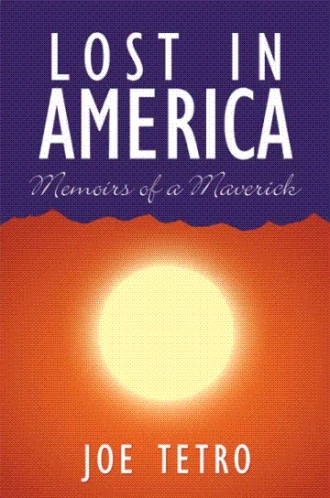
Lost in America
Memoirs of a Maverick
by
Book Cover & Preview Text
Thinking we were now seasoned riders of the rails, we climbed, like rookies, into an empty gondola up near the engine. It turned out to be a dusty, dirty, bone-jolting, too-close-to-the-clamor-of-the-engine ride. The next time the train stopped, we grabbed our groceries—but left our bags in the gondola—and made our way back along the train, and up onto the top of a box car whose fast forward motion soon took us flying through the glorious Colorado sunshine like two royal couriers.
As free as the wind blowing through our hair, and feeling beatified by this windblown freedom, we sailed atop our own rolling sun deck. Like wild-eyed vagabonds we surveyed our private kingdom of prairie landscapes. In the background, the pale blue grandeur of the Rockies rose out of the prairies like a fable in a faraway land of make believe. A grand sense of escape from the world of controls and restraints swept over me. Never before had the romanticist in me felt decked out in such full, high feather—a feeling that so validated this stripped-down journey that it erased all my doubts about what Paul and I'd done so capriciously.
As the freight raced north towards Union Pacific’s east-west trunk line running through Cheyenne, we made sandwiches, ate some fruit, and indulged in this idyllic interval of our journey. Before dark, during a short layover, we crawled off the boxcar, and made ourselves a bed for the night under a truck trailer that was cabled down to a flat car. We wrapped the thin blankets around ourselves Indian style, and, as the stars appeared, we felt shrewdly fixed for the road west through the coming cold Wyoming night.
However, around midnight, with Cheyenne and Laramie well behind us, the pulse of rolling steel beneath us had gradually slackened to a slow, ambling cu-lick-e-ty clack-ing, but we were too exhausted to pay attention to the slackened pace. Then, after several bucking jerks, a shrill squeaking sound ended with an utterly dead staccato stop. A nearby voice boomed out of the darkness. Paul raised up into the path of a flashlight beam that exposed our berth, and prepared to flee. “Come on, man, let’s make it!” he urged, giving a quick frenzied punch to my arm.
“Wait!” I pleaded as I grabbed the sleeve of his jacket. “Be cool, man! The fucker might shoot us. Come on, let’s just do what he says.” Luckily, my words defused Paul. With the rays of the flashlight still targeting us, we gathered up our blankets, and got off on the side of the flatcar facing the flashlight.
The voice behind the light flashed a badge, and told us, “You boys come with me!”. We followed the voice in the darkness to a small black coupe which we all three got in.
“I’m takin’ you boys in,” the man said in the sharp tones of a disapproving father.
“But our bags are up in a gondola up by the engine,” Paul pleaded....
Formats

Book Details
About the Book
These memoirs are how I coped, and didn't cope with the world around me whose ways I never felt matched my own. As a child, I pointed from our family car at a hobo walking along the highway and said, “That's what I want to be when I grow up.” Dad slammed on the brakes, and flew into a rage so extreme it resembled madness. Multiply that incident by a hundred, and you have a picture of my childhood.
Such explosiveness drove me deeper into myself where I began for my entire life to live in books as much as possible. But another side of me existed: by age five I was riding bucking calves at a roping club arena every summer Sunday, and by nine I was putting in ten hour workdays on the farm or ranch. I caught such hell driving cattle that I, sometimes, wound up in tears.
Later, I found the same kinds of bullying and crazy-making in the work place, and my inability to “play the game” kept me from ever carrying out long range plans. The “hobo” in me had won out over my background.
And after nearly forty years of moving from place to place, and job to job; riding freight trains; picking olives and topping onions in California; gandy dancing on the railroad; and after earning, between jobs, a B.A. in German Languages and Literature; after using psychedelic drugs and loving a broad canvass of women while drinking copious amounts of wine; after teaching English in a junior high for three months, then leaving unannounced—just to name a few of the escapades and foot loose adventures that made up my life, not to mention a year in the same madhouse where I’d previously worked, I finally wrote a book about it all.
About the Author
My writing preparation began as a young reader in a one room country school. For most lesson assignments we students had nearly an hour to finish, but I usually finished in around 10 minutes, and spent hours a day reading.
This served me well as a way to be busy and pass the time, but, on a deeper level, I was seeking a surrogate parent, some one—characters in the books I read—"to go to", someone less explosive and violent, more understanding and kinder than my parents, who didn't have a clue how to raise me, so they often reverted to violence to "straigten me out."
I later thrashed around in life, going from place to place, job to job, reading, traveling to other countries on the cheap. I found the American work place stifling, beset with petty infighting and nit-picking, and often promoting employees beyond their competency. My boss in the Bureau of Land management was an alcoholic. One saturday he came crawling acros the floor of the BLM's big main office and into his private office. Earlier having told me to call him Dale, he then commanded me to call him "Mr. Naylor."
Then, in my fifties, I showed a poem I'd written called "My Father's Chaps" to a woman who had a Ph.D in psychology and she wanted to keep it. She told me I was a poet, and that was the beginning of my identity as a writer. Since then, I've had twenty or thirty poems published in the Central Valley of California. This is my first book. In the words of a publisher/ writer N.L. Belardes, author of "Lord Part I": Joe Tetro's memoir is a raw journey, and adventurous read, a real bull ride through the American consciousness.