
Danger Zone
Road Map for The Communication “Potholes” Ahead !
by
Book Cover & Preview Text
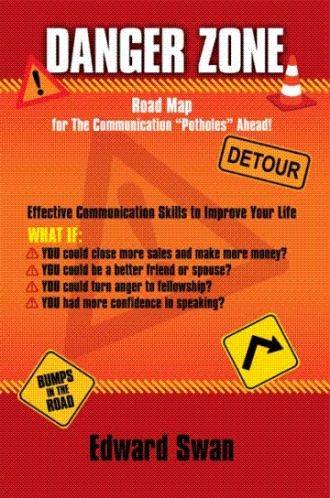
Although this book is targeted for salespeople, it is my hope that the information contained within will prove helpful to anyone wishing to improve their communications with other people. In writing this book, it occurred to me that many of the techniques and ideas discussed in the following pages could easily be used to improve personal relationships. The ability to recognize what we will call a “danger zone moment”, coupled with the confidence to deal with that conflict, will prove invaluable to all of us. Striving to improve our relationships with spouse, kids, extended family, peers, and business associates would certainly be time well spent. Knowing how to handle difficult situations, and developing the skill to deal with very angry people would certainly be a great tool for anyone to master. It is important to note here that not all danger zone moments involve angry people. Sometimes their annoyance can be very subtle, and we will talk more about this in the conclusion section of this book beginning with page 47.
If you look up the definition of salesmanship, it talks about “convincing someone using persuasive argument”. Argument implies a give and take, a discussion between two or more people, each using appropriate words and expressing personal thoughts. It also implies the ability to listen without comment. Using communication skills to change minds and resolve disagreements is just as valuable as being bilingual. Any skill that helps us resolve conflict is worth learning. Based on that definition, it is clear that salesmanship could just as easily be effective in non-selling situations. Actually if the truth be known, we all sell everyday at our jobs, school, social settings and with family.
The problem is that some of us sell very poorly.
Some salespeople think that selling is really just “data dumping” their information as quickly as possible, without allowing the client to speak, and then leaving the room, or office, as quickly as possible. Sadly, in our personal communications, we often follow this very same pattern. We seldom offer the other person an opportunity to ask questions or make a point. When we should be listening we are too busy talking, and we miss a golden opportunity to learn insights into the reasons the other person is so passionate, angry or emotional about his/her position or opinion. We will learn how to summon the confidence necessary to let the other person speak, without the fear of the consequence of listening to another point of view.
Few salespeople can handle the loud and angry client. I have no doubt that some salespeople would literally run away, if they thought for a second they could actually get away with that tactic. In our personal lives, many couples and family members argue, or disagree, in the very same manner. They yell, talk over each other, do not listen to reason, and finally in frustration shut down completely.
Our lives would be so much easier if we knew how to handle the Danger Zone. Let’s define the Danger Zone as any moment or incident, in any conversation, that has the potential to bring that conversation to a sudden and unproductive end.
Formats

Book Details
About the Book
NA
About the Author
NA