
Black Men and Blue Water
by
Book Cover & Preview Text
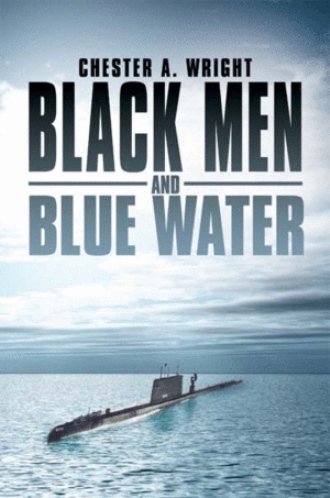
INTRODUCTION In reading most histories of the U.S. Navy, one is left with the impression that only the White men served and earned honor and distinction in battle. Th e Stewards Branch of the U.S. Navy possesses a longer “historical reach” than is currently realized by even the more scholarly of navy historians. Th e scholar, who fails to grasp this in attempting to analyze the social, political and deeper cultural aspects of naval personnel aff airs, will probably miss his mark by a wide margin. U.S. Naval History is about more than guns, ships, heroes, battles and dates. It is also a story of men, their behavior, and the greater society that shaped them and the major issues and events of their day. It is a story of governments that built ships and made personnel policy. In this country, race has always been a consideration. When the Messmen Branch (re-designated the Stewards Branch on the eve of WWII) is looked at from a historical perspective, race becomes the context. Th e fact that this branch was made up of Black, Yellow and Brown men makes it impossible to address naval policy in the normal exclusively White men historical context. Consequently, such a discussion cannot avoid the adverse eff ects of race on Naval Policy. Th e Messmen Branch did not simply occur along some magical or accidental continuum, but derived from social and political forces generated by White America. Th e creation of the Messmen Branch in 1893 occurred in response to how the broader society perceived the Negroes’ “place” in that society after slavery had been abolished. Th at place was the bottom rung of the U.S. social, economic and political ladder. Th e U.S. Navy, being part of this former slave-based system, created the Messmen Branch to defi ne an appropriate “place” in its organizational structure in line with the pervading social structure. Restricting Negroes to a servant’s role was seen as the appropriate action. Historically, this was the Navy’s fi rst step backward, from 100 years of liberalism, into racist practices. From that point, merit, character and the capability of the Negro was not a factor in his service. Race and Color gradually became the determinants of his acceptability, placement and promotion in the U.S. Navy. Th e Messmen Branch stood as a stark symbol of bigotry, oppression and racism to all races of color in this country from 1893 until 1974, a period of 81 years! Its promulgation and length of perpetuation is truly remarkable. Th e Messmen/Stewards Branch was arguably the most unique of all armed forces units. No other branch of any of the U.S. Armed forces, ever created, barred the service of White men! No other branch so rigidly restricted service to men of color, as was the case with the Navy Messmen/Stewards. No other branch created and sustained bigotry and the idea of racial inferiority, by personnel policy, as long as this branch of the U.S. Navy. No other branch hung onto such ideas as tenaciously as the U.S. Navy did. Regardless of the ineffi ciency, vulnerability to attack by black militants and the political liability, the U.S. Navy insisted on having a servant’s branch long after it was politically correct or feasible to do so. A shining example here rests on the fact that only members of the Stewards’ Branch were allowed to ride crack-fi ghting ships in World War II. Th ey gave an account of themselves as Gunners. Yet, in spite of their being decorated for uncommon valor and their gallantry in action, they were not made eligible for the rate of Chief Petty Offi cer until 1949, four years after World War II. Th eir promotion was grudging and stingy. Only two Chief Petty Offi cers were granted Navy wide. Th is is the story of the Stewards, Cooks and Messboys who manned that branch of naval service. Th is is the story of the men who fought and served under these trying circumstances. Th is is the story of men who served their country when to do so was to endure, or appear to accept the humiliating admission of one’s own inferiority. In this story can be found the heretofore-unwritten chapters of one phase of the Negroes’ march toward freedom in America, written by a man who participated in it. It is fi nally the story of one of the most unique groups of men who served our country’s Armed Forces. Regardless whether the member was a yellow man-Chinese, Japanese or Korean; a brown man-Philippino, Guamanian, Puerto Rican or Pacifi c Islander; or a Black man: all the men shared a commonly perceived perception that they were inferior. All members of the “Messmen’s Branch”—its original name—or the “Steward’s Branch”—its later designation—were neither perceived as nor were they called “Men”. Th e perception of their skin color caused these people not to be perceived as “Men” but as “Boys”, regardless of age, dignity or military bearing. Th is perception of these men of color lasted so long until it became a “tradition”, a tradition so strong that it outweighed “Law” or “Regulation”. External to this branch, both tradition and usage of the term was “Offi cers and Men” or Offi cers and Enlisted Men”. Since the days of the Navy’s Apprenticeship Program, no Sailor has been addressed as “Boy”. Th e only exception was the members of the Messmen/Stewards’ Branch. One of the most unique features of the members of this branch has been their ability to deport themselves as “Men” while being perceived as “Boys” by their Offi cers, Enlisted Chiefs and Petty Offi cers. To do this required “mental trickery” of the fi rst order, on the part of an individual, to pull this off , that is, to be a man and a person despite the constant negative perception of others. It became a survival requirement. Th e Stewards, Cooks and Steward Mates of the U. S. Navy managed to do so, while looked down upon by their own people, the “so called” Negro, until that group became “Black”—that is, ceased to be ashamed of the color that God gave them, in spite of what racists and bigots said about them. Among the unique features of these “so called
Formats

Book Details
About the Book
This story or history was written to correct one of the many wrongs in the recording of American History. It is a fact that the victors in battle or those in power in peace write the history of past events to support their views of what should have happened versus the cold hard facts. This is the story of the Stewards, Cooks and Messboys who manned that branch of naval service. The story of the men who fought and served under trying circumstances. The story of men who served their country when to do so was to endure, or to appear to accept the humiliating admission of one's own inferiority. In this story can be found the heretofore-unwritten chapters of one phase of the Negroes' march toward freedom in America, written by a man who participated in it.
About the Author
Chester Arthur Wright was born in the small hamlet of Hope, Arkansas in 1922. Hope is sixteen miles from Fulton where the Red River turns for its plunge into Louisiana. This is half way to the Texas border, 32 miles from Hope at Texarkana. Chester is one of thirteen children born to Sebe Eugene and Zetta Josephine Wright. Hope Arkansas today was famous for growing the biggest watermelons in the world. As the author laughingly recounted, “They grow so big we had to steal one on a partnership.”
Chester caught a freight train, went to Texarkana, and joined the U.S. Navy in July, 1940 with a 10th grade education. He was not motivated by any lofty sense of patriotism. Rather it was the poverty induced by the “depression” of the 1930’s and racism that tended to stymie the ambition of any young black. He entered a Navy that was the raciest branch of U.S. Armed Forces. It had barred Negroes from enlistment in 1919, after World War I “even as Servants”. Negroes were barred from enlisted from 1919 until 1932. When Negroes were allowed to enter the Navy again, the Navy would allow them in as “Servants only” Waiters, Cooks, Stewards, Room Cleaners, Shoe Shine boys, personal body servants to Navy officers. They were not allowed into other branches of the Navy until 1942, during World War II. The Negro Seamen, firemen, after, again being allowed in as other than Servants were not allowed to ride fighting Ships and many were put in Labor Battalions.
It was in 1949, four years after World War II before the U.S. Navy allowed Chief Stewards and Cooks to become Chief Petty Officers. Chester was one of the two Chief Stewards promoted to Chief Petty Officers. In 1959 when the Navy created two additional Enlisted Rates (E-8 and E-9), it again proved to be quite “Stingy”, with its Servants. Nonetheless Chester was again selected and promoted to Master Chief.
The author was embarked in U.S.S. Salmon (SSR-573) in the Far East. In 1959 he was disabled and home bound. He recuperated in Oaknoll Hospital in Oakland, California from 1959 to 1961. While in bed Via Correspondence Courses, he finished High School and prepped for College.
After accepting a disabled discharge in 1961, Chester attended Oakland City College, graduating with an Associate in Arts in 1963. Wright immediately enrolled at San Francisco State College and graduated in 1965 with a Bachelor of Arts Degree in Social Welfare. Chester received his Masters Degree in Social Work at University of California Los Angeles, California in 1968.
The author was both eye witness and participant in the March of Blacks from Servants only to the position of today’s Admirals. Black Men and Blue Water attempts to shed some light on the all ignored segment of Naval History.