
Acid Logic
A Decade of Humorous Writing on Pop Culture, Trash Cinema and Rebel Music
by
Book Cover & Preview Text
Antonio Fargas
You don't have to dig deep into the annals of the hyper-violent, uber-sexual 1970s African-American cinema movement known as blaxploitation before you start to notice a certain character actor who stands out as much for his sharp, jaw-thrusting features as he does for his collection of brightly colored, pimpalicious threads. This profile, of course, belongs to none other than legendary street thespian, Antonio Fargas—a man who defined the genre of blaxploitation just as much as Fred Williamson or Pam Grier. Which is funny, because if you take a look at Fargas' role sheet you realize that while he’s had a robust career, he really wasn't in that many blaxploitation films. He did have major roles in Foxy Brown and Cleopatra Jones, two of the most important movies of the moment and did some supporting work in Car Wash and Shaft which are also significant documents of the genre. He also brought the 'Sploitation movement to the small screen when he played the definitive cool daddy, Huggy Bear, on the hit seventies cop show Starsky and Hutch. But while that may seem like a healthy list of accomplishments, you have to consider that the blaxploitation movement was a b-movie assembly line that pumped out hundreds of titles over the course of its decade run. Action star Fred Williamson alone starred in over 20 films of the genre. By comparison, Fargas' contribution seems rather small.
So why is Fargas such an obvious candidate for discussion when one starts talking about seminal blaxploitation actors? Because Fargas is, as Nat King Cole might croon, “unforgettable.” Whenever I think of Foxy Brown, the first image to come to mind is Antonio’s portrayal of Foxy’s pimped-out, coked-up, jive talking, ne’er do well brother, Link. (Well, in all honesty, the first thing I think of is Pam Grier’s numerous topless scenes, but Fargas comes immediately after—it’s a disconcerting combination of images, lemme tell ya.) And whenever I recall Cleopatra Jones, I can’t help but focus in on Antonio’s Doodlebug Simkins, the pimped-out, coked-up, jive talking, ne’er do well (starting to see a pattern here?) drug henchman with a Napoleonic complex. Fargas had a talent for stealing the show in almost every movie he was in.
This is partly due to his appearance. Antonio wasn’t one of these ruggedly handsome, rough and tumble brothers like Fred Williamson, Richard Roundtree or quintessential bad-azz mofo, Bernie “that’s a real heavy trip” Casey. Those goombahs were a dime a dozen in blaxploitation films (though sorely needed to make sure the sistas left the seats soggy). But few players could capture the black loser—the wannabe MacDaddy that always got picked last in gym class and had to take his grandmother to the prom—as well as Fargas. Physically, Antonio was everything the traditional black hero was not: gawky, lean (but not “sexy lean”), short and decidedly unintimidating. (Such attributes could be used to describe a much bigger black star of the same era, Richard Pryor, who compensated for his shortcomings by a) being funny, and b) channeling the rage of the urban street.) And in addition to his limited musculature, Fargas was just plain ol’ ugly. Suffering from a severe under bite and jagged, angular features, he is noticeably reminiscent of Sammy Davis, Jr., a man who, in all fairness, had to rely more on his charms than looks to get the girls. Even Link, Antonio’s character in Foxy Brown honestly summarizes his shortcomings by saying, “I’m too small to be a football hero and I’m too ugly to be elected mayor!”
It would be easy to dismiss Fargas’ characters as obscene epitomes of seventies pimpdom and leave it at that. But I honestly think that if you peel away the layers of plush velvet jackets and silk undergarments you arrive at something… a profound truth about the black experience in America or whatnot. To make my point, I first need you to accept an admittedly questionable theory, that with the blaxploitation movement African Americans were able to take control of how they were portrayed onscreen. (I’ll admit, this is debatable—Shaft was created by a white man, and many 'Sploitation producers were white—but I think it’s true enough to stand on its own legs.) With that assumption in place, it’s easy to see how characters like Black Caesar and Superfly came to fruition. They were strong black archetypes who had pride, confidence, and most importantly, didn’t take shit from the man. And it’s equally understandable why characters like Foxy Brown and Cleopatra Jones were created —they were sexy, afro-touting females who highlighted the African ideals of beauty (e.g. big bootays and a voluminous rack) while running their own show. (Watching special agent Cleo Jones boss around whitey is in-and-of-itself worth the price of admission.) Now the creative instigators of blaxploitation could have stopped there, but I suspect they were plagued by a knowing realization: not all black men are statuesque ex-football players and not all black women were big-bosomed soul sisters. And if you were going to argue, as blaxploitation did, that the legacy of racism had so stalled your best and brightest (most blaxploitation heroes are either on the run, ex-cons, or have lost friends/lovers to the scourge of drug violence) then it only stands to reason that black losers were even doubly affected. And that’s where Antonio Fargas came in.
Formats

Book Details
About the Book
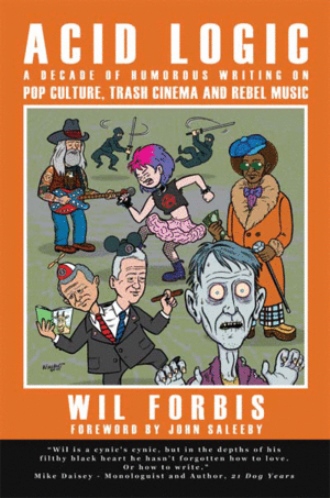
From the pages of Acidlogic.com, underground author Wil Forbis collects his most provocative, most shocking and funniest material into one volume! Gasp at comic essays on topics such as the impending threat of cloning and the commodified brilliance of the blaxploitation film movement. Swoon over profiles of the entertainment industry's most eccentric stars, from adult film auteur Doris Wishman to ninja actor Sho Kosugi to shock punk GG Allin. Thrill to interviews with cultural stalwarts like hard rock drummer Rikki Rockett, actor Curtis "Booger" Armstrong and horror director Stuart Gordon. Squeal with delight at fiction ranging from the horrifying to the absurd. THE ACID LOGIC REVOLUTION HAS ARRIVED!!!
About the Author
To the chagrin of friends, family and his limited pool of romantic interests, Wil Forbis launched Acid Logic (www.acidlogic.com), a humor/pop/culture web site, during the Internet boom of the late 1990s. While managing to be ignored by the hoards of venture capitalists intent on funding any entity with a "dot com" in its name, Acid Logic has become the web site of note for obnoxious banter, pithy commentary and pee pee jokes. Forbis lives in Los Angeles.