
Confucius Made Easy
An Easy Reading On This Great Sage
by
Book Cover & Preview Text
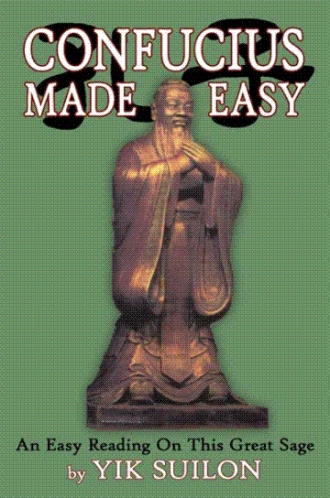
In writing a book like this, it is obvious that the information about Confucius has been around for at least the last two thousand and five hundred years. It is most unlikely that there will be new excavations from any archeological sites that will shed new light on the Great Master – Kongfutse – Confucius. Yet as much as and as many people know about this great man, not many would know much about him outside China especially when the information is usually written in Chinese. When other non-Chinese scholars have written about the sage in English, the writing is usually very scholastic, very philosophical and in profound English which is outside the interest of many laymen readers. That has given the author the courage to write about the sage so that it is simple and easy to read. Hence the named CONFUCIUS MADE EASY.
Confucius had captured the minds of both ancient and modern scholars alike. Many people have found such wisdom in his teachings that throughout history, Kings, Emperors, Ministers and Scholars have found the teachings of Confucius to be a good set of standards for their journeys in this world. It must be realized that having a set of very high standard does not mean that people will have to live by them in such a strict manner. If that were true, then the first person that would jump in joy will be the great sage himself. Having a high moral standard is like having a high mountain in the neighborhood. One does not have to climb that mountain everyday but one just casts one’s eyes towards this great mountain and receives inspirations from its great height and at the same time, receiving from it a sense of security knowing that nothing will make this great mountain go away. We truly have to thank the Great Master for giving us this constant reminder of our moral behavior and learning.
The Great Master had demonstrated throughout his life living his principles. Yet, as we move along with his life, we will come to realize that because of his rigid adherence to his principles, he had suffered much more than other people. In a way, he was the true witness to his teachings and principles. In fact, one of his aims was to become a Minister for the State so that he could put his principles into practice. Yet this was not to be because the world would simply not be able to follow such rigid principles. One can say that his political life had been a failure. Yet with thanks to this failure, the Great Master had concentrated his efforts on education thus giving the world the highest standard in learning. This high standard has become the very foundation upon which ancient and modern education has been set up to withstand the duration of millennia. The failure of his political career was not due to his inadequacies in his ideals but to the frail and corrupted human aspects of his kings and contemporaries. Another factor was due to the fact that scholastic evaluation of one’s ability was not introduced until four hundred years after him. The only way one could hope to serve one’s king was through recommendations or through one’s hereditary aristocracy.
Confucius firmly believed in the ideals of strict adherence to a set of behavior. His argument for peace and stability in a country was to have the King behave as a king should, the Minister behaved, as a minister should, the Father as a father should and lastly the Son as a son should. In this order of hierarchy, every person in the country would know where he stands. He would know his duties, his obligations and his loyalty. Yet, Confucius was not a sage made of stone without human feelings. In the centre of his teaching, his chief concern was the establishment of the idea of Ren – a sense of humanness. A close modern equivalent will be the idea of ‘Benevolence’ where one should truly treat another person as oneself. He went much further than that. In some of the quotations, the Great Master actually considered Ren as such that it would be normal for one to sacrifice one’s life for his friend in order to achieve this state of Ren. Without this sense of Ren, one’s sacrifice cannot be considered meaningful.
Much of Confucius’ ideals and teaching have come from books like the ‘Analects of Confucius’,’ the Book of the Mean, the Book of the Great Learning.’ The author has extracted much from these writings. Unfortunately, Confucius had never written a book himself. He had edited a number of ancient books like the Book of Poems, the Book of the Spring and Autumn Annals, the Book of Changes and others. In fact, he had used these books to impart to the readers his ideals. He had never changed history in order to voice his ideals but it was in the use of words that he succeeded to impart his ideals. So much so, the style of this writing had been classified as the ‘Spring and Autumn Annals Literary Presentation’. The reader was lead to his ideals through words he had chosen to describe a situation and that situation would then become a set of principles for the reader. He considered the Book of Spring and Autumn Annals as the book that future generations would either praise him or chide him.
It is hoped that the book will help readers to have a basic understanding of this Great Sage. This term for Confucius is no exaggeration as throughout the centuries, numerous emperors, kings and eminent scholars had paid tribute to this Great Master. If only those kings and our modern world can follow some of his ideals and teachings, the world would be a far far better place.
Formats

Book Details
About the Book
Confucius is a common household name. Many books have been written about this Great Sage in Chinese and English. Learned scholars have written these books. They are written for aspiring philosophers. The writer recognizes that such a Great Sage deserves to be appreciated by many more readers in a language that is more like a day-to-day conversation. In this way, the old and the young will have both the chance and the interest to read and know about the subject. It is easy to claim that one knows about Confucius or Shakespeare, but it is not that common for people to know more about these great men.
The reading of Confucius not only imparts a good example to the readers of the characteristics of a great man; it also gives the readers a good understanding of the moral principles in our society, while the opposing forces are stripping our society of such moralistic principles. In the end, people are left wandering about not knowing what kind of moralistic behavior they should have irrespective of what the world or the media is telling them to practice.
This book gives a chronological history of the life of Confucius. We read about his early poverty stricken childhood, his years as junior official and his rise to a position as Prime Minister of his beloved country and eventually as the greatest teacher. This book also gives a good understanding of the way that the world is always jealous and afraid of the great potential in a person. For such great individual may deprive them of their own opportunities. Thus they strive to undermine the able one. Many good people have this similar experience. It is the greatness of a man to stand firm on his principles in spite of the adversities they will face.
About the Author
Yik Suilon, M.Sc., trained and practiced as an engineer for a number of years and later as a Lecturer in Engineering Management Studies in England, has been in Higher Education for many years and as an industrialist in Canada, as Senior Vice-President of Telecommunications and computer companies and also worked as Consultant to Company Executives and tutor to young people.