
ICE AGE MYSTERY
A PROPOSED THEORY FOR CLIMATE CHANGE
by
Book Cover & Preview Text
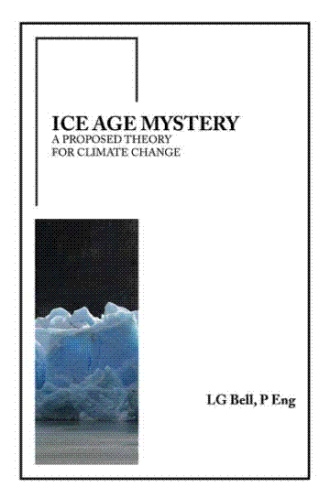
A theory for the cause of climate change is developed based on measurements of glaciation, and of atmosphere temperature and CO2 concentration, with some data going back almost two million years.
Previously accepted theory is that the Earth's attitude in space with respect to the Sun, Moon and other planets is what has caused climate cycles in the past. It is found in the present analysis that normal climate control was disrupted as continents moved to their present location. The system went into oscillation and the main influence on climate since then has been the ocean temperature acting opposite to that of the rest of the environment with a lag time of about 12,000years. When the ocean is colder skies are clear and there is CO2 buildup in the atmosphere. When the ocean is warmer skies are cloudy and CO2 is reabsorbed into the ocean. As well as solving the mystery of the Ice Age ending, predictions for future change can be made using theory related to these findings.
Formats

Book Details
About the Book
A theory for the cause of climate change is developed based on measurements of glaciation, and of atmosphere temperature and CO2 concentration, with some data going back almost two million years.
Previously accepted theory is that the Earth's attitude in space with respect to the Sun, Moon and other planets is what has caused climate cycles in the past. It is found in the present analysis that normal climate control was disrupted as continents moved to their present location. The system went into oscillation and the main influence on climate since then has been the ocean temperature acting opposite to that of the rest of the environment with a lag time of about 12,000years. When the ocean is colder skies are clear and there is CO2 buildup in the atmosphere. When the ocean is warmer skies are cloudy and CO2 is reabsorbed into the ocean. As well as solving the mystery of the Ice Age ending, predictions for future change can be made using theory related to these findings.
About the Author
L.G. Bell is a retired professional engineer. He lives with his wife in an apartment in Toronto and drives a Chevy Lumina.
The book is about my undertaking, as a retirement project, to solve the mystery of the ending of the Ice Age. In the course of doing this a wealth of information, some going back as far as 600 million years before present, was discovered, along with actual data for glaciation and atmosphere CO2 concentration and temperature for the more recent past. Analysis of the information leads to predictions of the probable effect of current global warming on future climate.
The story, if there is one, is about how the ideas developed and about the fight to get them accepted by mainstream climatology.