
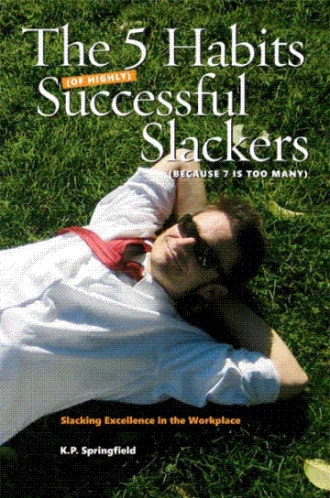
The 5 Habits Of Highly Successful Slackers (Because 7 Is Too Many)
Slacking Excellence in the Workplace
by
Book Cover & Preview Text
|
O |
ne day while successfully slacking at work, my father called. He asked me how my job was going and I mentioned to him that work had been quite productive, as I had written my first full-length screenplay within a two month period. After expressing some astonishment, he then asked me where I got the free time to take on such an intensive writing endeavor. “Well, I’ve got nine hours per day at work,” I responded. The astonishment multiplied. If my job was to write screenplays, then there wouldn’t be any surprise, however, my job was actually software sales. After explaining to him some of the successful slacking habits I had adopted over the three years at my company, he made a suggestion that I wasn’t expecting.
“Son, why don’t you write a book on how to slack-off at work? That is obviously your forte. I mean, Hell, if you wrote an entire screenplay when your job is sales, other people might be interested in hearing how you did it.”
What a genius idea my father had. I went to work immediately, at work. I blew off a few things that needed to get done. Okay, more than a few.
A second source of inspiration for The Five Habits came when I visited a local bookstore in order to check for similar or related publications on successful slacking. After looking in the self-help and business sections, all that could be found were books on management excellence, leadership effectiveness, executive skills development, how to be an effective communicator, and many other coma inducing imitations focused on appropriate business acumen.
Virtually every book was the same exact concept packaged in a different cover design with a different author. I thought “how refreshing would it be to have a completely antithetical book on slacking excellence?” It would at least stand out as something remotely original and have a chance of being purchased by a cynical corporate employee – who is far more common than most people think.
However, by far the most significant inspiration came from observing the overwhelming abundance of family and friends who have willingly become overworked corporate drones. I knew it was bad when my friend Nebby bragged to me about how he hadn’t taken a vacation in three years, but when I watched my miserable wife trudge to her car every morning to face 12 hours of what she called “Hell on Earth”, I knew something had to be done.
How demented are we to rationalize that not taking a vacation is a testament to our hard working demeanor? Why are we willing to put up with “Hell on Earth” when there are easier ways to make a buck? The growing popularity of this “burnout nation” concept has been highlighted in publications like Business Week and Scientific American Mind. It has become a phenomenon – work has taken over the life of Americans, a
Formats

Book Details
About the Book
The 5 Habits is the definitive guide on how to survive the corporate world through shirking useless responsibility, increasing leisure time, reducing stress, and improving quality of life all while receiving promotions, pay raises, and positive perception as a hard working and dedicated corporate employee.
For more information on the book, visit www.slackism.com.
About the Author
K.P. Springfield used to be a corporate American who put in long hours to be successful. However, when he heard about a friend in the hospital with work-related nervous breakdowns, listened to another friend boast about how he hadn't taken a vacation in three years, and experienced the misery of his wife trudging to work everyday for 12 hours of "Hell on Earth", he knew something had to be done to help better peoples' lives.
By adopting five key slacking habits within his own job, K.P. achieved grade and pay raises, reduced stress and responsibility, gained more free time and even got inducted into a corporate "Hall of Fame" for doing no more than three hours of work a day.