
The Spirit of America
War on Religion
by
Book Cover & Preview Text
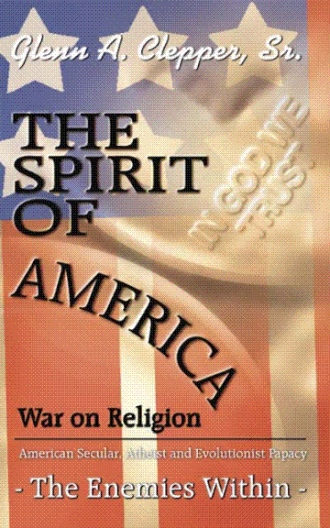
American History and Traditional American Values, including Religion (our Heritage) are the foundation, that the future may learn from the past. This requires Americans dedicated to the understanding and teaching of our nation's factual and philosophical heritage to promote freedom, unity, progress, religion, and responsibility among our citizens. However, historical facts clearly reveal there is a war on religion promulgated by atheist, secular and evolutionist interests, through the court system. They are embracing, below the radar, the "myth" of Separation of Church and State, and America's court systems, both federal and state, appear to be legislating from the bench, in contrast with our Founders wishes. However, history also reveals that religion clearly was one of the foundations which made our country great. To better understand the content of this book one should first understand our founders intentions insofar as the federal and state intent for Separation of Powers:
From the beginning, the intent of our founders was the division of state and federal government was to be three independent branches.
The first three articles of the U.S. Constitution call for the powers of the federal government to be divided among three separate branches: the legislative, the executive, and the judiciary branch. Under the separation of powers, each branch is independent, has a separate function, and may not usurp the functions of another branch. However, the branches are interrelated. They cooperate with one another and also prevent one another from attempting to assume too much power. This relationship is described as one of checks and balances, where the functions of one branch serve to contain and modify the power of another. Through this elaborate system of safeguards, the Framers of the Constitution sought to protect the nation against tyranny.
Under the separation of powers, each branch of government has a specific function. The legislative branch—the Congress—makes the laws. The Executive branch—the president— implements the laws. The judiciary—the court system—interprets the laws and decides legal controversies. The system of federal taxation provides a good example of each branch at work. Congress passes legislation regarding taxes. The president is responsible for appointing a director of the Internal Revenue Service to carry out the law through the collection of taxes. The courts rule on cases concerning the application of the tax laws.
Under the system of checks and balances, each branch acts as a restraint on the powers of the other two. The president can either sign the legislation of Congress, making it law, or veto it. The Congress, through the Senate, has the power of advise and consent on presidential appointments and can therefore reject an appointee. The courts, given the sole power to interpret the Constitution and the laws, can uphold or overturn acts of the legislature or rule on actions by the president. Most judges are appointed, and therefore Congress and the president can affect the judiciary. Thus at no time does all authority rest with a single branch of government. Instead, power is measured, apportioned, and restrained among the three government branches. The states also follow the three-part model of government, through state governors, state legislatures, and the state court systems.
The purpose of this book, therefore, is to examine the facts, to determine if the judiciary is legislating from the bench insofar as religion, an infringement on their intended restraints. Therefore this book is for the edification of our citizens and the future of this Great Country we all love. We need to be well informed and stand tall for our Heritage.
In God We Trust
Formats

Book Details
About the Book
In God We Trust
About the Author
Glenn A. Clepper, Sr. was born at the end of the Great Depression at the beautiful Allegheny River village of Wattersonville, Pennsylvania.
Glenn is the youngest of one sister and three brothers.
Glenn attended and graduated from Kittanning High School. He attended and graduated from Grove City College at Grove City, Pennsylvania.
He served his duty in the military as a member of the Army Security Agency and was discharged in 1962. He is a proud member and past Officer of the American Legion.
He has been married to Betty Clepper for 47 years; has two children, Melissa and Glenn, their husbands and wives, and two grandchildren.
Glenn is a 32nd degree Mason. He is an active member of a internationally-recognized Florida civic club.
Glenn is an associate of a web site at Kittanning, Pennsylvania, where he creates and posts articles of interest to the public.