
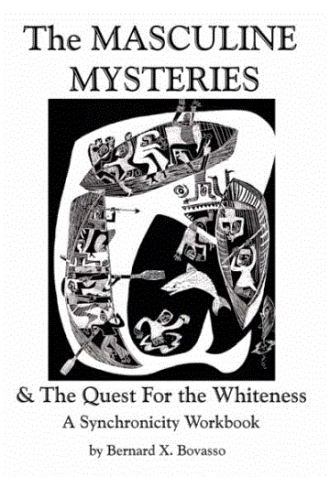
THE MASCULINE MYSTERIES and The Quest for the WHITENESS
A Synchronicity Workbook
by
Book Cover & Preview Text
Formats

Book Details
About the Book
THE MASCULINE QUEST FOR THE WHITENESS
The telestic nature of the Masculine Mysteries served as the medium for The Whiteness which, in its generality, points directly to a representation of Death and the masculine drive to achieve union of the Self at the last stop in life: the divine after-life unity otherwise known as God or Allah, or, as Jung psychologically paraphrased it, the Unus Mundus . For Freud this unity was called Eros, as simply “life drive,” in his distinction between Eros and Thanatos. For Jung it included the Unus Mundus as final and everlasting Oneness. For Goethe it was perhaps a return to the All and which, of course, is no-place at all, i.e., u-topos. For Herman Melville it was expressed through his Capt. Ahab who was joined in final unity with the great white whale. Today we may recognize as much in the suicidal martyr. In all cases the quest for The Whiteness expressed a haste to prematurely achieve final perfection. Such drives, for the most part were, at least typically, fit for men except for its feminine demeanor exemplified by the animus of the feminine psychology, a woman's inner and largely unconscious "maleness." In all cases, the color of all color and exclusively male quest for Final Perfection I must treat with regard to its form as only inferentially metaphysical and theological. But the content in fact addressed what Jung referred to as the imago dei: God as the psychological rather than the metaphysical Self. From this less than theological standpoint the Deity, as Melville noted in his Moby Dick, was concealed beneath the veil of Whiteness.
.
The above polarities I have generalized as The Whiteness, the heroic masculine thanatic trieb (death instinct) and The Blackness as Eros and the creative feminine proclivity for "life" and endopsychic perception. In the first part of this work, however, I start out with a more naive and narrative approach. I then move on to more complex metapsychological speculations and not the least of which is my notice and notation of word and number synchronicties.
Bernard X. Bovasso Saugerties,
Front cover design by the author
About the Author
Bernard X. Bovasso is essentially a painter and a poet and a onetime art and drama reviewer for the Woodstock Times of Woodstock, N.Y. His interest in the work of C.G. Jung of
The present work recapitulates much of this more so that it was accompanied by a cluster of synchronicistic experiences that by no means diminished his often contentious relation to neo-Jungian psychologists and their theoretical affectations. In effect, the writting of The Masculine Mysteries preceded the recently published (2005) Polyimagical Realm and its critique of “Archetypal Psychology.”