
The Making of Heroes
by
Book Cover & Preview Text
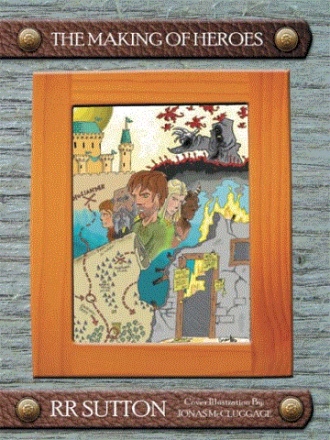
Welcome to the wonderful world of role playing. I would like to take a few sentences to explain to you how this book came about. Being a Christian man and wanting to raise my children in that same way, I always shied away from role-playing games. I have three children, who, at the time, were sixteen years old (son), twelve years old (son ) and ten years old (daughter). My oldest boy had gotten together with some friends and was having a great time role playing. He finally convinced me to try it, so one Saturday, we went out and bought the typical books on the subject, sat down, made our characters, and proceeded to have a fun afternoon. My three children and I spent four hours together laughing, talking, and having fun. Also, this is something they continued to want to do. My reservation was that they chose to be not-so-honorable characters, like thieves, and they had no qualms about choosing to behave is dastardly ways. I tried to impress upon them the need to be like Christ, even when they were playing, but they insisted that the rules allowed them to be that way.
I decided to come up with a role-playing scheme that forced the players to behave in an honorable way and this book is the result. My children started inviting their friends and for what has now been three years we have gotten together on Friday nights with up to twenty-five other kids to play “The Making of Heroes”. The benefit to me is that I know where my children are on Friday nights, we are having fun together, and I get to influence other children in the neighborhood on righteous behavior.
Like a typical role-playing game, each player has to become a character in the game. They fill out character sheets that define their attributes while playing. A Quest Leader will tell a story, and when the story comes to a place where the characters make decisions, then die are rolled, and the Quest Leader interprets the die rolls and tells what happened in the story. What makes this game different is the fact that the players have to behave in an upright manner. If they steal, lie, or try to take advantage of others, then it is the responsibility of the Quest Leader to ensure that the player is rewarded in a way that would motivate them to behave differently.
Example: When we first started playing, our group was attacked by a haggle of goblins. After the battle was over, one of the players didn’t think he got enough experience, so he decided to shoot one of his companions. He actually got a good die roll, but this is not heroic behavior. The Quest Leader (me) interpreted that die roll in this way: “As you were preparing to shoot your friend, you stepped on a loose stone, you stumbled, and shot yourself in the foot. This means that you can only move at half-speed for the next week.” As you see, the Quest Leader controls all results in the game, and it is their responsibility to ensure that the game is played in an heroic way.
There are aspects of this game that allow Quest Leaders to give rewards for positive behavior; Helpful, Kindness and Mercy points can be given out when the corresponding behavior is demonstrated. These points can then be used in the game to give that player certain advantages. If a player performs a heroic action, they can be given a Hero Token that eventually allows that player to get a Divinely Inspired Ability. The more Hero Tokens a player gets, the more powerful their Divinely Inspired Ability becomes. Certain characters can also perform Miraculous Deeds in the power of the One True God.
In conclusion: I realize that this game will not appeal to everyone, and it is not necessarily meant to be the Christians’ answer to role-playing. What it does do is give a framework for those who enjoy this type of game to be able to get together and play it in a way that promotes good behavior. The key to this is the Quest Leader, and more detail in how to do this is given in the Quest Leader Chapter.
If you have any questions, or want to discuss this in any way, please contact me at makingofheroes@gmail.com
Formats

Book Details
About the Book
Welcome to the world of roleplaying.
This book is all you need to get started in a wonderful adventure! Learn how to create a fantastical character and use it to defeat evil in the fair land of Holiander. In its pages you will discover over 100 miraculous deeds, over 60 weapon types, 10 different villianous characters for your band of heroes to overcome, and a method of generating hundreds of special items to empower your hero. As your character grows it can choose from over 100 heroic abilities and select a unique Divinely Inspired Ability. Because this game rewards honorable behavior, it can be used as a tool to build character in youth.
Ages 10 and up.
About the Author
For over 30 years Randy Sutton has enjoyed the playing of various types of games. He is actively involved with the youth in his community and developed this game to be used as a character builder for young people. Every Friday night for the past three years he has lead 'Making of Heroes' quests for 10-30 participants. He currently lives in Goleta, California with his wife and three kids.