
Freedom's Vector
The Path To Prosperity, Opportunity and Dignity
by
Book Cover & Preview Text
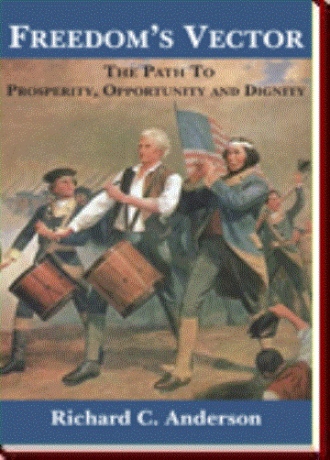
Well…almost. The blacks who were counted as only three fifths of a person did not think this infant was legitimate. The native Americans thought this birth certificate was a forgery. And still do.
It took 80 years and 624,511 of us dead in the Civil War to make the black man whole, and free, and equal. Before he paid the price with his own blood, Abraham Lincoln, number 624,512, the namesake of the ancient father of Western Civilization, made this young
Looking back at the conception of
We should assess the degree to which we Americans are free, have equal opportunity, honor human dignity, and have followed our strategic operating plan. Let’s try to make that assessment in the spirit of love and respect for the better virtues of an
The greatest threat to our individual freedom comes from the age-old syndicate of money and power. The corporation, the engine of our prosperity, will eventually make puppets of our government and enslave us all if we do not shut off the cash flow, masquerading as “free speech,” from the corporate boardrooms to Washington.
Our guidelines for attacking
Individual freedom, equal opportunity, and human dignity are basic “goods” that we should strive to maximize.
Personal responsibility within the framework of a democratic politic is the only safeguard against tyranny.
Prosperity thrives under private management and withers under government control.
It is critically important to challenge government institutions for efficacy, that is, both for efficiency of effort and quality of result.
Foreign policy should reflect our national interests, project our social values, and embrace the use of force only as a last resort.
Our morality is the barometer of our social greatness and should reflect our best virtues.
The pursuit of knowledge is the universal quest of mankind, but does not by itself offer the hope of finding eternal truth.
Americans may have the system of government they desire. It is guaranteed in the United States Constitution which is of, by, and for us all. But we will get only the one we deserve.
Since politics is the art of the possible, politicians are limited in their ability to get to the root of
Formats

Book Details
About the Book
Freedom’s Vector: The Path to Prosperity,
Our country can recapture the spirit of ’76, if we bring our better virtues and a sense of responsibility to bear upon the task. If our leaders reform their economics. If money and power do not stand in the way of freedom and democracy.
If you love
About the Author
Dick Anderson is a retired research scientist, investment advisor, and veteran
Freedom’s Vector started out as an exercise in learning and self-discovery. It ended up as this book, which Dick is pleased to share with you.