
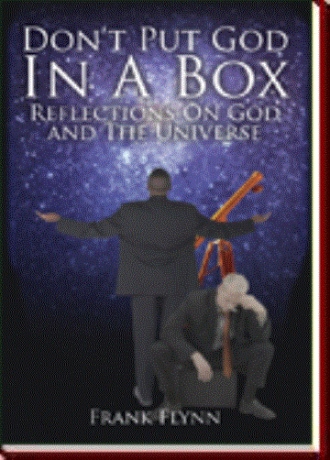
Don't Put God In A Box
Reflections On God and the Universe
by
Book Cover & Preview Text
In July 1994 Comet Shoemaker-Levi 9 hurtled into Jupiter, the greatest head-on collision in recorded history. This comet had only been discovered a short time before. It had run too close to Jupiter on its journey round the Sun and had been ‘captured’ by Jupiter and so was now rather unusually a satellite comet of Jupiter, moving round Jupiter in an elliptical orbit. It was clear it was moving in dangerously close to Jupiter itself and in its penultimate orbit in 1992 it passed so close to the surface of the planet that Jupiter’s massive gravitational force shattered it into fragments.
About 20 large remnants continued in orbit, each a ‘mini’ comet complete with tail. The largest fragment was about 5km across. They came to be known as the ‘string of pearls’. So much kinetic energy 1 was lost from the Jupiter-grazing encounter it became clear this comet would not be able to escape and this would be the final orbit. When the ‘string’ again came in close to Jupiter it was certain each component would suffer a head-on impact and become annihilated. Comet specialists were able to calculate closely the expected place and time of the impacts of each member of the string.
As fate would have it the impacts all occurred round the back of Jupiter as seen from the Earth. However Jupiter has a very rapid rotation period of about 10 hours and the evidence of these massive impacts soon became visible. Jupiter was pock-marked with impact ‘scars’ stretching in line over a large part of its surface. Because Jupiter is a fluid object these collisions were really ‘splash-downs. The gas ejected from each impact shot up into space and then splashed down again like giant fountains covering wide areas up to 1000 km in diameter.
To get some idea of the scale of this impact, imagine a huge rock 5km in diameter hurtling towards the Earth with a speed of 80 km/sec! It is not surprising that this event marked a defining moment in our attitude towards possible Earth collisions. Until then it had been known that occasionally a large meteor, or possibly even a small comet or asteroid did in fact encounter the Earth, but no one in the astronomical community or elsewhere really took the threat very seriously. However since Shoemaker-Levi this subject has been treated with considerably more respect, and now many observatories have staff whose job it is to keep a watch for intruders. Likely candidates are mainly meteors but could also be asteroids which have strayed away from their habitual orbital belt between Mars and Jupiter. They could even be rogue comets coming in close to the Sun, and passing uncomfortably close to the Earth.
***********
There is a very primitive psychological aspect to a total eclipse, as well as its physical splendour. I believe it is to do with the feeling of being cut-off from our normal sustaining source of energy. It is actually rather frightening. It almost instantly gets dark and the temperature drops steeply. We know of course with our minds that this artificial state of affairs will only last two or three minutes, and then we can return to our familiar comfort zone of warmth and light. It is almost with a feeling of relief that we see the beautiful ‘diamond ring’ effect as the intense disc of the Sun again bursts out from behind the Moon, and very quickly it becomes light and warm again.
Cats and dogs hate this surprising and rather sinister phenomenon and are best kept indoors. Bird life becomes totally disorientated for a few minutes as for an instant all their normal ‘props’ of life are disrupted.
It is sobering to reflect that such a total cut-off of the Earth’s regular power supply, if sustained, would quite quickly lead to the end of life on the planet. Life would carry on, using stored energy for a little while but then, rather like a battery running down without being recharged, the Earth would become lifeless. Yes it would continue to obey the laws of motion and orbit the Sun like all the other planets, but it would be a dead world. We have two minutes watching a total eclipse to remind ourselves of our total dependence on the Sun as our source of energy and to experience the mercifully brief but very real sensation of having our ultimate power supply cut off, like a brief taste of what it would really be like.
As a Christian I find the phenomenon of an eclipse helpful in giving me just a tiny glimpse into what it must have been like for Jesus, dying on the cross, when God actually turned his face
Formats

Book Details
About the Book
Does the mind blowing scale of the universe out there scare you? Does it confirm in you a conviction that there is no God - at least that such a God if he were to exist is altogether unreachable and unknowable - or does the magnificence and design of the universe point you to a great creator, a living being who created us too, a Loving Heavenly Father to whom we can actually relate?
This short book ‘Don’t put God in a Box’ is a personal statement of an ordinary Christian who has also had a scientific education. His main thrust is that scientific truths and matters of religious faith can happily coexist side by side, and how an honest exposure to the grandeur of the universe can enrich the faith of a believer.
About the Author
Dr. Frank Flynn read astronomy at University College London, and then went on to do his Ph.D. in astronomical optics at
For most of his working life he has been a teacher of mathematics, and for ten years was headmaster of
Frank Flynn is a committed Christian and passionately believes a scientific view of the universe can be happily harmonised with the Christian faith.