
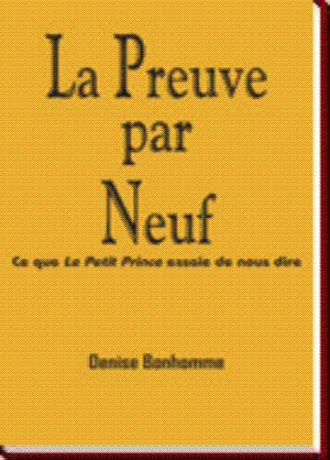
La Preuve par Neuf
Ce que Le Petit Prince essaie de nous dire
by
Book Cover & Preview Text
Il était une fois une petite maison habitée par deux personnes. L’une d’elles avait “un certain âge.” C’était un monsieur et donc une grande personne. L’autre était un petit garçon. C’est à dire ce qu’on appelle un enfant.
Les deux habitants s’entendaient bien. Parfois, on aurait pu croire qu’ils ne faisaient qu’un seul et même esprit. Pourtant, il leur arrivait d’avoir des idées très différentes…ce qui rendait leurs conversations plus intéressantes qu’elles n’auraient pu l’être autrement. Car enfin, la vie serait bien ennuyeuse si tout le monde pensait de même sur “notre petit tas de boue” (comme dirait Voltaire).
Ils restaient souvent perplexes, incapables de tirer de conclusion de leurs causeries. Comme ils étaient honnêtes, ils se résignaient à cet état de choses et se séparaient gentiment en se disant “Après tout, ‘que sais-je?’” (suivant en cela le conseil de Montaigne, Vigny et de bien d’autres). Ils cherchaient souvent l’avis d’une sagesse supérieure. Ils avaient alors recours à deux objets très anciens qui se trouvaient dans leur petite maison. L’un était un énorme grimoire contenant tous les livres qui avaient été écrits depuis l’aurore des temps. L’autre était un miroir magique un peu comme celui de Blancheneige. L’ennui c’est qu’il n’était pas toujours aimable et refusait de répondre si on lui posait des questions vraiment trop bêtes sur des sujets tels que la politique, le football, la théologie ou les cravates. Il refusait surtout de répondre quand l’un des deux compères lui demandait qui était le plus malin: le monsieur, nommé Eusèbe, qui était la grande personne et croyait tout savoir ou le petit garçon, nommé Justin, qui était l’enfant et dont le plus grand désir était d’ apprendre. Le miroir magique disait alors que la question serait résolue en bon temps. Il ajoutait qu’en attendant, on trouverait des choses utiles si on se donnait la peine de consulter le grimoire.
C’est ainsi que les deux amis dénichèrent un jour un livre intitulé Le Petit Prince. Tout de suite, les deux illustrations de la première page les firent rêver. Comment pouvait-on dire, comme le fait l’auteur, que la première image est magnifique? La grande personne jugea tout de suite que l’image était absurde et que le livre était probablement absurde d’un bout à l’autre. L’enfant trouvait que le dessin de la pauvre petite bête engloutie dans les replis d’un horrible serpent n’était nullement magnifique mais affreux. Car il voyait avec le coeur. Par contre, il se demandait pourquoi et comment un auteur intelligent peut écrire ou dessiner des absurdités. Sage question que devraient se poser de nombreux lecteurs au lieu de conclure en vitesse – comme cela arrive trop souvent - que l’auteur célèbre n’était qu’un sot ou un malade. En effet, comme le dit Voltaire dans
L’enfant dormit très mal la nuit suivante. Mais, dans un rêve, il lui sembla voir le vieux grimoire. Il entendit aussi une voix grave qui lui disait:, regarde le chiffre sept Le lendemain, il courut étudier l’image.En l’e
Formats

Book Details
About the Book
Si vous avez lu et aimé Le Petit Prince et si vous aimez les devinettes, ce livre vous intéressera probablement. Que veut dire la “magnifique image” du début du livre de Saint-Exupéry? La plupart des lecteurs ne la trouvent pas “magnifique” bien au contraire. Seulement, ceux qui savent que “l’essentiel est invisible pour les yeux” voient là une invitation à s’instruire et à réfléchir. Le “chapeau” qui est en réalité bien autre chose est une autre invitation à chercher au-delà des apparences. En lisant ce livre d’une admiratrice de Saint-Exupéry vous verrez ce que représentent la Forêt Vierge mentionnée à la première page, le pilote, le petit prince, l’éternel cache-nez d’or du petit prince et le merveilleux “renard.” Vous verrez ce que sont vraiment “les enfants.” Vous saisirez le sens profond de la guerre des “moutons” contre “la rose.” Vous reconnaîtrez le symbolisme universel de l’arbre, de la corde, de la roue et du puits de science. Vous serez édifiés par l’expérience de l’astronome Turc. Vous verrez comme tout cela se rattache aux événements et à la politique actuels car, comme le remarque l’auteur de ce livre, “tout cela se tient.” Vous vous poserez peut-être une question passionnante: Saint Exupéry voyait-il l’avenir? C’est pourquoi le Petit Prince a comme le dit finalement son auteur: “tellement d’importance.” If you have read and loved The Little Prince and if you like riddles, this book will probably interest you. What is the meaning of the “magnificent image” at the beginning of that book? Most readers do not find it magnificent, on the contrary. Yet, those who know that “the essential is invisible to the eyes” see in it an invitation to learn and to think. The “hat” that actually is something quite different is another invitation to look beyond appearance. As you read this book by an admirer of Saint-Exupéry, you will see what is represented by the Virgin Forest mentioned on the first page
About the Author
Born in 1926 in
Denise Bonhomme lives in