
Fantimals
Fifty-Five Fables of Feathered, Fuzzy, and Freaky Friends
by
Book Cover & Preview Text
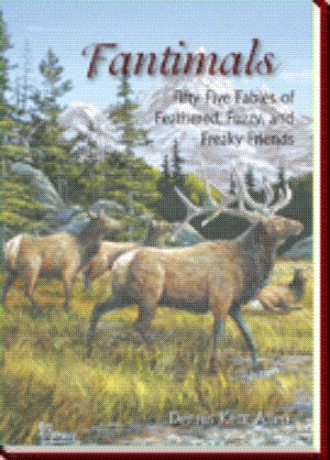
This collection of fables is written for children from beginning school age to about twelve. The stories are set in a world without humans. Using some of the natural characteristics of North American animals and taking literary license to add other traits, Dennis has fashioned tales that show how the use or misuse of those features and tendencies can bring about joy or sadness to the bearer. The animals in the stories talk to each other and do things that people do, whether good or bad, and are rewarded or punished accordingly.
Once familiar with the tales, young people are reminded of what is proper or improper behavior by nature itself. The real animals they encounter reinforce the themes of the stories: when they see a deer, they will also see poise and grace; hearing a mosquito whining by their ear reminds them not to gossip; a butterfly is a metaphor that death only changes the form of life . . . and so on.
Dennis has set at the heart of most of these stories a Great Creator whose name is never spoken. The stories and their morals easily transcend parochial boundaries.
The author wishes to thank all who have shaped his own moral codes, especially his parents who have passed into the next world as beautiful, eternal butterflies.
EXCERPTS:
Gus was their unchallenged leader, even though he was one of the youngest among them. He taught them how he moved his wings to gain altitude and to fly farther and faster. It wasn’t very long until the geese were flying high. They could even fly higher than Ernest Eagle.
The sight of his changed appearance was too much. No wonder Farren Fox scampered off when Verglum landed . . . Verglum’s outward image finally reflected the soul that was inside.
And he knew that if he were ever to become lovely again, he would have to make a very big change – on the inside first.
He lifted his head and his eyes to heaven and opened his mouth. A sound came out that pierced the winter’s night cold. It was a lonely sound that praised the Great Creator for all of creation. Cory spoke of the countless galaxies and stars, and of planets that circled the suns. Next he praised the creatures who were placed upon the earth, each having its own purpose for living and being. Lastly, he thanked the Creator for his own simple but wonderful life and for the tender care the Great Creator shows for all his creatures she sensed a pair of hungry eyes . . . The next moment, Peggy felt something very heavy land upon her. As soon as it did, she heard the loudest, screeching yelps she had ever heard.
“Ouch! Ouch! Oh! Oh! I hurt! Where did you get all of those needles?” came the painful sounding question.
“Needles?” Peggy questioned back.
“Ooh! Ouch! Yes, they’re all over you. How did you get them to stay on without hurting you?”
“. . . I think I know where I got the needles. They were a gift.”
“Ooh! Ooh! Who would give needles as a gift?”
“Someone very wise . . . Now, let’s both be on our way, and please don’t try to eat me again.”
“Ouch! Hurt! Ooh! Pain! I wasn’t trying to eat you. I was only practicing my pounce, but don’t worry about me or anyone else trying to eat you. No one wants to eat needles.”
In his mouth and stomach, he felt a change occur. As the voice had declared, he wanted to eat fish, only fish, and there was only one way to get them: he had to go into the water, the cold, blue water. It wasn’t a chore he would like, but he had to do it and be good at it if he wanted to live.
From then on, Deek never boasted of his brilliant colors or of their eye-catching shine. Quietly, he wished he were more like the color-blended creatures who went about their lives unnoticed. He realized there was much more to life than being looked upon and praised by others. There were quiet, spiritual pleasures common creatures enjoyed – pleasures Deek had never before now experienced. Two of those were comfort and peace.
“Well, Tuckery, you aren’t dull. Have you seen how long and wide your tail has grown, and how colorful your head is?”
“No, I haven’t. Am I pretty?”
“Let’s just say that now you stand out very well. And your voice . . .”
“What about my voice?” Tuckery was becoming a little alarmed at what he was hearing.
“It’s . . . well, it’s very noticeable.”
Formats



Book Details
About the Book
Using some of the natural characteristics of North American animals and taking literary license to add other traits, Dennis has fashioned tales that show how the use or misuse of those features can bring about joy or sadness. The animals in the stories talk and do things that people do, whether good or bad, and are rewarded or punished accordingly. Young people are then reminded of what is proper or improper behavior by nature itself. The real animals they encounter reinforce the themes of the stories: when they see a deer, they will also see poise and grace; a dragonfly can turn their thoughts toward things spiritual; a pretty butterfly indicates that death only changes the form of life . . . and so on. The author wishes to thank all who have shaped his own moral codes, especially his parents who have passed into the next world as beautiful, eternal butterflies.
About the Author
Dennis loves stories – but not just stories that only entertain: there needs to be a noble reason for reciting the tale. In this book, the author has assembled a collection of stories he wants his grandchildren to hear or read. They are character-shaping tales of good and bad examples. This book is Dennis’s legacy to posterity. He hopes that through the telling and reading, generations now living, and those who shall yet live, will consider a deep commitment to eternal relationships and spiritual faith in the Creator-Of-All-Things.
This is Dennis’s sixth book. Two previous works, novels In Her Image and Dark Academy are available from AUTHORHOUSE.