
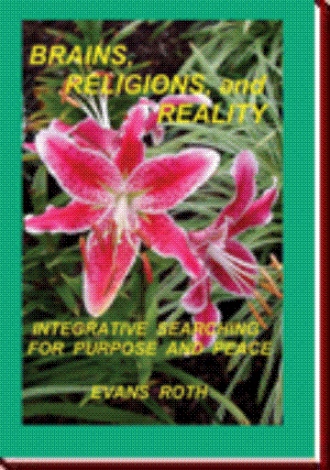
Brains, Religions, and Reality
Integrative Searching for Purpose and Peace
by
Book Cover & Preview Text
FOREWORD
a. Why should you read this book?
Have you ever had a feeling that something doesn’t make sense the way you had been thinking about it? You suspected or realized that some thing was wrong in general or for you in particular and had recognized a basic cognitive conflict (BCC) in the “pitch” you were getting was wrong.
This book identifies numerous BCCs. Beyond getting a message from each one, your considering them will sharpen your ability to recognize others, some of which have important meanings for us. To develop your ability to see these conflicts will save you time, money, grief, and pain. BCCs are discussed in more detail later (Ref. 10).
Have you questioned the purpose of life, including your life? Most people have. An example of two noted people who did and arrived at different answers is in a book by Nicoli who compares Sigmund Freud and C.S. Lewis. First, he describes them as atheists. Wait a minute, you say, Lewis wasn’t an atheist. But he avowedly was, in the first part of his life. Nicoli then contrasts Lewis in the second half of his life with his previous atheism and also with Freud, the life-long atheist. One of his themes seems to be that Lewis found purpose and peace after his conversion to Christianity, but that Freud, never found a purpose with which he could find peace. Thus Nicoli’s book explores life with and without a purpose.
If you’re having too much fun and satisfaction with your career and/or pleasure seeking and don’t want to get into such matters as considering a deeper purpose, this book may not for you, at least not yet! But sooner or later.... Why not sooner.
_ This book explores how to find purpose and peace of mind. Your search is your responsibility and will be different from mine, but I promise this book will help with your search.
b. How to use this book.
There are several ways a book like this that spans many subjects could be organized. As presented, it has a flow of ideas developed in an analytic framework and suitable for sequential reading, but given subjects are often discussed in several places. If you wish to use the book to pursue particular topics, I have added cross-referencing indicators, e.g., the one to Chapter 10 above, that can be used to look backward or forward for more on that subject, beyond what the index offers.
Footnotes are also used and kept on relevant pages rather than clustered at the end; most refer to sources recommended for further reading.
Text boxes are used throughout to highlight concepts. Single-line boxes contain important summary statements, while double-lined boxes, one of which you have already encountered, contain vital premises. While the text may range from overly to inadequately detailed, these boxes highlight important ideas for you.
c. Why did I write all this?
My original purposes were, first, to explain to my family and friends where I had arrived after a full career; second, to develop my understanding further; and, third, to share useful analytical methods.
My career has given me opportunities to develop several outlooks because I was involved in a variety of activities, including travel to many countries where I met a host of interesting people. The book represents my effort to put it all together in what is not only an examined but also an extended life. Am I trying to “sell” my way of looking at life? In the sense that I feel a degree of satisfaction—peace of mind— in what is here, yes. But people who read this type of book will take exceptions and, hopefully, will be induced—perhaps aggravated enough—to examine their own lives; the earlier in life this process starts, the better it will develop. But I do suggest that write about your ideas since doing so imposes discipline and forces clear and integrated thinking.
That’s the hindsight view. I had no such intentions in the beginning when I started to write a series of six essays on concepts I thought might be useful to other people. This approach was difficult for two reasons. First, each person is on his/her own search for meaning cannot be expected to give much attention to my set of concepts unless couched in generic terms, a difficult task. Second, since I am writing in retirement, I had time to think
(a dangerous activity) and to read numerous books (equally dangerous); the result was a series of extrapolations and extensions. In short, I was snookered into writing a book. Then the difficulties escalated!
Formats

Book Details
About the Book
Brains, Religions, and Reality synthesizes a worldview incorporating 21st-century knowledge and:
Summarizes the unique characteristics of humans and the critical need for intellectual maturation.
Identifies many basic cognitive conflicts that are impeding human progress and laments four syndromic sicknesses: Egocentrism, Fundamentalism, Despair, and Hyper-Immanence.
Proposes Integrative Theology, a new construct compatible with modern knowledge.
Develops a postmodern explanation for the origin of evil.
Indicates the importance and means for people to undertake hero journeys to search for purposes leading to peace of mind.
Portrays commonalities of science and religion and their critical need for mutual respect.
Proposes a geopolitical theme that addresses the causes of terrorism.
Points out that inclusivity is the most important future direction for humans.
About the Author
Dr. Roth has more than fifty years of experience as a student, Professor, administrator, and researcher in Cell Biology at six major American universities. He received the Ph.D. degree from the University of Chicago and has held positions at Indiana University Medical School and Argonne National Laboratory. He has authored more than sixty papers in leading scientific journals.
From 1984-2000, he assisted many universities in Eastern Europe to adapt to their new democracies and market-driven economies. He has served on Boards of Directors for three for-profit corporations and is an active, on-line investor.
He has been active in churches and religious studies ranging from conservative to postmodern theologies and has found pragmatic commonalities between science and theology.