
The Culture Crafters
An In-Depth Look at How Pop Culture Seduces Today’s Youth and How to Counter Its Influence
by
Book Cover & Preview Text
How Pop Culture Influences
How does popular culture lure and charm the masses? Benno Muller Hill says, “The majority of the masses look for security and safety. They figure if a lot of people are doing something, it must be right. If most people accept it, then it probably represents fairness, equality, compassion, and sensitivity.”
Setting and following trends is a characteristic of all cultures. Today’s popular culture influences the cars we drive, our stock market picks, the clothes we buy, the movies and television programs we view, the restaurants we frequent, the medicines we take, the homes we buy, the trips we take, the sports we play, the books we read, the indebtedness that’s on our credit cards—and, yes, even our values and standards are now determined by pop culture, better known as political correctness.
Life is much simpler when we just go along with the trends. It requires less thinking and work. We don’t have to worry about standing out. If we go along with pop culture, we just blend in with everyone else.
The media takes polls and conducts surveys, and whatever the majority says is treated as truth or what’s best for everyone. But history demonstrates that the majority is not always right. Today’s pop culture ignores and often reviles objective truth. Therefore, their views are often wrong, even if they are shared by a majority of their peers.
Jesus explained pop culture’s appeal by comparing it to a broad road that many people travel down but which eventually leads to eternal destruction (Matthew 7:13). It is the easy way. It is the road of least resistance, and it appeals to the majority. However, Jesus also spoke of another path. A narrow road, with few traveling on it. Jesus said this road leads to life—here on earth, and afterward, eternal life (v. 14).
Jesus warned in the next verse, “Beware of false prophets, which come to you in sheep’s clothing, but inwardly they are ravening wolves.” Jesus’ warning is similar to Paul’s: “Beware, lest any man spoil you through philosophy and vain deceit” (Colossians 2:8).
Neither Jesus nor Paul in these passages was making reference to leaders of a religious sect or cult. Rather, they were cautioning against the majority in society, those in mainstream culture who gravitate toward popular man-made philosophies and appealing ideas. This broad, convenient and acceptable way is the road of deception that Jesus warned leads to destruction.
How Ideas Are Processed
How do today’s culture crafters get their ideas to the masses? How do they persuade the culture to buy into philosophies and beliefs that are not factual?
Gregory Koukl and Francis Beckwith, in their book Relativism, explain the process: “Ideas that are whispered are seldom analyzed well, for they simply don’t draw enough attention. By means of repetition and passive acceptance over time, they take on the force of common wisdom, a ‘truth’ that everyone knows but no one has stopped to examine . . . a kind of intellectual urban legend.
When ideas like these take root, they are difficult to dislodge. The ideas become so much a part of our emerging intellectual constitution that we are increasingly incapable of critical self-reflection. Even if we did, we have little conviction that such analysis would do any good anyway.”
Formats

Book Details
About the Book
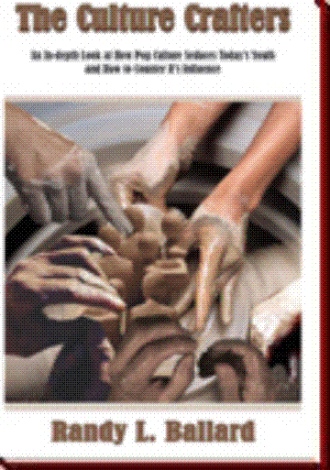
The Culture Crafters is both a frightening and shocking in-depth account of how popular culture seduces and deceives today’s youth. The book exposes major forces inside the American pop culture that is shaping the worldview of children and youth such as television, movies, the Internet, public policy, books, education, and music. However, the author makes it clear that the cultural battle for the next generation must be fought in the spiritual realm, not with human weapons aimed at human agendas, personalities, or organizations. The Culture Crafters encourages parents, teachers, and ministers to counteract the deception of the culture crafters with sound, practical principles from God’s Word and to employ spiritual weapons that are designed to destroy every stronghold of the real Enemy.
About the Author
Randy Ballard has 23 years of ministerial experience serving as church planter, pastor, and a state church administrator. He has a B.S. from
Randy resides with his wife, Annette, and son, Gabriel, in Morrow,
The Culture Crafters is Randy’s first published book, he has written numerable magazine and newspaper articles. With the book he hopes to illustrate how pop culture is impacting today’s youth and how parents and church leaders can counter its influence.