
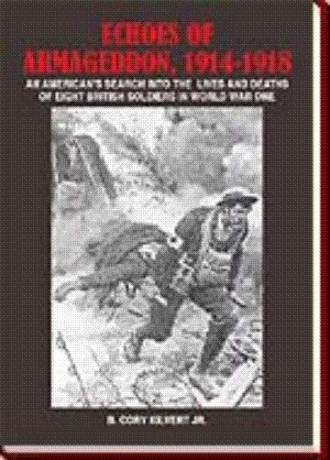
ECHOES OF ARMAGEDDON, 1914-1918
AN AMERICAN'S SEARCH INTO THE LIVES AND DEATHS OF EIGHT BRITISH SOLDIERS IN WORLD WAR ONE
by
Book Cover & Preview Text
By the end of 1914, 90,000
officers and men of the British Expeditionary Force in
The remaining men of the 1st Battalion
could be proud of themselves, and they were. On November 11th, with
little to sustain them beyond biscuits and rum, they and the men of other
battalions in the Gheluvelt salient had helped bar
the way to Ypres, less than five miles to their west.
Facing them was the finest force their enemy could hurl at them, an entire
division of the Prussian Guard, selected for the sole purpose of destroying
them.
Rushing forward, this elite enemy
formation almost reached the Royal Field Artillery’s gun line but was
systematically decimated by a blizzard of shrapnel fired over open sights.
Soaked to the skin, some of the King’s men would have been suffering from
trench foot, and by the end of that winter, 20,000 British soldiers would be
invalided because of it.
Late that night of the 11th
along the southern fringes of Polygon Wood, the 1st King’s remained exactly
where they had stood at dawn. In a turnip field not more than seventy-five
yards ahead of them lay a serpentine wall of dead and wounded from the shattered
German 3rd Foot Guard Regiment.
Exhausted, shivering and caked with mud when relieved in the rain and cold, the
battalion’s survivors were still facing front, unvanquished. They had been in
battle for three straight weeks.
Elsewhere on the Western Front,
General Sir Douglas Haig’s offensive at Neuve Chapelle on
On the morning of that warm and
clear April day in Canadian Expeditionary Force (CEF) trenches slightly
northeast of the Flemish town of
Retching, gasping and panicking,
these French Colonials fled south, but none of the four Canadian battalions or
the British 28th Division to their southeast were seriously affected
and held onto their positions. However, all present soon realized that hordes
of Germans were pouring through a wide gap in the line vacated by the Algerian
French ‘Turcos’ and were heading for St. Julien less than two miles to the south. If this enemy mass
could not be stopped, the Allied front line would be separated from its
supplies and allow the Germans to continue south, capture Ypres
and then head for the Channel ports to cut off the British from their lifeline.
Formats

Book Details
About the Book
Echoes of Armageddon, 1914-1918 relates the gripping story of eight
totally anonymous British officers and men who fought under appalling trench
warfare conditions and did not survive this conflict. Their medals have been in
the author's collection for many years and are named to each recipient. This
scant information served as his starting point for attempting to recreate these
soldiers' lives and the circumstances of their deaths.
This unique departure from the
norm enables the reader to link with the author as he travels through
This book also tells of certain
political events and social conditions in
The author has made every effort
to provide accurate dates for each incident mentioned throughout this book by
relying on The Times Diary & Index
of the War 1914-1918, a now very
rare volume that lists newspaper headlines for every major event over the
course of this entire conflict.
About the Author
B. Cory Kilvert,
Jr., is a freelance industrial public relations writer and photographer, but
his avocational interest for more than forty years
has been the history of the British Army. On his father's side, he comes from a
long line of British and Canadian soldiers.
He has lectured at The United
States Military Academy at
Echoes of Armageddon,
1914-1918 is his first military book to be published.
Kilvert
volunteered for four years in the U. S. Air Force during the Korean War and was
assigned to the National Security Agency.