
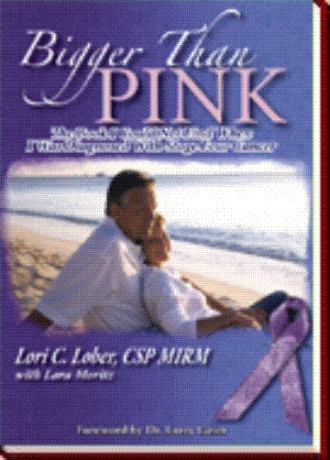
Bigger Than Pink!
The Book I could not find when I was diagnosed with stage four cancer
by
Book Cover & Preview Text
FOREWORD
BY
Larry J. Geier, MD
Medical Oncologist
I first met Lori Lober
in 2003 at a symposium focusing on the prevention and early detection of breast
cancer. She was one of many women there
that day, many of whom were breast cancer survivors. But for some reason she stood out among the
crowd, and her questions and comments after my presentation were right on the
money and greatly appreciated. We both
came away from that encounter with the feeling that, “Gee, he/she really gets
what this is all about.” I knew that she
and others had created the “Touched By Cancer
Foundation” in
On the surface, the book is an
accounting of her trials and tribulations in fighting Stage IV breast cancer,
including the things that went wrong, and the things that went right. Since her cancer was invisible to the
mammogram, there was an unfortunate delay in her diagnosis. She had difficulty identifying a team of
doctors with whom she could communicate in the way that she wanted, and that
she could trust would be providing aggressive state-of-the-art care. But ultimately she achieved an amazing
result, in that she is cancer-free now four years out from her diagnosis. That accomplishment is remarkable in itself,
no matter what the path to get there.
But this book is much more than a mere
chronicle. It is a window into the
person Lori really is, a woman with great spirit, and
a remarkable will to survive. She didn’t
just beat the odds to get where she is today, she
refused to accept those odds, and was determined to do whatever it took to give
herself the best chance to beat the cancer.
This included not only the best and most aggressive therapy that
traditional or “Western” medicine had to offer, but also a combination of
complementary types of treatment not routinely used in cancer care. Among these were such things as acupuncture,
reflexology, herbal medicine, colonic cleansings, and therapeutic touch and
massage.
Most of us American-trained physicians
know little or nothing about these alternative treatment modalities, and tend
to have a certain level of mistrust of them because they don’t seem
sufficiently “scientific” for our liking.
That usually means that we haven’t yet figured out a way to measure them
scientifically, and thereby “prove” a cause and effect relationship between the
treatment and a beneficial outcome. In
my opinion, we even tend to be somewhat arrogant in our view, daring to call
what we do with surgery and medicines “traditional,” while designating
treatments that have been used successfully for centuries as
“alternative.” Some of us are perhaps
more open-minded, and prefer to “integrate” the best of both worlds whenever
possible, for the maximum benefit of the patient. I certainly don’t claim to adequately
understand how some of these modalities work, but I have indeed seen them work
in many patients--.helping to control pain, to relieve stress, to improve
nutritional state, to maintain energy, and to apparently bolster the immune
system. I honestly don’t know if they
help to fight the cancer directly in some way we can’t yet define, but I know
all too well the limitations of chemotherapy, radiation, and surgery, and
frankly, I can use all the help I can get.
I do prefer to know when my patients are considering such therapies so
that I can help to guide them the best I can, but I know I still have much to
learn. To that end, this book has been
quite helpful, and I have learned much from Lori’s descriptions of the various
treatments she included in her program, why she chose them, and the benefits
she received. It might be that a
different combination would be effective in different patients, but these are
surely a good place to start.
Presumably you are reading this book
because either you or someone you care about is battling cancer. If so, I believe you will find it to be both
instructional and inspirational, a rare combination. Lori alludes to Lance Armstrong and how she
found his book to be inspirational to her, but I believe if their positions
were reversed, he would say the same thing about her writings. Lori once asked me if I thought she was truly
a “cancer survivor” since she had Stage IV disease and is still taking active
therapy. No one can say for sure whether
she is truly “cured” or is living in harmony with her disease, but it is certainly
true that for some people cancer is best viewed as a chronic illness requiring
chronic management. Either way, in my
view Lori is the absolute personification of the phrase cancer survivor. I find her spirit and determination, her
ability to integrate the best of traditional and alternative medicine, tailored
to her own needs, and her willingness to give to others without hesitation, all
to be remarkable, admirable, and truly inspiring.
Larry J. Geier,
MD
Medical Oncologist
Formats

Book Details
About the Book
After having already suffered the loss of a brother to cancer, Lori Lober experienced the unthinkable: she too was diagnosed with cancer, hers being Stage IV, metastatic breast cancer. Bigger than Pink is the accounting of Lori’s successes and failures that have led her to remain NED (no evidence of disease) for almost three years. Bigger than Pink is part therapeutic, part self-help, but 100 percent applicable to ALL who have been impacted by cancer.
About the Author
Prior to Lori Lober’s cancer diagnosis she was recognized as one of the nation’s top new home sales and marketing professionals by the National Association of Home Builders. She is a Certified New Home Sales Professional and a member of the
Lara Moritz is a television news anchor for KMBC-TV in