
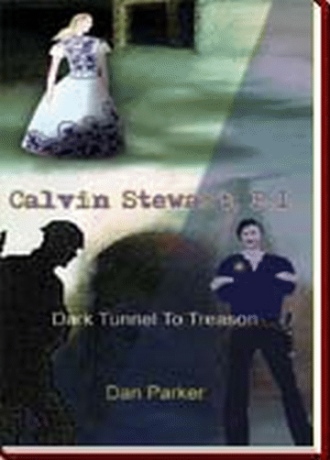
Calvin Stewart, P.I.
Dark Tunnel To Treason
by
Book Cover & Preview Text
Calvin skirted the clearing and came up behind the building. Squinting through a dusty window, he saw what looked like the truck that Lester Pitts was driving when he brought Malone home last Sunday night on Spring Lake. To the right of the truck was a set of steps in front of a door on the inside wall. He managed to jolt the window free and slid it up. It took some doing to wiggle his large frame through the small opening, but after a couple of bruised ribs and scraped hips, he was inside.
After closing the window, he checked the truck over. Sure enough, Van Buren Trucking Co. was printed on both doors. He opened the driver side door and made a note of the mileage. The cab smelled of stale booze and cigarette smoke. A rifle lay across the floor in front of the seat, and a revolver wrapped in paper was wedged between the seat and backrest. He closed the door and walked to the back. The door to the covered rack was unlocked; he pulled it open and looked in. It was empty, but skid marks on the blank floor told him it had hauled some heavy cargo.
Calvin waked to the front of the truck and snapped a picture. He then turned his attention to the door above the steps. It opened on squeaky hinges, and Calvin stepped into a large open room. There were remnants of coal scattered on the floor and cobwebs hanging from every nook and cranny, corner, and timber. The room smelled heavily of gasoline and motor oil. From the sliding door off the loading dock, a set of mining railroad tracks ran across the floor through a large open doorway. A steel cable was attached to a steel drum mounted on timbers in front of the sliding door; it followed the tracks through the open door. A twenty-horse, gas engine that was mounted on the floor beside it powered the drum. “This is how coal was taken to the factory to heat the forges before they were converted to electricity,” he thought.
Following the tracks through the dark opening, he quickly sensed a rapid descent. He followed the tracks downward until the tunnel was completely dark. Not wanting to chance injuring himself, he returned to the truck and rummaged through the cab until he found a flashlight. He tried the switch, and a beam of light shot out through the dusty air.
Armed with the light, he returned to the tunnel and followed the tracks lower and lower. The air was dank, and it was hard to breathe; his skin felt clammy, and the floor was moist and becoming increasingly slippery. He shined the light ahead, and it beamed off a steel-wheeled cart sitting on the tracks attached to the steel cable. The ground was level from the cart to a wide steel door about twenty feet beyond it. “This has got to be the questionable door on the drawings,” he thought.
Inching forward, he turned the door handle. To his surprise, it wasn’t locked. He very carefully pushed the door inward. There was light coming from under a door directly across the room. He had seen the door on his tour with Burkhart. It was secured with a heavy padlock and looked as if it hadn’t been opened in years. He looked around the room; it was sixteen feet square with a twenty-foot ceiling. To his left was an old coal furnace, long past its usefulness. Discarded machine parts were piled against the walls and littered the floor. Calvin stepped inside. In the corner to his right, behind the door was an open steel stairway leading downward. He carefully closed the door and waited; he could hear voices and running machinery from behind the opposite door.
After determining that he hadn’t been discovered, he beamed the flashlight down the stairway. It went down about six feet to steel grated landing. While shining the light ahead of him, Calvin cautiously went down the steps. They turned left at the landing; he followed them to another landing, turned right, and followed them to the floor below.
This room was the same size as the one above it. Calvin opened the door ahead of him and shined the light across the room. The beam fell on one piece of machinery after another. There were welders, drill presses, lathes, sheet metal breaks, and tape and die presses. A forge at the far end of the room showed signs of recent use, and recently used molds were stacked on the floor beside it.
Calvin found a light switch next to the door and flipped it on, flooding the room with light. A series of assembly line benches were against the wall at the far end of the room, and at the end of the benches were two packing crates. He walked over and looked inside. Each crate contained six grenade launchers. They were packed side by side and three high. “This is the mother load.”
Formats



Book Details
About the Book
Dark Tunnel To Treason is an action novel of mystery, suspense and romance.
“Some things just don’t turn out as planned,” ex-sergeant Calvin Stewart remarks when he returns to a different life after serving his time in the Army. In the 1940’s, during a time of passionate patriotism when wives, girlfriends, and mothers do not know if their men will return from the war, Calvin must create a new life for himself, and two prisoners and a bus ride home will determine everything.
Rumor has it that the Germans have
stolen a weapon of war that was created in the
Unexpectedly linked by their dreadful past, Calvin’s lost love is replaced by a new romance full of joy, contentment, and youth. A thunderstorm of secrets, confrontations, snooping, ambushes, and love are weaved together to begin Calvin Stewart’s new life.
About the Author
Dan Parker was raised in rural
Calvin Stewart, P.I. / Dark Tunnel To Treason is his third novel. His first and second novels, Threshing Time and a Weekend At School can be purchased by calling 1-888-280-7715 or visit www.1stbooks.com