
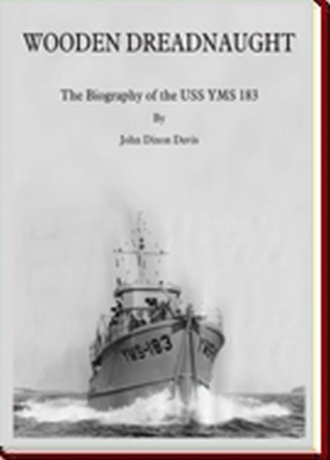
Wooden Dreadnaught
The Biography of the USS YMS 183
by
Book Cover & Preview Text
Introduction
“In July 1940, at
There are a few of us whose memory of those days is still quite vivid.
President Roosevelt, however, realizing that it would eventually be our fight indeed, though he could not for obvious reasons say so at this time, persuaded the Congress to authorize the strengthening of our Navy and Merchant Marine, as noted above. A very interesting account of the events of
In the October, 1942 issue of Yachting Magazine, Herbert L. Stone wrote, “With an exposed coast line of some eight thousand miles, containing many harbors and bays into and out of which pours the seaborne commerce so vital to the United States, it was natural that one of the largest (in point of numbers) and most important of the Navy’s building programs was that for new mine sweepers, or “sweeps” as they were generally called in the service.” (See End Note No. ).
This building program included several types and classes of mine sweepers, the 98’ AMc (Auxiliary Mine Sweeper, coastal) and the 136’ YMS (Yard Mine Sweeper) both built of wood. Three classes of steel hull sweeps, designed to operate with the fleet for longer periods, in deeper water and at relatively high speeds included the 180’ AM, the 220’ AM (Auxiliary Minesweeper) and the Destroyer Mine Sweeper (regular Destroyer fleet types fitted with high speed sweep gear). The histories of the various mine sweepers are important and some of their stories have been written, but our purpose in this book is to tell the general story of the wooden hull Yard Mine Sweeper and the USS YMS 183, in particular.
Sooner or later the reader will ask why the YMS, a Commissioned ship, was not given a name and all other commissioned mine craft were given names. Even the “lowly” 97’ AMc, which early in the war was not commissioned, was given a name. What was going on here? To say that YMS personnel were troubled by this oddity is only half of our frustration. One answer that was particularly onerous was that there were so many YMSes (481 to be exact) that it was too much trouble to find names for them all, so a number would have to do. Closer to the truth, however, was the cynical answer that it was a “typical” Navy “snafu”. According to Franklyn K. Zinn, former member of Experimental Minesweeping Group One in 1941-42, there is credence in this answer. He writes in U.S. Naval Institute Proceedings issue of October 1999, “Never in all my years in mine warfare did I ever hear anyone ask why the sleeker, longer, more seaworthy minesweepers were named yard mine sweepers or YMSs (no names, just numbers), but the shorter, less seaworthy, homelier AMCs or coastal mine sweepers all had names. Of course, the prefix ‘A’ also was used for Aps, Ads, Ars, and even Ams, to indicate auxiliary ships. For those of you who may have wondered about this all these years, let me elucidate. In 1941 and 1942, I was faced with this question, and being part of Experimental Minesweeping Group One some of this time, I asked the group commander, Nathan W. Bard, why this was so. He told me that in the rush to build sweepers right before and right after we got into World War II, someone in the Bureau of Ships mistakenly had wrapped the specifications for YMSs in an envelope marked ‘Specifications for AMCs’ and vice-versa. When the error was discovered, it was too late to change this, as they had to get the new ships out to sea. So the error was allowed to stand, lo these many years.” (See End Note No.
Formats

Book Details
About the Book
Wooden Dreadnaught is a detailed recount of the daily activities on board the YMS 183 during World War II in the Pacific. The actual ship log has been used along with the recollections of the remaining crew. The book takes the YMS 183 from its original construction site to its final resting place. The author’s goal is to give the reader an insight into the monotony of the daily routine along with the highlights of their involvement in WWII. It is an excellent reference source for other naval historians.
About the Author
Author