
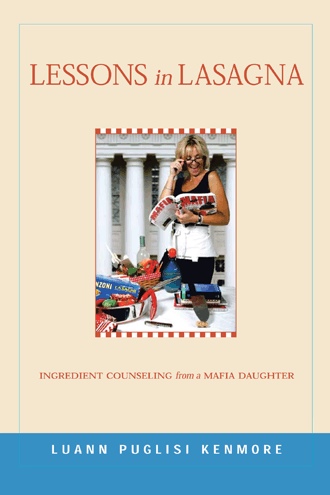
Lessons in Lasagna
Ingredient Counseling from a Mafia Daughter
by
Book Cover & Preview Text
INCEPTION
After my father disappeared—and my funding—I returned to waiting tables and closet writing. I moved to
While figuring out how to put these words together with a binding, I was asked whom I was writing this for; I took that as a sort of insinuation that perhaps no one would want to read this book. After some thought and inner examination, I knew the answer to the question; I decided it was me. I am the giver and the receiver; I wrote for myself. It’s my truth, simply put. It became my opportunity to assemble the chaos of my past into a viable means of self-expression—a slather of peace in my room of tortures.
I wrote it as though I were building a house, all the while planning its housewarming party. I had some difficulty staying focused. Building the foundation before putting up curtains, so many memories, emotions, and incidents I’d buried resurfaced. I found myself going off on tangents, so, in the end, I’d let myself go, then reeled myself in by re-editing over and over.
In a sense, it was like preparing a recipe, adding and subtracting ingredients until the flavor is satisfying. As a writer, I have potential. But I am hard on myself. Foolishly, I feared what others thought; I trusted their judgment more than my own. It seemed everyone wanted to edit my thoughts, perhaps because they hadn’t spoken their own. In this process of exposing myself, I found I could be easily crushed; I concealed it well. When you consider yourself to be an outsider, whether by virtue or proxy, you define yourself by others—at least I did.
It’s a precarious, unbalanced way to exist. I found myself sighing a lot, and, eventually, I couldn’t breathe. I carried a paper bag around with me for a long time feeling hypersensitive to criticism from people whose outlook shouldn’t matter to me. I proceeded fighting my roundness into their square fittings; it never felt right. I attempted several means to overcome self-deprecation; most were unsuccessfully. Then I decided, “Screw it—what’s the worst thing that could happen?” So people walked away saying, “What was she thinking?”
I didn’t care; the reality is I am already a success in my life. I have a great family, which I prize caring for, a landscape of friends and acquaintances, and a home that is my haven. I laugh, cook, garden, read, socialize, and play with my husband, kids, and dogs. We are healthy, have a strong faith, and are complete in the knowledge of our comforts. I am kind because it feels good, and, slowly, I am learning to receive. Anything else is like fries with a garden burger—the burger is good on its own; the fries are merely enhancers.
With these revelations in place, I focused on where my comforts lie. Two activities I felt sufficiently confident doing are writing and cooking. I express myself through both; together, they have become my scaffolding. I don’t pretend to be a genius at either. I am a woman grappling with healing, and embracing and valuing mortality; I get that it is temporary.
I have a willingness to keep going, which is why I wrote this. I meet a lot of people haunted and ashamed by their struggles. I have been stalked by shame myself—and still am, though less and less. It felt good to open the attic and release its haunting inhabitants.
I invite you to leave any ghosts, fears, or shame in the blank pages I have provided at the end of this book. I have and will continue to expose them all—perhaps through fiction as to protect my personal life, but I will do it. I have a feeling that if I am done with this process, I may not need to be here anymore. So I embrace all of the old and new inhabitants. There are definitely ones who are stubborn and need to go, so I continue.
Formats

Book Details
About the Book
Layering the good with the bad; Luann Puglisi Kenmore has taken her chaotic life, added her own ingredients and created rituals and recipes to simmer her experiences. Luann has held tight to the promise a meal and a well told story has healing properties as well as the ability to feed the soul. The daughter of a Mafia bad guy, Luann has connected those sometimes horrifying experiences; losing her father to an organization that once made him powerful, physical trials, a life filled with limousines, expensive cars and fancy clothes, to a quiet life as a mommy. “Writing and cooking have been my scaffolding; savoring the ingredients I’ve been dealt and turning them into meals instead of hazardous waste has freed me of traumatic alternatives.”
About the Author
Luann Puglisi Kenmore grew up in a small-savy town on the eastern end of Long Island; known as the “Hamptons”. Her itinerary did not include the crushing blow she survived when her Mafia connected father disappeared in 1980; after his arrest pending a lengthy sting operation. The whirlwind of fear and tension she experienced having the FBI, CIA, and Mafia officianados stalking her led her to flee to the west coast where she transformed the once exciting albeit scary life of a Mafia daughter- to a suburban wife, mommy, fitness trainer and writer. Look for her next novel, She’s No Pocohontas.