
Signal Chase
by
Book Cover & Preview Text
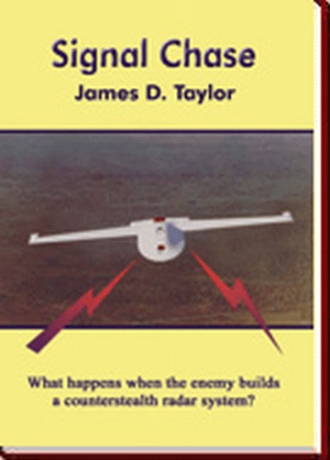
“Only from space,” Ransom
answered. “But when clouds block the view, our spy satellites have problems,
and if the skies are clear, the enemy knows the orbital schedules. They can
take cover when our space-based systems pass overhead. I convinced the Joint Chiefs
and the Congressional Intelligence Oversight Committee we have something
better.”
“So you’re using stealth aircraft for
low-level spy missions.” Red smiled broadly. “Congratulations. It’s about
time.”
“Yep.
When we’re watching, nobody can put up a building, dig a hole, move a vehicle,
or deploy an army without our knowledge. We can do it day or night.” The
general smirked at the image he’d painted.
“You must be using the Dark Star
stealth drone.”
Ransom’s jaw dropped. “How the
hell did you know that?”
“I helped Universal Aerospace
design it. All the specifications and requirements pointed to something like
this.” Red laughed. “Bill, how long do you really think you can keep this
operation under cover?”
“This is Judd Wiesel’s
pet program,” Ransom said shortly. “So it had better stay top secret.”
Red drummed his long fingers on
the polished wooden chair arm. “Judd Wiesel is one of
several reasons why I retired. When his office stopped our cruise-missile
detection project, I figured nobody was interested in defense research any
more.”
“The Honorable Judd Wiesel to you. No matter what you think, he is an
undersecretary of defense now. He told everybody you were full of crackpot
ideas.”
“So I heard.” Red rolled his
eyes. “My industry friends ignored him. Never could understand his motives.”
Ransom relaxed back into his
chair. “He’s probably forgotten the whole thing by now.”
“Maybe not.
Did you know the Pentagon tried to stop my publisher?” Red had written and
edited two books filled with equations, schematic diagrams, and pictures of
wiggly lines that anyone who wanted to know about ultra-wideband radar would be
able to figure out.
“I heard, and those books are why
I need you.” Ransom walked to the wall of computer screens.
“There must be other experts. Why me?”
The general smiled. “Because
you’ve got some special qualifications my technical staff doesn’t have.”
Red sighed and whispered, “Ah,
those qualifications.”
“Not many people have an
engineering background and special-operations experience. You may need both.”
“You should know I’m out of practice and a bit
old for that nonsense.” Red guessed Ransom had discovered his single raid with
the Special Forces. His left shoulder still ached from the East German bullet
he had taken while stealing an enemy radar set almost
twenty-five years earlier.
“Here’s why I need you.” Ransom
tapped a spot on one of the maps. “Three days ago a Dark Star drone disappeared
right there.”
“In
“We don’t know. We lost the
satellite control link during the flight.”
“Strange. The drone should have
returned to base using the emergency recovery system.” Red recalled that when
communications were interrupted for more than ten minutes, Robopilot,
the Dark Star aircraft flight control computer, would automatically complete
the mission and return safely.
“It had happened before, so
that’s what we thought, too. But the plane never returned to our operating base
at Birobidzhan.” Ransom indicated a town along the
Trans-Siberian Railway. “It’s right here, just north of the
“Couldn’t you find it with the
satellite search and rescue locator?” Red asked. A special transmitter
activated by passing satellites was part of the Dark Star’s electronics. Only
destruction would stop the system from responding to the appropriate radio
signal.
“Quit just after we lost
communications.” Ransom twisted his hands and stared at the blue carpet. “We
assume it self-destructed. Nothing will remain but aluminum flakes and the
engines.”
“Any telemetry indications about
what caused it?” Red knew the command center received constant reports about
every system in the aircraft.
“None.
Everything was perfect.” Ransom shook his head, mystified. “According to our
satellite reports, no Chinese aircraft were near it.”
Red moved closer to the computer
display. “I’d guess the Chinese haven’t built a stealth fighter yet, so they
didn’t intercept it,” he mused, half to himself. “Then what happened?”
“My DATC team concluded it was
some unknown system failure. The Pentagon concurred, end of
story.”
“At least there were no captured
pilots, like Gary Powers after the U-2 spy plane incident,” he said. “But I’m
surprised the Chinese haven’t raised a stink. I would have expected this in the
headlines. Sounds as if folks on both sides want to whitewash
this business.”
Red realized it would cause a
major crisis in
Ransom’s shoulders slumped. “I
think we have just been lucky. The plane might have crashed in some remote
place, and they don’t know yet. We’re getting damage control ready, just in
case.”
“Maybe this exp
Formats

Book Details
About the Book
About Signal Chase
By
James D. Taylor
I wrote Signal Chase to show the practical implications of my two books: Introduction to Ultra-wideband Radar Systems and Ultra-wideband Radar Technology.
What would happen if a foreign
power developed effective counterstealth radar?
Military officers know this violates several landmark principles. First,
To answer this question, I mixed defense politics, geopolitical danger, a short fuse, imminent war, patriotism and international conspiracy.
Colonel Red Bannerman and Major Ardis Moore must find a radar system designed to detect stealth aircraft, but not be detectable by the other side, i.e. a stealthy radar. Bannerman, Moore and General Suvorov typify the thinking patriots who work in the background to keep their countries free.
I give the reader a subtle education in high technology through a tight mystery story. Red Bannerman takes the reader inside a humanistic engineers mind.
About the Author
James D. Taylor
James D. Taylor learned creative writing by preparing military officer evaluations, concept papers, and justifying research programs. After graduating from the Virginia Military Institute in 1963 as an electrical engineer, he embarked on a twenty-eight year career as an army and air force officer. Advanced professional studies, a Master’s Degree, and his broad scientific knowledge led to staff assignments in defense technology planning.
Retiring in 1991 with the rank of Lieutenant Colonel, USAF, he published Introduction to Ultra-wideband Radar Systems and Ultra-wideband Radar Technology with CRC Press. He taught ultra-wideband radar classes in America, Scotland, Italy, and Russia. His military history and geopolitical avocations inspired Signal Chase. For relaxation, he studies foreign languages and competes in cowboy action shooting sports.