
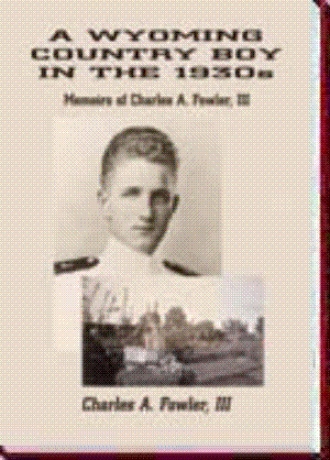
A WYOMING COUNTRY BOY IN THE 1930s
Memoirs of Charles A. Fowler, III
by
Book Cover & Preview Text
To me, the phrase "working the land" has so many facets to it that I cannot begin to enumerate all of them. Among those facets are tilling the soil, planting field and garden crops, nourishing and harvesting the crops, stacking hay, thrashing, irrigating, caring for cattle and poultry in fair weather and foul. It includes tasks such as digging holes for fence posts, shoveling dirt, nursing a sick cow back to health, and watching a young calf cavort about.
The word "bonding" is a very popular word in today's culture. It is my belief that working the land creates a special bond between an individual and the land he has been working. At least that is so for me and the small farm where I grew up. Every time I visit Torrington, I'm compelled to go to see “our” farm. First I drive up and down US 26 where our farm fronted and then up and down the county road along the east side of the property. (See Map 6.) As I drive along the county road, I stop at the division boxes, DB to see what is going on there. Who is using irrigation water, and how big a head of water do they have?
Of the buildings on our property in 1943, only the house and garage remain (year 2000). Subsequent owners and time have changed things drastically. The stately cottonwoods trees that marked the borders of the State Farm are largely leafless, stark white skeletons waiting for a chain saw to take them down or a strong Wyoming wind to topple them. Many of the windbreak trees which Dad planted and nourished are dead or dying. Of the orchard which Dad and I planted, only one or two scrubby trees remain.
I know these visits are going to hurt, because they mix sadness with nostalgia. Do you understand why I must go back there to see that land even though it hurts? It's because that is where I grew up in Wyoming. That's where I thrust a spade into the earth hundreds of times and hoed thousands of weeds. That's where I picked bushels of tomatoes, beans, peas, cucumbers, corn and strawberries. That's where I bathed several hundred times in the washtub. That's where I saw the duststorm clouds boil as they came toward us and blizzards blot out trees at the river's edge as the snow moved towards us across the intervening fields. That's where hail and grasshoppers made a sieve of plant and tree leaves. That's where drought decimated promising crops. That's where Dad and I brought a cold, cold truck engine to life in sub-zero temperatures. That's where I plopped my fanny on a milking stool hundreds of times and pumped more than enough milk to fill a tank truck. That's where I skinny dipped hundreds of times. That’s where I heard the meadowlark warble his beautiful tune. That's where I became an apprentice painter. That's where I pushed the lawnmower dozens of miles. That's where I caught the school bus hundreds of times. That's where I sweat gallons of honest sweat. That's where I learned to saw and hammer. Words fail me to describe what a ball I had growing up on those few acres in Wyoming. My, how I loved and still love that spot of ground and the memories associated with it! When you really work the land, you bond with it
As mentioned in the essay, “Our Dairy Business,” my cousin Reid Gamble was manager of the Western Produce potato operation. In addition to sorting and culling out damaged potatoes, they introduced washing the spuds before bagging them. During the months that operation was active, we made a run there on Saturdays to bring home bags of cull potatoes to feed the cows. The cows wolfed them down with relish. Their milk production increased modestly when the cows had potatoes to eat.
When winter came, there were problems with getting that Model T truck started. When overnight temperatures fell below freezing, Dad drained the radiator. That meant heating water in the house to put in the rad before we could drive the truck again. If the overnight temperature had been in the 0F to +20F range, I would man the hand crank, and Dad would sit in the cab where he would press on the electric starter. As a preliminary I would turn the crank over 5 or 6 times. This put some lubrication on the cylinder walls and kind of loosened up the rotating parts. Those first few revolutions could be very difficult. After loosening up the engine, as I cranked, Dad pressed down on the starter button. If all went well, the engine would fire up and we would let the engine warm up for maybe a minute before heading for the fields. Other times the engine would run for a few seconds and sputter to a stop. Then we had to repeat the starting procedure.
If the temperature were below zero, Dad would have heated an extra amount of water, some of which he poured over the manifold. This would warm air that was drawn into the cylinders, and assist in getting the engine started. If the engine were balky, it might take 5 or 6 tries to get it started. By then we were beginning to get a bit edgy and wonder if the engine was going to start at all.
In really cold weather, below –20F, the tricks mentioned above were often not successful in starting the engine. In addition to using the above stratagems, we jacked up the rear axle on one side to lift that tire off the ground. Dad would take his right foot off the right-most foot pedal, allowing the drive train to engage. As I cranked, the wheel th
Formats

Book Details
About the Book
These memoirs describe what it was like to grow up in the 1930s on a small poultry and dairy farm in Eastern Wyoming. Older relatives of the author obtained title to properties in this area via homesteading. Due to the construction of Pathfinder Dam on the North Platte River, the formerly arid lands where they farmed could now be irrigated.
The author recounts the circumstances which led to his parents meeting and marrying. His family lived for fourteen years in a basement house. He describes how his family persisted through close brushes with death, frequent illnesses, the financial depression of the 1930s, drought, dust storms, grasshopper infestations, hail, and the womenfolk made clothing from empty feed sacks.
The story starts before the depression of the 1930s and continues until the author entered the Naval Academy in 1944. The author recalls the excitement of learning new ideas in school and the activities of recess. He remembers the long hours spent on farming tasks-irrigating, gardening, tending the cattle and chickens, painting, milking, and delivering milk. He recalls his great interest in railroads. He notes the almost indescribable joy of his mother when the family built a real house and moved into it in 1941.
About the Author
The author graduated from the U. S. Naval Academy in 1948, and began teaching Electrical Engineering there almost immediately. He earned a Master of Science Degree from the University of Wyoming, and the Doctor of Science Degree from The George Washington University. After teaching for 32 years, he left the teaching field to work for an engineering company for eleven years. After authoring numerous technical reports, he decided to write his memoirs of growing up on a small farm in Eastern Wyoming. The author's parents were devoutly religious, and their respect for God rubbed off on the author.