
Transylvania and Hungary
by
Book Cover & Preview Text
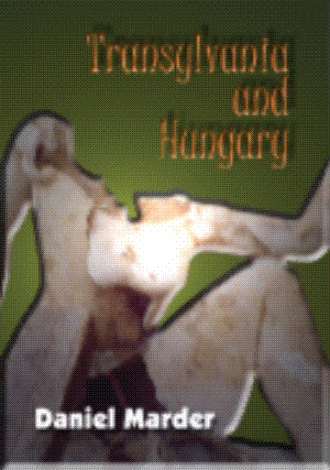
"Transylvania will kindle your fire." This from a young
assistant to his retired senior. On an
extended mountain walk, I had confessed my weariness with scholarship. Thirty
years of it! My young English colleague
was confident my creative juices could still be excited. In Egar, Matt and I were guests of his young
lady and her family Kauty was the third fiancée the Englishman had managed in
six years as a vagabond instructor in Hungary.
He had also reached the last stage of his doctorate on the design of
three Gothic churches in Transylvania.
This static pursuit belied his vitality.
Matt exuded innocent wonder and curiosity instead of the reserve
expected of a transplanted Englishman. He
listened well; Hungarians were affected by his sincere interest, his empathy,
and genuine sense of caring. Often he
was taken for Magyar, having mastered the language, acquired the culture, and
studied the history. He no longer
counted expenses in quid but in forints.
Every year he bicycled home across Hungary, Austria, Germany and
France, the last time with Kauty. And
everywhere, Hungarians were charmed with his knowledge and preference for their
native ways, in spite of his unshaven face, unkempt hair, and blunt opinions.
The baroque city of Eger should have stirred my creative juices
but instead only dilated my pedantic veins.
I stood on the restored fortifications where the town women
repulsed the Turks in 1552 by dowsing their heads with boiling water as they
climbed the walls; I duly recorded as historical mementoes the minaret marking
the Turks farthest thrust north and the Romanesque remnants in the rebuilt
Cathedral. Perhaps Eger"s famed
Bulls' Blood wine could have stimulated the appropriate energy, but suffering
late onset diabetes, I refrained.
I was in Hungary to teach at L. Klossuth University in Debrecen on
the Alfold, the great eastern plain.
Stimulation was everywhere. A visiting professor from Oklahoma, I still
hadn't seen the Hortobàgy, most romantic puszta (prairie), where Hungary's
lassoing cowboys roam.
So why Transylvania? Why
another country before I explored this one.
I suspected my young friend, also visiting faculty, simply wanted
companionship as he pursued his own agenda in the medieval churches. It was a fabled land. I was curious.
In Debrecen, Reka Ruark
gave us messages for her publisher friends in Koloszvar, Miklós and Irina. Reka was a Hungarian English professor
married to an American Fulbrighter.
"Koloszvar is Cluj to the Romanians." She considered it the cultural capital of
Erdèly. "That's the Szèkely name
for Transylvania. If you use it in
public, you could be arrested."
"And Szèkely?"
"The purest Hungarians." She was effusive. "Romania's Magyar minority, most noble,
most innocent, unspoiled by the excesses of western civilization." Szèkelys arrived from somewhere in the East
with Arpàd in 896 and stayed when the Magyar Chieftain led his tribes to the
Alfold plain and Pannonia to establish the Hungarian nation. Reka claimed that when King Stephan returned
to Transylvania, the Szèkelys had already settled the (empty land,' and
received their king with open arms.
They fought with him in 1003, when he slew Guyla the Vlach, the original
Romanian according to Reka, actually Wallachian. But according to most histories, Romanians were originally
Dacians who inhabited the forests when the Romans arrived.
For one brief year, 1600, the Vlatch king, Michael the Brave,
campaigning for the Orthodox Church against the Protestants, united Wallacia,
Moldavia, and Transylvania into a single state, prefiguring modern
Romania. But the Hapsburg Emperor,
Rudolph II, could not tolerate such independence. Michael was doomed to be murdered. This occurred the following year by order of the Emperor's
commissioner, General Gorgio Basta. A
fury of Jesuit proselytizing followed, accompanied by severe prosecution of
Vlach, an earlier ethnic cleansing. The
pieces were not put together again for three and a half centuries, when the
Treaty of Triano created the country of Romania in 1920.
Formats

Book Details
About the Book
Two visiting professors in Hungary, one young and English, the other retired and American, tour Transylvania, but theirs is no standard journey to this mystical and fabled province of Romania. Matt, the young Englishman has been there several times. In the various towns, some Saxon, some Hungarian, they stay with Szèkley friends (people descended from the early Magyars who came in 896).
They encounter evidence and opinion supporting the Hungarian belief that Romanians abuse their minorities, especially Hungarians. The abuse is considered retaliation for the centuries under Austrian-Hungarian dominion when the local Hungarians barely tolerated them. They learn of secret police, still in place after Dictator Ceausescu’s execution four years before. Szèkelys are currently upset about police murders and rapes which are officially denied or overlooked on grounds of provocation. All Szèkelys acknowledge discrimination but some see these outrages as the usual police brutality practiced everywhere. Discrimination might disappear if they accepted their roles as Romanians, the way Hungarians do in America.
These attitudes emerge through many conversations, with Szèkely families, with a young zealot priest who is a Hungarian nationalist, with a Calvinist minister who is a guru to the Szèkelys, and with others. Romania's surging nationalism is matched, we become aware, with that in Hungary itself. Some Szèkelys, like the young priest, hope that Hungary will invade Romania and liberate them. Parallels with the situation in the former Yugoslavia are apparent.
A climactic moment occurs for the older professor when they visit a Szèkely teacher whose liveliness contrasts with the usual desolute mood of the country. Strolling along a river rich in mystery and fable, their discussions roam all over Romanian history and lead him to see the illusory nature of things which result in horrific consequences.
The teacher’s “granny” is a unique lOO-year old who allows a glimpse into her past--two years in a security prison because she would not reveal information (she did not have) about her former student, the Calvinist minister. He was imprisoned for lack of.respect to the monomaniac dictator, Nikolai Ceausescu.
Encounters with Romanian youth, Yuppies and thugs, who believe the propaganda that they are descended from Romans, pepper the text. So do the Saxons who arrived in Transylvania soon after the Magyars, and the gypsies, calloused by mistreatment, who maintain their customs while eking out their own clandestine existence.
Near the end our two travelers stay with a family in an old Saxon town, Sighisoara, where Vlad Dracul was born. After amusing speculations about the Dracula myths, they turn to myths at hand. The family are dominant members of the embryo democratic and feminist movements. We see how it is possible to ingrain mechanisms of democracy but not its spirit in a country that remains mired in habitual authoritarian patterns.
Elements of the travelogue are scattered throughout, including a visit to a Romanian orphanage.