
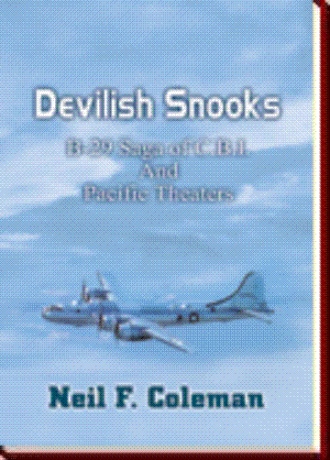
Devilish Snooks
B-29 Saga of C.B.I. And Pacific Theaters
by
Book Cover & Preview Text
The powerful Wright engines accelerated slowly as
the pilot gently pushed the four throttles forward propelling the Air Transport
Command C-54 down Miami Municipal Airport’s long concrete runway. Excitement and tension gripped the
thirty-two passengers as the huge aircraft became airborne.
It was 8:30 p.m. on March 15, 1944.
Those passengers seated by the small windows were
able to see numerous automobile headlights probing the criss-crossing streets
below clearly outlined in the twilight engulfed city by a multitude of
streetlights and glittering and flashing neon signs. The metropolis slid slowly behind and then disappeared as the
aircraft banked sharply to the right, picked up its outbound course to the
southeast and entered a thin layer of clouds.
The passengers adjusted their seat belts and moved
their reclining seats to a more comfortable position. Each bid a silent goodbye to Uncle Sam, fully aware that it could
be a long time before they returned, perhaps never. Regardless of what the future might hold, the nine members of the
first B-29 Superfortress combat crew to go overseas were very excited.
The inception of the B-29 Superfortress occurred on
November 10, 1939 when the government authorized the Boeing Airplane Company to
begin manufacturing the plane on May 17, 1941.
Production of the new aircraft was delayed several months due to the
crash that killed Eddie Allen, Boeing’s chief test pilot, and twenty eight
others on February 18, 1943. After
several design changes, the first production model rolled off the assembly line
in July.
The first B-29 organization, the 58th
Bombardment Wing, VH, (Very Heavy), with Brigadier General Kenneth B. Wolfe in
command, was activated at Marietta, Georgia on June 1, 1943. On November 17 of that year the unit was
officially transferred to Smokey Hill Army AirField near Salina, Kansas.
The 58th Wing comprised four Bombardment
Groups, all assigned to air bases in Kansas.
The 73rd, with Colonel Chapman in command, was also stationed
at Salina. The 444th, located
at Great Bend AAF, was commanded by Colonel Harvey while Colonel Richie was the
commander of the 462nd at Walker AAF. Colonel Lewis R. Parker commanded the 40th Bomb Group
assigned to Pratt AAF.
Formats

Book Details
About the Book
Devilish Snooks is a saga of a World War II B-29
combat crew stationed in the CBI and Pacific Theaters.
After completing basic training, and two or more
technical schools the men were placed on a flight crew for combat training.
The crew was flown to India, encountered extreme
heat, heavy rain and dangerous insects plus inadequate food. The crew flew long, dangerous missions
against Japanese targets.
The 40 Bomb Group was re-assigned to Tinian Island
in the Pacific and struck targets in Japan.
The crew completed their required missions in July and sent home.
About the Author
Mr. Coleman is a veteran of 22 years in the U.S. Air
Force as a B-29 Central Fire Control Gunner and Air Operations Supervisor. He served the United States in the China,
Burma, India and Pacific Theaters in World War II earning several decorations
including the Distinguished Flying Cross and three Air Medals. He also served during the Korean and Vietnam
conflicts.
His spy novel ‘Honeycomb’ was recently published.