
In Search of Sublet
A Story of Wyoming
by
Book Cover & Preview Text
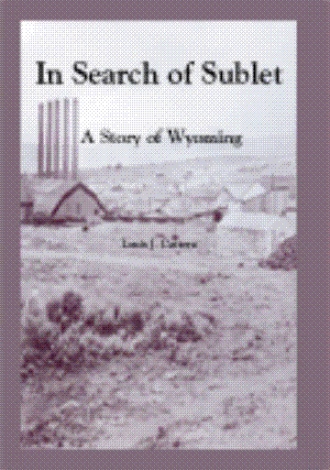
The ruins lay to the north of Kemmerer on the slopes of Oyster Ridge. We took Hwy 189 north to where it makes a nearly 100 degree turn to the east and through what I shall call the Oyster Ridge road cut. At the foot of the eastern slope lay a nondescript road - actually more of a trail - leading north and rising 500 feet or more to the top of the ridge which reached an elevation of over 7600 feet above sea level. We could tell that the trail had been used to some extent, but it still required careful navigation to reach the top; the surface was washed out in areas and there was nothing left but the rock base. The trail rose steadily until reaching the crest of the ridge then continued on a meandering track northward. The wind was blowing hard as we neared the top. We stopped to get our bearings as we weren’t certain in which direction the ruins lay. Searching with binoculars, we soon discovered the remnants of a stone structure to the northwest; it was here that the ground began to fall steeply away from the crest of the ridge to where lay the dry bed of Willow Creek. Once we sited this stone structure all else fell into place. Soon we located other foundations strewn about the slopes--at long last we had reached Sublet!. Distance is very deceiving in the hills. What appears to be a few hundred yards can actually be miles when traversing the terrain on foot. With the thin air at the elevation of 7500 feet plus the fact that we had been sitting too long behind a desk, we soon discovered that the hiking was going to be a bit more strenuous than we had anticipated. The slopes below were strewn with the stones of old foundations, coal slag, remnants of empty rusted powder kegs, rusted and twisted pieces of metal, rotting rail ties, pieces of power house equipment, pipe sections, and boiler parts, as well as the battered and bullet ridden skeleton of a rusted body of a Ford Model "T" auto. Yet, amid all this detritus of time lay a collection of the most beautiful and fragile of wildflowers--the sun and constant wind of the high plains did nothing to disturb their silent beauty. For a time we wandered about on the upper reaches of the slope, going from one outcrop of foundations to another; from rubble heap to rubble heap picking up remnants of the past; an old ice skate runner, the type which could be attached to shoes; an old hob-nailed boot, so small that it looked as though a young boy would have worn it; fragments of a cast off carbide lamp; segments of rusted powder casks; rail road spikes; a piece of an old pocket watch. This is what remained after years of scavenging by the residents of the nearby towns, and wanderers; we were not the first souls here, nor would be the last; there would always be one last item of sentimental value to pick up by yet another visitor.
Formats


Book Details
About the Book
In Search of Sublet: A Story of Wyoming
About the Author
Louis J. Cattera
He holds an AAS in Surveying Technology from Macomb Community College, Warren, Michigan, a BET (Civil) from Wayne State University, Detroit, and an MSA from Central Michigan University.
He has worked 40 years in the construction industry as a surveyor, field engineer, project engineer and document control manager, as well as having held positions in related architectural and manufacturing fields.
In 1998 he retired to Homosassa, Florida where he now lives with his wife Vina.