
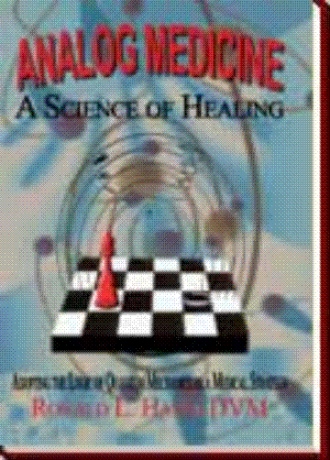
Analog Medicine - A Science of Healing
Adopting the Logic of Quantum Mechanics as a Medical Strategy
by
Book Cover & Preview Text
SCIENCE or ART
Once upon a long time ago, in a Stone Age culture far away, two tribes came together for a hunt. In camp that night, celebrating their success, a young man named Sci witnessed a truly magical event that would ultimately change his life and mankind forever. One of the members of the other tribe was a fire maker. He was a gnarly old man with no teeth. He worn a strange hat and his body was covered in mystical tattoos. The rest of his clan beat on a drum and chanted while the old man rubbed two sticks together. After a short time, smoke began to rise from one of the sticks. He laid the smoking stick in a bed of pine needles and gently blew fire into it. All in all, this was a very impressive display and also a very complex ritual.
Later, back at home camp, Sci and his friends tried to copy to the best of their collective recollection what the fire maker had done. They tried several times to no avail. They had not yet developed logic, so the only tactics available to them were memory, imitation and trial and error. They were faced with the formidable task of reproducing the complete scenario that they had observed. Every failure could be attributed to an almost infinite number of possible oversights. Maybe they did not get the tattoos or the chant right. What direction was he facing when he blew fire into the pine needles? He probably has a fire God. Did anyone notice what kind of wood he used? Some suggested that they steal the magic drum. After numerous failures, they lost interest and decided it was hopeless.
Their confusion made many in the tribe feel vulnerable and threatened by this magic. The fire maker was obviously a powerful demon or witch and they suggested that he should be eliminated for the safety of the tribe.
Then, one day, word came to them of a different fire maker in another tribe close by. They decided to go and see if they could figure out what they were doing wrong. But to their dismay, this fire maker was completely different. He did not even know about the other fire maker and he said that he learned to make fire from a vision. If Sci and his friends wanted to watch, they would have to pay him. He was a young man with teeth, no tattoos and he wore a feathered headdress. To begin with, he prayed to a fire God and made an offering to the four directions. Next he struck two rocks together while his helper played a flute. He then carefully and slowly blew fire into some dry moss.
They had witnessed two different fire makers using two entirely different rituals. Now, our young man was completely confused and overwhelmed. Mastery of a complex task such as fire making without logic becomes an individualized accomplishment, and some will just have a knack for it. The fire maker is an artist, and he is personally valued by his society for his unique abilities. After all, no fire maker means no fire.
The act of fire building will seldom be advanced by the artistic approach because there is simply no incentive for the master to simplify and economize the ritual that he identifies with. He has a vested interest in maintaining the status quo by keeping it complex and magical. After all, if everyone in society could make fire, he would lose his leverage and status. However, he will give you some magic rocks and teach you the ritual-for a price.
Then one chilly morning, Sci awoke, stretched, and rubbed his hands together to warm them up. He took notice that the faster he rubbed, the warmer they get. He also knew that heat is associated with fire. A pattern began to take shape in his mind, and he had an idea. Logic was born. Maybe rubbing sticks together really fast makes fire!
With this new way of thinking about fire making, he could reduce the complexity of the situation to one factor: friction. He could now concentrate all his attention and efforts on manipulating the sticks. His subsequent success in producing fire proved that the logical approach was, in fact, an effective way to solve problems.
Sitting by the fire one night, our new fire maker discussed his great achievement. He said that he now "understood" fire making, and he communicated the idea to the others in his group. Within a very short time, almost everyone in his tribe learned the technology of fire building. Not only had they learned a valuable skill, they had acquired a new and far more effective way of dealing with life and solving problems.
Logic simplifies reality by focusing our attention on only one of the many possible series of simultaneous events or patterns going on: 1,2,3; A,B,C; Red, Orange, Yellow, Green, Blue; Friction ⇒ Heat ⇒ Fire.
Logic is an abstract idea, and the transfer of ideas between individuals is called communication. It is the idea, pattern or logic that is stored in the brain as memory, and when we perceive this same series of events in reality again, an association is made with that idea, and we say that we "understand." The logic gives a sense of meaning to the events that we observe. Understanding means that we are able to accurately predict and prepare for the future, and this ultimately leads to a feeling of control and a sense of security. We all like that.
Rituals are the reproduction of an activity without any logical basis or understanding. Rituals are enduring because there is no basis for changing their sequence. They are performed and copied, but not communicated because they have no abstract idea or meaning to be transferred. They are complicated by the lack of focus and, therefore only a few individuals in a society will have the time or ability to master them completely. Logic transforms ritual into technology. Technology is simple and economical by comparison, so many more people will be able to exploit it successfully.
Technology is the backbone and definition of culture and the basis of its evolution. We define, evaluate, and name cultures for their technological developments: "Hunter-gathers," "the Stone-age," "the Bronze-age," "the Industrial-age," and "the Information-age" are labels we have used to describe different cultures. An advanced civilization has well developed technologies that economize on man’s efforts in regard to his physical survival. Spiritual focus and development occurs only when the immediate concerns for physical survival can be temporarily set aside.
This all seems to be pretty straightforward until we realize that there is an inherit limit to the logical process. Our young Stone Age hero enjoyed a great deal of prestige as a wise sage and respected teacher. He had, after all, developed the technology of fire building, and society would always be grateful for this gift, but he soon found that people expected him to solve other problems for them with this new way of thinking. Buoyed up by his past success, he told everyone that they could also make fire by rubbing two rocks together. Just imagine his embarrassment. He had now inadvertently discovered that his logic only applied in specific cases. To explain and understand the second fire builder’s technique, Sci would have to come up with another idea or logic.
The logical investigation and manipulation of reality that Sci developed eventually became known as "science." Motivated by the sting of embarrassment and a grant from the newly formed science foundation, our Stone-age hero analyzed the second fire builder’s ritual. Sci conducted several experiments over the years and came eventually to the conclusion that some types of rock contained fire. He found that by striking them s
Formats

Book Details
About the Book
Analog Medicine is a book that demystifies the healing process. I wrote it for my friends and colleagues who are struggling to become better healers. Healing and health represent a complex puzzle with multiple interlocking pieces. To solve that puzzle and see the whole picture, we have to successfully fit all the pieces together. We must study the complicated details of the individual parts while always keeping in mind how they relate to that big picture. Educated individuals typically err in this effort by concentrating far too much time and attention on the details of each individual part. The board certified surgeon and master acupuncturist are experts focused exclusively on different integral, yet isolated, parts of the total reality. To become healers, these technical experts must broaden their view of reality to encompass the whole. A review of the latest developments in other scientific fields such as physics, neurophysiology , linguistics and logic will help in this regard.
Healing is a comprehensive process that spans all the dimensions of reality .It is, on a higher level, a quantum energy phenomenon that can not be accurately explained, described, or effectively manipulated using the limited format of Newtonian physics. Science now accepts an expanded, more energetic, view of reality. This new paradigm is expressed in the tenets of Quantum Mechanics. That logical format is the key to becoming a better and more effective healer.
Analog Medicine outlines exactly how this can be done. It suggests a simple, logical, and scientific approach to healing yourself and others. This book is also about how we can integrate conventional medicine, alternative medicine, and spirituality into one comprehensive "Holistic" health care system. That system would be simpler, more effective, more humane, and much less expensive than the one in place today.
About the Author
I am a 1969 graduate of the College of Veterinary Medicine, Iowa State University, in Ames, Iowa. There I worked as a professional medical illustrator and instructor in the anatomy department under Doctor Robert Getty. I moved west to facilitate my past time of horse and mule packing.
For the next thirty years, I practiced conventional veterinary medicine in Utah and Idaho. The emphasis of my practice in the last twenty of those years has been contract dairy herd health work. Herd health programs are more comprehensive and holistic by nature than ambulatory work. Concerns about drug residues ultimately lead me to investigate and use other alternative medical approaches. In 1992, I became a certified veterinary acupuncturist under the tutelage of the father of American Veterinary Acupuncture, Doctor Grady Young. Doctor Young also introduced me to the modality called Radionics. Neither proved to be the silver bullet I was hoping for, and that eventually led me to investigate several other alternative modalities. I found each of the modalities I studied to be effective, but they were impossible to integrate.
Subsequent studies of theoretical physics, logic, and neurophysiology provided a true epiphany and solution. I discovered that all the health care modalities I had studied could be logically integrated into one comprehensive, effective, and simple holistic format.
This simple and basic logical approach has proved to be spectacularly successful in dealing with difficult medical conditions like allergies and cancer. It also led to the discovery of the unique treatment protocol I call "Sound Therapy".