
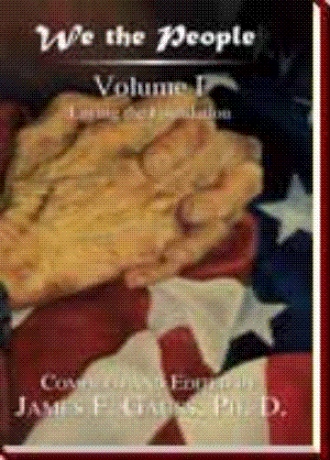
We the People
Volume I : Laying the Foundation
by
Book Cover & Preview Text
Historical Context. Shortly after his arrival and first visit to West New Jersey in the New World, William Penn was quick to establish a friendly rapport with the native Indian groups along the Delaware River. While it was a routine practice among early colonists to steal Indian land and treat them like "savages", Penn sought them out as equals, treated them fairly, made it a point to learn their different dialects, traveled among them unarmed or without an escort and established the first lasting treaty with the Susquehannocks, Shawnees and Lenni-Lenape---a treaty that was ratified without the benefit of an oath and was never broken for 70 years. Penn recognized that in order to actually possess the land inheritance of Pennsylvania granted to him by the King, he would have to gain the trust of the current resident tribes and chiefs of the area and negotiate a fair and just price for their land. He was viewed among tribal leaders as a fair, just and peaceful European. As a result, during the many Indian reprisals in defense of their land from unfair land grabs by non-Quakers, Quaker homesteads and farms were always spared by the local tribes.
In May, 1682 and February, 1683, Penn formulated his Frame of Government for Pennsylvania, a foundation of representative government that would become a vital example to the Founding Fathers a few decades later. Penn’s vision of a fair and just government elected by and for the fair governance of the people was unique. He also established the rule by which laws could be made and administered and the limitations of governmental interference in the lives of the people. He further guaran- teed the freedom of religious expression and worship to all inhabitants, whether they were of a Quaker persuasion or not.
In addition to religious and political freedom, his constitutional Frame of Government provided for unlimited free enterprise, a free press, the establishment of private property rights, a fair jury trial, and a provision for peaceful governmental change through lawful amendments to the constitution.
He returned to England in 1684, where in 1686, his great influence with King James II resulted in the King’s proclamation for releasing all those held in prison for their religious beliefs. Penn did not return to American soil again until 1699.
At the end of 1701 he sailed once again to England, only to arrive and find that his personal financial advisor and steward of his estate, Philip Ford, a fellow Quaker, had stolen a substantial amount from his estate, essentially bankrupting Penn. In 1702, Ford’s widow had Penn thrown into debtor’s prison. Although Penn had errantlly and unknowingly signed over his deed to Pennsylvania to Ford, in 1708 the Lord Chancellor in England returned the land ownership to Penn and his heirs.
In America, although Penn received "rent" for the land he leased out to others, he never made enough to cover his expenses and frequently funded his novel concept of colonization in the New World out of his own pocket.
William Penn has been called the "first great hero of American liberty." He was responsible for establishing the first real sanctuary in the New World which provided protection for those seeking freedom of religion and freedom of conscience. Unlike the Puritans of New England that tolerated no deviations from their beliefs, Penn welcomed diversity in Christian thought and faith. He was, perhaps, the first to advocate equal rights for women and Native Americans---a free-thinking concept of justice that was alien to both the New and Old World at the time.
His revolutionary ideas of freedom and government eventually found there way into the U.S. Constitution after the American Revolu- tionary War.
Despite his advanced thinking on personal liberty and justice, Penn had one glaring shortcoming---at least from the post-civil rights era of the twentieth century---he owned a few slaves in America, as did other Quakers. Although he treated them fairly and with kindness, it is not clear how he and other Quakers of the period justified this disparity in their liberal religious thinking and practice. However, by 1758, 40 years after Penn’s death, Quakers in America adopted an anti-slavery position, way before it was a popular position to hold.
Formats

Book Details
About the Book
Tired of American history that has been revised to be politically correct, or reinterpreted to conform to present-day political or philosophical thinking? Weary of reading someone else's rendition of history when all you want to know is what those who made the history really thought and why they acted as they did? The three volumes of We the People (Laying the Foundation, Birth of a Nation and Growing Pains of a Nation) are a must-have set of unadulterated American history resources for every family library. Each volume is full of historical documents, from the Mayflower Compact to the Declaration of Independence to Dr. Martin Luther King, Jr.' s I Have A Dream speech, along with a myriad of others. Each document is presented in its entirety with only a brief introduction to set the historical context and define its history makers. Volume I covers from pre-colonial America to the start of the American Revolution. Volume II takes you through the Revolutionary War to the Civil War. Volume III brings you up to the current era of political, spiritual and philosophical challenges. Don't just read about history, read what the history-makers thought and wrote. Highly endorsed by national figures as a must read for every American.
About the Author
James F. Gauss grew up near historic Morristown, New Jersey. He earned his Bachelor of Science "With Distinction" from the University of Delaware and his Doctorate from Rutgers University. A student of American history, nostalgia and the Bible, he is a prolific writer and frequent speaker on various general interest and biblical topics. His research and writing is meticulous and detailed but reader friendly. He is an organized and engaging orator whose message is challenging and easy to understand. Other books by Gauss include: A Champion's Heart, Christians Confronting Crisis and Volumes II and III of We the People. He has several additional book manuscripts in stages of development.