
Out of Egypt
A Boyhood in Small Town America Before and During World War II
by
Book Cover & Preview Text
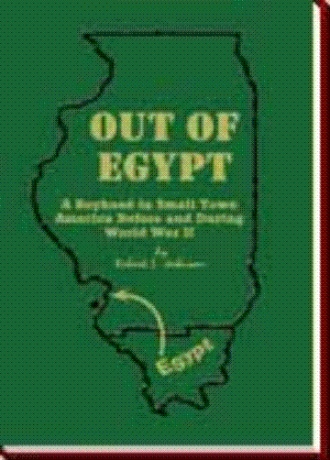
American traditional values have been a hot topic in national discourse, and although I wasn’t trying to be topical when I wrote this book, I can see in retrospect that the traditional family is what this book is all about. The family of the thirties and forties looks eminently traditional from the cultural milieu of America in the nineties. At least from where I sit.
My intention in writing the book was simply to paint a picture, as best I could, of how it was to grow up in small town America in what would today be called an age of innocence. It was to give my children a glimpse of the World War II era that is gone forever, except in the mind’s eye of a boy who lived through it.
I recently told a friend of mine I was writing a book about my childhood. "Your childhood," he exclaimed with some consternation, "You must have had a good childhood!" I did.
And I guess I had taken it for granted that everyone of my generation shared my experiences. Not necessarily true. A good and happy childhood seems to be even more of a rarity in this modern day when most of us have every material advantage, but where substantially more than half of our children are either from homes broken by divorce, or from single parent homes where the mother never married in the first place. Many of those children will never know the security and warmth of having loving and caring parents as I and everyone I knew in my childhood had.
My children have grown up in a world totally unlike the one that I grew up in, and although I know this can be said of every generation, I think it is especially true in contrasting the America of the early l930’s with turn-of-the-century American life.
I have lived through World War II, the greatest war in the history of mankind, the development of atomic weapons, the "Cold War," the Korean War, the War in Vietnam, and various and sundry smaller conflicts. It is very largely as a result of those wars that social and technological change has accelerated at a phenomenal rate.
Let’s face it, in this country a secure and nurturing childhood has become the exception, rather than the rule. We live in an age of working mothers, day care centers, "latch key" children, and "home alone" children. Many of those children are cast off and abandoned. Legalized abortion has meant that one million, six hundred thousand children a year have been "terminated," with no childhood at all.
Most pathetically and least understandably, we have countless cases of child abuse each year in our modern "civilized" society of the latter twentieth century. Many of these child victims are beaten to death by those who should love them. As we enter the millennium, I believe we are witnessing the "decline of Rome," but it gives me no joy to say it.
How the world has changed since the thirties. For one thing, it has gotten more crowded. World population and the population of the United States have doubled in spite of the use of birth control, wars, pogroms, famine, disease, abortion, and other methods of population control, both natural and unnatural. Humane people deplore any unnatural or unnecessary loss of life, yet the world’s population is outrunning the available food supply.
As the family unit has disintegrated and the use of narcotics has proliferated, the crime rate has skyrocketed and the judicial system has become increasingly ineffectual. Crime, race, and public safety are at the forefront of our daily concerns. We are afraid for ourselves, and we are more afraid for our children.
We have begun to question whether a democratic government can adequately control our social problems. Faith in our elected government is at the core of our American tradition. If we lose that, our society will continue to unravel.
When I grew up, Americans believed there was a natural progression of learning and knowledge from generation to generation, which drew us up from our savage and barbaric past to our more civilized and ennobled present. We believed that in America we were at the pinnacle of an enlightened civilization.
Even though we were the descendants of outcasts from every nation on earth, this land gave us an opportunity to start afresh, liberated from the "decadence" of the rest of the world. We truly felt for a time that we were God’s chosen people, living the dream. I hope we haven’t totally lost faith in the dream. Hence the book.
Because World War II had such an impact on my generation, I have taken the liberty of outlining the progression of the war from 1941 through 1945 at the beginning of the appropriate chapters. I did this to show the impact of world events and the war effort on my family, our community and region.
The war was never far from our thoughts. For my gerneration it was the defining event of the 20th Century. For us it remains the great reference point for our life’s story. Events in life are either dated before or after the war, and we are reminded that a good many things happened during it, as well. Information concerning the conflict was gleaned from general reference works. Teaching American History for thirty years was probably of some help, too.
I hope you enjoy this bird’s eye view of the joys and foibles of my childhood years. I am firmly convenienced that our youthful experiences determine what kind of person we will become. After reading this, you’ll know how I became who I am.
Formats


Book Details
About the Book
Egypt is what locals call the scenic Ozark foothills of Southern Illinois. Out of Egypt captures the experiences of a young boy who grew up in small town and rural America during the 1930’s and 40’s. The author grew up in Carbondale, Illinois, but spent much of his time on the farms of his uncles west of Murphysboro.
The story is told from a small boy’s point of view with puckish good humor. The events of his youth are cast against the changes in American life being wrought by the Great Depression and World War II. Those changes had a profound impact on the boy’s family, hometown, and the surrounding area. Out of Egypt is a pithy slice of small town Americana during the pre-war and World War II years.
The book is about facing up to the many challenges of boyhood and trying to gain wisdom in the process.
About the Author
Robert Johnson was born and raised in Carbondale, Illinois in the heart of "Egypt," the scenic southernmost part of the state.
After high school he joined the Navy for destroyer service during the Korean War. After Korean theatre operations he participated in Destroyer Squadron 20’s World Cruise, and NATO’S Operation Mariner in the North Atlantic.
Following the Navy, he returned to Carbondale and completed a Masters degree in history and political science at Southern Illinois University. In 1958 he left Southern Illinois to teach history for 30 years at high schools in Granite City, Illinois, near St. Louis, Missouri.
After retirement he has written Out of Egypt and another book about his naval service, Fletcher Destroyer Bluejacket.