
Gramatica Apasionada
Reminiscences of a Love Affair with the Spanish Language
by
Book Cover & Preview Text
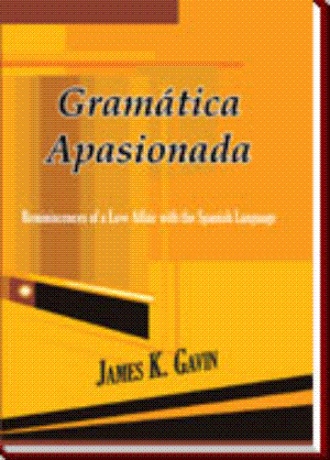
A funny thing happened to the Latin verb esse (to be) on its way to becoming the Spanish verb ser. It got mugged by its fellow Latin verb sedere (to sit).
The results of this 'verbal assault' are still being felt across the millennia. These consequences have particularly complicated life for twentieth century speakers of English who wish to learn Spanish. Even if one has only a sketchy knowledge of Ancient History it is obvious that blame for the resulting linguistic difficulties must be placed in the blood-stained hands of Brutus. For without the authoritative leadership of Julius Caesar your everyday Roman-in-the-street began getting sloppy about his personal speech habits. The beautifully crafted and rational Latin of classical times started becoming rather – how else can I say it? – vulgar.
In this specific case here's what happened. Instead of using esse, people began to use the verb sedere to locate things They might have said, for example, "the goblet sits on the table," instead of saying, "the goblet is on the table." This is a seemingly innocuous substitution. But centuries later it would still be causing confusion and consternation across the breadth of a distant continent, from Connecticut to California.
As this usage became commonplace it precipitated a more general breakdown of the boundaries between the two verbs. Perhaps one might then have said for example, "the centurion sits ill," instead of, "the centurion is ill." In any case, esse and sedere were getting their wires seriously crossed. This encroachment upon its territory should have alarmed esse but it was in the middle of multiple identity crises (on its way to becoming ser, essere in Italian, etc.) and paid no attention. Sedere, meanwhile, which was by nature quite sedentary, got a lot of unaccustomed exercise during its raids on esse's territory and slimmed down to estar.
This process went on for many years. The result was that eventually Spanish (though not its French cousin) ended up with two verbs meaning 'to be.' This has proven to be a most vexatious problem for students of Spanish as a second language. So, listen up, Mr. Shakespeare, "to be or not to be" is not the question. To be (ser) or to be (estar), that is the question!
These two verbs (ser and estar) that translate 'to be' are not interchangeable, nor is their use haphazard. They serve distinct purposes. English speakers may initially be confused by this, but turn the case around and look at it from the other side. The Spanish verb esperar translates 'to wait,' 'to hope,' and 'to expect.' When the English-speaking student of Spanish learns this he or she frequently responds, "But those are such different things, how can they be lumped together into one verb?" And because English has created three separate compartments, i.e. verbs, we do see them as distinct activities. But give this a little thought. These are three very inter-related activities. Hoping and expecting both involve waiting, the difference being in the mental outlook of the 'waiter.' Spanish ignores this distinction and calls both kinds of waiting 'waiting.'
Likewise, when the Spanish-speaker who wants to learn English discovers that we have only one verb for ser and estar he might just as fairly ask, "But there are so many different kinds of being, how can you lump them all together into one verb?"
What Will Be 'Be' Will Be 'Be'
In order to get a sense of the different kinds of being expressed by ser and estar it might be helpful to list the nouns that share their root or stem with ser and some of the nouns that have a common root with estar.
There are only two common nouns in Spanish that come from the same root as ser. One is esencia or 'essence' – this is more obvious when you remember that ser comes from the Latin esse – and the other is ser itself. When used as a noun ser means 'being,' as in ser humano, 'human being.' So the verb ser relates to essence and being or existence.
There are a number of nouns related to estar. Here are four: estado, estación, estancia, and bienestar.
Estado means 'state.' It can be either a geographical state like el Estado de Nuevo México or un estado emocional o físico, 'an emotional or physical state or condition.' Estación is 'station' (among other things) as in train station, a place to get the train. Estancia means 'stay,' as in 'being there,' e.g. we had a pleasant stay in Madrid. (In the Americas an estancia may also be a cattle ranch). Bienestar is 'welfare' which refers to one's condition. The verb estar has to do with place or location and condition.
Many students who have come to me with a limited exposure to Spanish, perhaps a year or two in high school or college, have arrived at my door with the firmly imbedded belief that ser is for permanent things and estar is for the temporary. So let's deal with that misconception right now.
First, as a rule of thumb for making necessarily quick choices when you are out on the street actually speaking Spanish, this permanent/temporary guideline will make you right far more often than wrong. But it totally misses the point of ser and estar. Ser and estar are about two kinds of being, essence and condition. The essence of something may be temporary and a condition can be quite permanent.
Question: how do say, "He is young," in Spanish? Perhaps you, dear reader, know, as I do, that youth is a fleeting thing. It is temporary. So do we use estar? No. Age is one of the most essential characteristics of a person. El es joven. Age, the difference between being five, fifteen, and fifty years old, defines the essence of a person as much as being male or female, kind or cruel.
Formats

Book Details
About the Book
The person learning to speak Spanish is running an obstacle course. The same errors, problems and linguistic traps are laid out before every student at predictable stages of the learning process. Young or old, linguistically adept or steady plodder, every student of Spanish must get over a series of obstacles that are set out in path almost as precisely as the barriers in the 800 meter high hurdles foot race. This book intends to help clear those hurdles.
The nuts and bolts of Spanish grammar have been dealt with quite well in any number of books. There is no need for another presentation of all this basic material. The emphasis of this book is on helping the student to get past the big barriers that block his way. It contains eighteen essays that deal with everything from attitude and the accent mark to the subjunctive and verb phobia.
The purpose of this book is to help you to learn to speak Spanish by correlating the practical knowledge acquired by one who learned Spanish on the streets of South and Central America with those elements of grammar that he found most useful as he struggled toward linguistic proficiency. The intent of this book is to combine our innate linguistic common sense and academic Spanish, the latter as handmaiden to the former.
About the Author
James Gavin started learning Spanish as a Peace Corps volunteer in Venezuela. Since then, pursuing parallel careers as an artist and Spanish-speaker-for-hire (teacher, translator, interpreter, language evaluator and advisor) he has lived in Puerto Rico, Nueva York, and Costa Rica. He has also worked and traveled extensively in Spain, Mexico, Honduras, Panama and the Dominican Republic. He now lives, happily surrounded by Spanish-speakers, in northern New Mexico.
The linguistic insights accumulated during his forty years of diverse experiences as a learner, speaker and teacher of Spanish are gathered together in Gramatica Apasionada. This is a philosophical grammar book, a grammar con alma.