
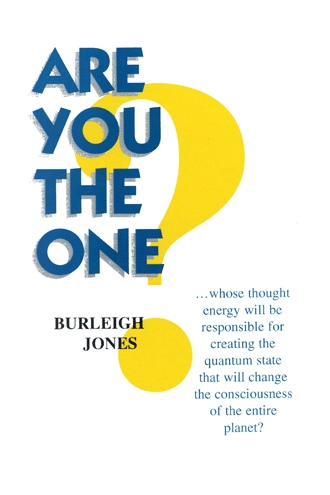
Are You the One?
. . . whose thought energy will be responsible for creating the quantum state that will change the consciousness of the entire planet?
by
Book Cover & Preview Text
PROLOGUE
At the forefront in our legacy of history is the idea of a creator. This creator has been defined by numerous names, with as many differences in connotation, depending on where and when in civilization the idea originated.
Not until scientific investigation into the heart of the atom, in the early twentieth century, was there a scientific alternative to the concept of the mystery of God.
The scientific discoveries that the ideas of energy is and consciousness could be used by science to establish a foundation for the definition of an intelligent life force within nature, did not suggest that the mystery of God become obsolete. Instead, it opened up new and credible dimensions of thought for contemplation of the omnipresence, omnipotence, and omniscience of the mystery of life. These discoveries by science did another thing too, they provided a premise through which science, philosophy, and theology are developing a common ground relative to a synergism of belief about the mystery of life.
Early atomic explorers discovered consciousness at the core of the atom. Quantum mechanics reveals that most of the behavioral aspects of things within the atom offer stupendous information for substantiating many of the observations and subsequent conclusions already reached in science, theology and philosophy about consciousness and thought.
Until discovery of the behavior of energy forces within the atom, our scientific, philosophical, and theological investigation of cosmology had been limited to the study of the microscopic and macroscopic forms.
Quantum physics opened a new window through which the invisible life forces of nature in the atom could be investigated, and understood in the light of cause and effect relationships to the microscopic and macroscopic forms. This new knowledge about the energy forces of nature, affects our concepts of reality in just about every way possible; especially those relating to our perception of a creator and sustainer of the Universe, and all the forms within it.
Without special education, training, and access to the elaborate test equipment of the physicist we cannot knowingly experience the submicroscopic world of the atom. It is not a practical world for us; consequently, we cannot directly relate to it as we can to the macroscopic world of outer things that are familiar in our environment. To the average person the submicroscopic aspects of nature are remote, esoteric, and unrelated to the way we live our lives in the visible world; yet the energy forces within the invisible submicroscopic are the creator and sustainer of the visible.
Only through inferential knowledge will the majority of us ever know anything about the theory of quantum physics. Be that as it may, its effects are at the heart of our lives. We can readily observe that formulas derived from the theory of quantum mechanics provide the methodology for manufacturing and producing numerous material products that we use in our daily lives. Observations of the behavior of electrons and other constituent parts of the atom also reveal important answers and corroborate certain phenomena regarding philosophical and theological enigmas.
Perhaps the most significant contribution quantum mechanics offers to philosophy and theology is providing scientific evidence that consciousness is the common thread that links together everything in the universe. This observation provides the scientist, the philosopher, and the theologian the same premise from, and through which an understanding of life may be realized; an understanding that emerges from the pragmatic knowledge attained through the laboratory of living a life, and which can subsequently be verified in the laboratory of science.
With this new knowledge there is no longer a need for a conflict of criteria in our attempts to explain the mystery of life. Scientists, philosophers, and theologians may embrace this knowledge with equal appreciation.
The mystery to be considered here is the causal energy that creates and sustains life. Is it God? The fact of the matter is that no one knows. There is no empirical knowledge about what God actually is or even if there is a God. Many thinkers throughout the evolution of reflective thought in humankind have formed certain beliefs and then have taught those beliefs to those who would listen.
All beliefs about a God were declared by those who had no doubt formed their opinions from observing energy expressing through nature. These persons would have observed how they personally reacted to and assimilated what they saw and had heard others proclaim. It is obvious to us, with our current understanding of the evolution of consciousness, that different perspectives have emerged relative to the cultural period, the mores of the society, the points of reference used in evaluating observations, and the numerous and sundry conditions that affect the conclusions reached through human thought at any given time.
Through observations of how consciousness expresses in nature, we have become aware of definable harmonies and disharmonies in respect to certain cause-and-effect relationships. We may not know or understand the "why" behind a causal principle, but we do understand, through observation and personal experience, the effect of some thought or act. This knowledge coupled with its application through our thoughts and actions can bring into manifestation physical health, mental serenity, and spiritual repose.
We do not know why consciousness has caused atoms to form our specific mechanism, which we call Homo sapiens, in such a way that we have become the universe aware of itself and so that our thoughts create the world we experience. We are just becoming aware that that is the way that it is. With this awareness we can immediately see that we must take responsibility for self-management. Through our thoughts and actions we can achieve optimum health, and peace with ourselves, others, and the universe.
Both science and theology now agree on certain scientific and spiritual laws and have developed formulas relative to them. This knowledge illustrates to us that the kind and quality of individual and corporate life we experience can, in a most significant way, be determined by the thoughts we think and the acts we perform.
Because this book is about the mystery of life, I was inclined to select "The Mystery of Life" as a title. However, my primary objective has been to impress upon the reader the credibility of how just one individual's "awareness," understanding of and living in accordance with the laws of nature, may become the catalyst creating the quantum state to release profound transformative energy. Physicist Fred Allen Wolf, in his book "Space, Time and Beyond," suggested: "It may take 1,000 or 10,000 "aware" individuals to release that energy toward a transformative consciousness."1. Hence, the idea for the title question: Are you the one whose thought energy will be responsible for creating the quantum state that will change the consciousness of the entire planet?
When enough people become aware of the peace and harmony they can experience within their own lives by living in accordance with the laws of the universe that affect body, mind, and soul, then conflict and fear between our brothers and sisters with whom we share this planet Earth will diminish and eventually disappear.
As we become aware of the reality of ourselves as being the universe awa
Formats

Book Details
About the Book
WHAT OTHERS HAVE TO SAY
"Our society is expressing a re-awakening of spiritual values. As we do so, we are finding new connections between the divine and the material. Are You The One? will help anyone involved in the process, and will serve as a guide to many who are striving to harmonize their intellectual and spiritual instincts."
Larry Dossey, M.D.
Author of Healing Words: The Power of Prayer and the Practice of Medicine
"Burleigh and I became acquainted discussing the manuscript of Are You The One? I discovered through his work the beauty and wonder of the harmonious relationship between theology, philosophy and science. Burleigh brings each of the disciplines nto focus as necessary to our spiritual development."
Rev. Sandra D. Weisner
Founder and Director, The Light Works Ministry
"What a masterpiece of insight and wisdom. What I appreciate most is Burleigh’s gift of taking complex intellectual and spiritual ideas and research and distilling it all down to words that most everyone can understand and apply in their own lives. I now have a greater understanding of the confluence of mind, body, and spirit harmony in the greater whole after reading this enthralling book."
Susan Smith Jones, Ph.D.
Professor at University of California, Los Angeles
Author of Choose to Live Peacefully and A Fresh Start
About the Author
Burleigh Jones had an extensive career in Engineering and Management for a major airline and aerospace manufacturer for thirty years. Twelve of the thirty years were spent in Quality Assurance Management working on the NASA Apollo Program.
Since taking early retirement in 1983, he has been actively involved in lay ministry, working and teaching in churches, chaplaincy, hospice, 12-Step Recovery Programs, and teaching seminars.