
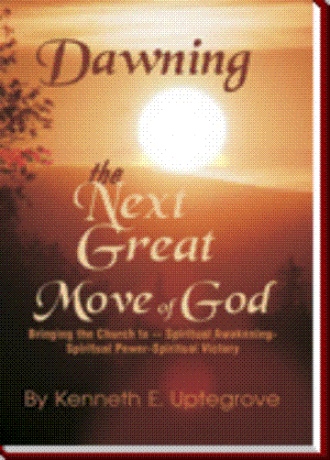
Dawning: The Next Great Move of God
Bringing the Church to -- Spiritual Awakening-Spiritual Power-Spiritual Victory
by
Book Cover & Preview Text
Foreword
This book contains answers for Christians who are hungry for greater insight into what God is doing today to bring forth a great end time harvest. The question we must all ask ourselves is, just how hungry are we? Are we truly growing in God’s wisdom and truth, or are we stagnating in the status quo?
By virtue of being human, we live in ... and frequently are subject to ... the flesh. But to grow is to take the risk of muddling around in both error and truth, and not always knowing the difference. To not grow spiritually is to stagnate, which leads to death. Either way the risk is real ... a closed loop ... and risk is unavoidable so long as we live.
Those who take the growth route are “seekers of wisdom and truth.” Those who take what is considered the safe route are in fact taking the route to stagnation. The middle ground between growth and stagnation could be called the conservative or traditionalist route.
A traditionalist is often a minimalist; i.e., one who holds to well established standards set in place by the founders of their tradition without variance or consideration. Minimalists lean towards Murphy’s Law that states: Whatever can go wrong will go wrong ... and Satan always wins the lion’s share. In the end God wins, but He will have only the pitiful, picked over, unavoidable minimum to show for His narrow victory ... according to Murphy’s Law.
But God’s law is radical, and says just the opposite of Murphy’s Law. God is absolutely victorious. Victory is another aspect of who God is ... He is perpetually and absolutely victorious. His victory is unceasingly on schedule and is all encompassing. And the Lion of Judah takes the lion’s share! Amen!
Before God created
our universe He already had foreknowledge of every human and bird and flower
that would exist on Earth during human history. Because He is omnipotent,
omnipresent, and omniscient in space and time, He was perfectly able to
foreknow before the creation that Adam would fall, and that every human would
fall short of the glory of God. This also explains how He was able to write all
those names in the Lamb’s book of life (Rev. 21: 27). Isn’t it wonderful that
He made provision for our salvation through Jesus Christ before creating our
universe?
But what is foreknowledge?
Time is God’s will in motion. To God there is no future or past. He is the mighty I AM who lives in the eternal present tense. For God the present was, the present is, and the present will be ... simultaneously. He predetermined the beginning, world history, and the end of all events eons before the events transpire. He is able to be “the Alpha and the Omega” because His foreknowledge is part of being omnipotent, omniscient, and omnipresent in all of time and space.
That is why ... before creating anything ... He was able to record in the Bible all that will ever happen on earth. To us that is prophecy of future events. But for God, He is already there and has already done that ... present tense. So, for Him, foreknowledge is (as He told Moses) summed up in His name ... I AM THAT I AM.
When someone talks about God doing “a quick work,” we must remember that He knew before the foundation of the world the exact day that He would do that “quick work.” All that He will ever do is as much an established fact in His mind as the fall of Adam was before the foundation of the world.
That means He is precisely on time and is absolutely in control, and never has to rush. He may release some events in rapid succession, but He is never pressured or persuaded to react to anything.
So, God’s foreknowledge comes out of His omnipresence in all of time. And with this divine foreknowledge comes His ability to hold the future in His absolute, omniscient power. He is THE epitome, THE definition of “absolute victory.”
Perhaps this understanding of God’s omnipresence in time will help dispel the poorly thought out Deist notion that says, “God doesn't have foreknowledge of everything, but is dependent, in part, upon our choices and actions.”
When we take a second look at the Jonah epic we can see that Jonah still could have chosen to not deliver God’s message to Nineveh even after being belched up by that “great fish.” God allowed both Jonah’s will and His will to be fulfilled. But if Jonah had lain on that beach, reeking of vomit, and still refused to go, God would have sent another prophet. God chooses whom He chooses, but His will is inevitably done.
Omnipresence in time is beyond our comprehension, but maybe a chess game scenario will help our human perspective. Consider what would happen if you could look into the future and watch the next game with your chess opponent. Even if you lost that future game, you then know in advance what your opponents moves will be, and you can prepare to counter them before the game is played in the present tense.
However, your opponent may be able to counter your new strategy. So you would have to replay that scene over and over again so as to see every possible move of your opponent before allowing the future to evolve into the present and past tense.
When we add God’s omnipotence to His omnipresence we can see that His ways are far above our ways. In fact, they are so far above our ways that even our best explanations of how He is able to write history in advance is beyond our comprehension.
As one commentator put it, “History is His Story ... prophecy is history in the making.”
This concept of God as omnipotent, omnipresent, and omniscient in space and time leads me to suspect that this I AM’ness of God transcends all human theologies. Specifically, this concept transcends Calvinism and Arminianism. It even transcends our concept of “the sovereignty of God.” God is always beyond our definitions.
But before someone has decided that I have invented a new school of theology, and names it Uptegroveism, let me point out that I don’t understand what I just said. This concept transcends human thinking. But man never ceases to endeavor to place God in a box. That is what doctrines and theologies are all about. But Christianity is bigger than just doctrines, isn’t it? When my sons were three years old they were not capable of understanding their father, but they loved me nonetheless. And I loved them passionately, despite their immaturity. We can have that relationship with our Heavenly father, can’t we?
Does this help you gain a larger concept of God?
The Bible describes a life of virtue, glory, privile
Formats

Book Details
About the Book
Most Christian books are written on what God has done in the past and on what we can learn from those visitations. There are also many books devoted to various needs, issues and problems confronting the church today as well as methodologies to address them. However, too little is published on what the Lord currently is speaking to the church. By God’s grace, that is what the author has attempted to do in this book.
You might say that the best of a hundred books is condensed into this one book, with the added bonus of about a dozen all-new insights thrown in. These twenty essays are a unique work that deserves the attention of all serious Bible students. Whether you agree or disagree with the author, you will be stretched and enriched for your effort to prove or disprove his gracious assertions.
About the Author
Kenneth Uptegrove is a Christian writer who desires to speak to the entire Christian community. Ken is the founder and sole operator of ArkHaven Ministries and Publications.
Ken uses the apologetic style of writing, and is well known for being academic, thorough, and gracious. His prior career as a computer professional influenced this style of writing.
In 1987, at age fifty, he went into full time ministry, concentrating his efforts on writing a newsletter, articles for a local paper, and working on a book. Since going into ministry work, he has studied church history and related subjects extensively, such as Bible manuscript history, Bible translations, and Holy Land archeology.
He also is conversational in such subjects as psychology, philosophy, cosmology, archaeology, astronomy, geophysics, paleontology, anthropology, Egyptology, naturopathy, and horticulture. He is his own Webmaster, and has designed websites for other ministries as well. His website is www.arkhaven.org.
At the turn of the twentieth century, the author would have been called a gentleman scholar. Today we would say his training was in God’s University of Silence. Simply stated, he holds no degrees and has no seminary or Bible school training, but is described by some as being didactic. Although his writing style is formal and serious, in real life Ken is warm and humorous, and is well known for his perpetual smile.
Ken was an honor student and all-conference basketball center in his high school years (1953-56). Then he spent three years in the Army (1957-60), two of which were spent in Germany. In 2002 Ken and his wife, Joyce, celebrated their 39th wedding anniversary. They have three sons, two of whom are married. They have seven grandchildren.
Ken’s father was a first stringer at the University of Nebraska Cornhuskers football team in 1932-1934, and was a successful educator and coach. Ken’s mother turned 93 in February of 2003, and still lives alone.
The Uptegrove’s are active members in a 13,000 member Southern Baptist Church in Springdale, Arkansas. Millions see this church service every week on national TV and over the Internet. Their pastor, Dr. Ronnie Floyd, is a major leader in the Southern Baptist Convention.