
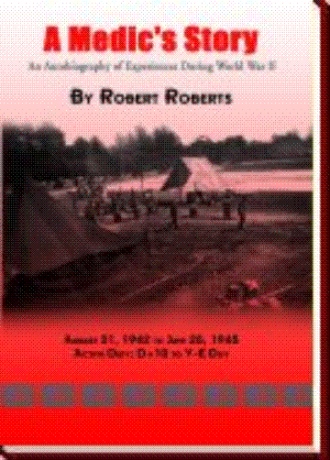
A Medic's Story
An Autobiography of Experiences During World War II
by
Book Cover & Preview Text
Our next move took us to about 14 kilometers from Weimar, Germany. Our assignment was to prepare inmates housed at Buchenwald Concentration Camp for evacuation to more permanent quarters at Blankenhain, Germany. If you had seen Buchenwald as I did I’d put my money on you realizing what we all fought for. You would understand what greed, power, lack of respect and hatred for one another can do to destroy the world as well as you and I as human beings. Thank God the Nazis didn’t prevail. The Buchenwald scene was almost beyond belief and a horror to behold. To think that man could be so inhumane was difficult to come to terms with. To look at these walking, skin covered skeletons was pitiful. To see dead humans emaciated bodies stacked in piles was a horrific sight. The filth and stench was overwhelming to the point of being sickening. Our initial task was to prepare an area in which to set up our hospital and house our personnel. The selected area had to be close to the camp. The only appropriate buildings available were the former residences of the SS Troops, who ran the camp. When Buchenwald was over run by our troops, the inmates were so enraged at the ugly way they had been treated by the SS Troops that they attacked the SS barracks and killed as many SS as they possibly could. Then they smeared the walls of the barracks with their excrement and trashed the barracks. It looked as though the building interiors could not be salvaged. It took untold hard work, by our enlisted men, to clean up and sterilize the building area, to make the buildings acceptable as a hospital and living quarters, for our medical personnel. This was the first time our nurses did not accompany us, so the task we were to undertake put a very heavy load on the doctors and enlisted personnel, who remained. Besides being very undernourished, all were suffering from some type of lung disease but particularly Tuberculosis. Most of the patients had not bathed in months and many were infested with lice. Typhus was prevalent and had to be prevented from spreading. Patients were admitted at the rate of 10 to 15 per hour. Patients were bathed and their clothes discarded and burned. Each patient was then sprayed with DDT powder and given clean pajamas. Only after the above treatment were they admitted to a ward. The laboratory routinely performed blood, sputum and urine tests on each patient. Sedimentation rates were done on afebrile patients and also laryngeal and bronchoscope examinations were performed if indicated. A chest x-ray was taken on each patient. Of the 600 patients admitted, 433 were diagnosed with Tuberculosis. CHAPTER VI We assembled on the beach and were told to wait for further instructions. About one half-hour later a messenger arrived with news that trucks would arrive to transport us to our destination. They could not estimate how long we might have to wait but advised us to dig in (fox holes) because at dark "all hell would break out". We did just that, but the soil off the beach was pretty hard to dig in. As it usually happens in the Army, our trucks arrived just as the fox holes were completed. This task did keep us occupied during the wait. We boarded the trucks, which drove along the beach road 8 or 10 miles. We learned we were in La Cambe, Normandy. We unloaded into a field surrounded by hedgerows. The field contained poles the size of short (10 to 15 foot) telephone poles, like I’m sitting on, placed strategically 15 to 20 feet apart to prevent air landings of any type. We were instructed to wait for the engineers to come to remove the poles with a warning that the poles might be mined. After about an hour and half there was no sign of arriving engineers. Our Executive Officer (our Commanding Officer Colonel Robert Johnson had been reassigned) made what might have been a fatal decision. We were to line up at arms length across the field and then walk across the field observing and reporting anything that appeared to be suspicious. After fulfilling his request he instructed the truck drivers to hook their wenches to the poles and pull them out. When this job was about one third complete, the engineers arrived and the Major was thoroughly chewed out for endangering the lives of his troops. The engineers swept the field with mine detectors and then completed the pole removal. Luckily no mines were detected. The origin of hedgerows in Normandy dates back to Roman times. A two to three foot wide ditch, with a mound of dirt from the ditch thrown up on either side, surrounded the cattle grazing fields. The resulting depth of the ditch usually averaged from four to five feet. Hedgerow contours around the fields were usually irregular. Dense ten to fifteen foot hedges planted on either side of the trench sometimes formed a dense canopy over the trenches. The hedgerows gave the Germans a distinct advantage over the Expeditionary Forces in the early days resulting in heavy Allied casualties. By this time night was approaching and we set up our tent for the evening. Each soldier carried one half of his tent in his pack, called a shelter half. Our tent was pitched in close to the hedgerow base for protection from flak. Our equipment had not yet arrived. There was no more we could do. Our trucks were marked with the Geneva Red Cross and we also displayed a large canvas about 30ft x 30ft in size, with a large red cross on it for protection. We were all unarmed. Darkness came on at 11 P.M. On the dot of 11 P.M. a spectacular display of anti-aircraft and other arms began. Flack whizzed by our heads and could be heard impacting the hedgerows. Our tents had been set up at the base of the hedgerow for protection. We could hear occasional small arms fire not far off. The firing continued from 11 P.M. all through the night until 7 A.M. in the morning. The barrage continued every night and for several weeks thereafter. The fire cover could be seen as a bright red dome over the beachhead, which at this time reached a maximum depth of 10 to 15 kilometers into Normandy. In the daytime the air space over the beachhead was protected by an ultimatum that all unidentified aircraft would be shot down immediately if not identified or if flares were not displayed with proper identification. On several occasions we witnessed the shooting down of hostile aircraft or their destruction in aerial dogfights. It was almost impossible to penetrate the beachhead unless the planes came in at tree top level. The few German planes that entered this airspace were quickly destroyed.
OMAHA BEACH AND THE HEDGEROWS
June 16 to July 14
Formats

Book Details
About the Book
This book is an autobiography concerning my own personal experiences and impressions in the Military Service during the War Years (1942 to 1945). I was a non-combatant soldier in the First Army with the 45th Evacuation Hospital Semi-Mobile. I served as a Medical Laboratory Technician. The 45th actively entered the European conflict on D+ 10 and took part in every major First Army engagement from that day until V -E Day. The following were the highlights of my active duty: Omaha Beach and the Hedgerows of Normandy. The Breakthrough at St. Lo - Operation "Cobra" The Falaise Gap - General Patton's Third Army enters the conflict The Battle of the Bulge The Crossing of the Rhine River at Remagen The 45th Evacuation Hospital's part in the repatriation of Prisoners at Buchenwald Concentration Camp Also included are my experiences during: Basic Training and Technical School. Tennessee Maneuvers Boat Trip on the "Aquitania" to Britain. Life in Britain before D-Day Point System qualification for discharge Train Trip from Germany to "Camp Lucky Strike" in France Boat trip home on a "Liberty Ship". Discharge at Fort Dix, New Jersey During the initial landing on Omaha Beach until the St. Lo Breakthrough we had very limited knowledge concerning our exact geographic location. What little we learned was from troops on the move, patients and the "Stars and Stripes" paper, which we received sporadically. It was not until the St. Lo breakthrough that we learned the Beachhead was a very, very narrow strip of land. The front lines were only a few miles away and never more than ten miles from our tent hospital at any time before the breakout from the hedgerow countries in Normandy. My story begins with complications on being drafted and ends with my discharge from the Army immediately after V-E Day.
About the Author
Mr. Roberts earned a B.S. degree in chemistry from the University of Delaware. Dupont employed him in their Fundamental Research of High Polymers as a Research Chemist. After twenty-two years he left Dupont to pursue corporate management positions, first with Garlock Inc. and several years later with Fluorodynamics Inc. The Fluropolymer products developed attracted a series of company "buy-outs": most significantly The Carborundum Co., Standard Oil of Ohio and British Petroleum. He was member of the Fluoropolymer Division of the Society of the Plastics Industry. The Journal of Polymer Science, Chemical Engineering, Journal of the American Chemical Society and others published a number of his articles. He is the author and inventor of more than thirty U.S. and foreign patents.