
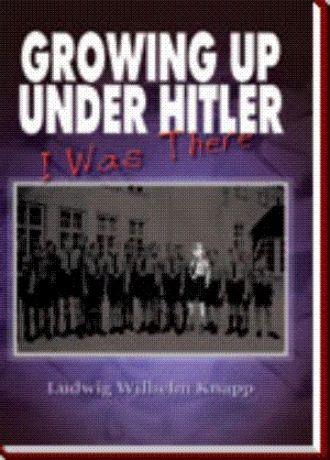
Growing Up Under Hitler
I Was There
by
Book Cover & Preview Text
My father’s letters came from the center of the Soviet Union. His unit was involved in the construction of roads and bridges, and I received his letters on a regular basis. When we picked up our camp’s mail at the town post office, we also received the daily papers. I recall the Pearl Harbor attack headlines. Two days later in December 1941, Germany declared war on the USA, thereby sealing its fate. It is correct to say that there was friction between the Western allies, but those differences were small in comparison to the difficulties that prevailed among the Axis powers. The three Axis countries were united by name only; each member acted for his own national interest. There was no agreement about priority as existed among the western allies. The 1941/42 winter in Europe was one of the coldest on record. Since Germany had hoped to finish its Eastern campaign before the onset of cold weather, its forces were ill-prepared to face the brutal cold. The Russians counterattacked and regained some territory. An appeal by the German leadership urged that all Germans contribute warm clothing and skis for the troops in Russia. There was a good response. Nonetheless, the effects of the cold weather was felt much more by our troops than by the Russians, who were better equipped with winter clothing and already possessed equipment that would withstand low temperatures. This inequity caused the first reverses on the battlefield, but a major front breakthrough was prevented by the bravery of the German soldiers at the high cost of their lives. After a youngster stayed six months in the KLV Camp, his parents were given a chance to express their wishes, whether to have their son return home to the air-raid areas or to permit him to stay for another six months. Our campleader convinced all of us to stay for another six months and asked our parents to vote accordingly. As a result, we all stayed a full year. Since, in my own case, I did not have a home to return to, I had the "honor" of receiving a total of 27 months of the finest National Socialistic Indoctrination administered by Heinrich Steffens. If he had known that shortly after my camp departure, I would be attending my home church again, he would have classified me as a complete failure. On January 30, 1943, Adolf Hitler had, for ten years, controlled the helm of Germany. No doubt those were the most turbulent years in the country’s history, but the worst was yet to come. On that evening of the tenth anniversary I received the beating of my life administered by the camp leader. It happened the following way: It was suppertime and we were eating. One spot at our table was empty because Karl Lamberts, one of the campers, was on milk detail. He and another guy had gone to town to fetch milk for the next day. During the war years, we ate many soups that sometimes defied identification. That evening was somewhat unusual because we were serving two half-portions of soups. One was sweet and tasted like pudding; the other was a ground pea soup. Now comes the problem we had no extra soup bowl in which to save the second half for Karl. Jokingly, I suggested that we combine both portions into one bowl. Guenter Richards, who was ladling out the soup, dared me to do that. Well, I did not want to back down on a dare so I filled the "mixture" into one bowl. Shortly afterward, Karl returned from town, sat at the table and tasted his soup mixture. After being informed of the details that preceded his return, he reported me to the camp leader who called me to his table in front of everybody and gave me a severe beating on my butt, using a furring strip. I screamed, but to no avail. Thinking back, maybe the camp leader did not like the radio reports from the Eastern Front and thereby found an outlet for his frustration. The town Kapellen, in which we were stationed, was under attack; some damage nearby did occur and even some roof tiles of our quarters went flying. We learned later about the fate of the ammunition train. While it was under attack, some cars started burning; however, the escort crew managed to disengage the burning cars and save themselves and the train. Self-preservation makes heroes out of common men.
Formats

Book Details
About the Book
One of the most remarkable documents to come out of the Second World War, this memoir reveals the moods and experiences of a teenager destined to be a member of the elite Hitler Youth (Hitler Jugend). Young Ludwig deserves to be heard as he recalls how after his father was drafted and his mother committed suicide, he – an ordinary German boy – found himself in a new environment, compelled to follow the models programmed by the Hitler regime. Written with exceptional candor and clarity, his keen observations and perceptions then and now demonstrate that deep moral convictions are inextinguishable. His description of Hitler zealots, of returning German POW’s, the hard years before and after 1945, black humor and mind control will make this account a primary source for historians of the Nazi period.
About the Author
Ludwig Wilhelm Knapp was born in Dormagen, Germany in 1930, three years before Hitler’s ascent to power in 1933. After his father was drafted and his mother committed suicide, his formal education landed him in a Hitler Jugend (Youth) School, geared to produce a model soldier. Before the collapse of the Nazi regime in 1945, he participated in trenching work for the Army along Germany’s western borders. In the postwar period, he worked as an apprentice and later electrician for the Dormagen Bayer Plant. In 1954, he immigrated to the United States where his two uncles had lived since the 1920s. On arrival, he joined the U.S. Army, married Doris Gordon in 1956 and has since resided in New Jersey, not far from his two adult children and their families. During the twenty-eight years that he worked at Procter & Gamble, he served as a Scoutmaster for a local troop and more recently has devoted himself to Habitat for Humanity as a weekly volunteer. An avid reader of military history, he felt that it was time to record the story of the era he had witnessed first hand as a youth in Germany.