
Drive Without Fear
by
Book Cover & Preview Text
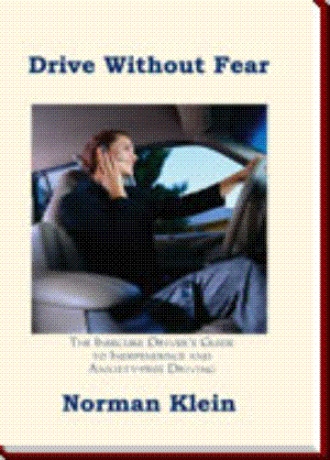
For many a widow the challenge of learning to drive can help her through a trying period. By staying busy, she can ease the pain of her loss. The therapeutic value of learning to drive is immeasurable for a grieving widow. Marge was afraid to drive alone. She knew how to drive and had been driving for twelve years. After fifteen years of marriage, her husband died of cancer. She stayed at his side until he passed away. Five years later she remarried. For seven years she was happy with her new husband. Unfortunately, one morning, without any warning, her husband suffered a massive heart attack and died almost instantly. This second tragedy in her life had a traumatic effect on her. Her few relatives lived in another city. For months she hardly went out of her apartment. Marge lost her desire to mingle with other people. Marge had an automobile, but when she decided to drive for the first time since her husband’s death, she froze at the wheel. She got out of the car almost in a state of shock. She could feel her heart pounding. A month later she decided to call a driving school. Marge took six one-hour lessons but her driving was tentative. She stopped taking lessons. In spite of her need for driving her car, she seemed powerless. She would get behind the wheel but could not muster enough courage to move the car. It appeared that the shock of witnessing the demise of her two husbands had made her agoraphobic. For some unknown reason agoraphobia affects women more than men. It is a mental sickness that is sometimes caused by the loss of a loved one. Many women afflicted with this condition are afraid to leave their homes and reluctant to mingle with other people. Recent experiments have proven that agoraphobic people can overcome their problems by doing what they feared in spite of pounding heart beats and sweaty palms. Marge called me and told me about her problem. I proceeded to give her driving lessons. As long as I sat beside her, she drove beautifully. I tried to convince her to drive alone, but she told me she was not ready. After listening to her excuses for a few weeks, I devised a plan to help her. She lived in a suburban apartment building which was away from city traffic. The building was surrounded by a quiet circular rural area leading back to the building. Without telling her what I had in mind, I arrived one day wearing my jogging shoes. After driving around the building a few times, I told her what I wanted to do. My plan was simple. I would jog along her side as she drove slowly. At first she protested, but I finally convinced her to try. As she drove slowly, I jogged near the car and talked to her as if I was sitting beside her. Occasionally, she panicked, and I stopped. After a few minutes, she started out again with me jogging along with words of encouragement. The next three times I saw her I continued with the same procedure. Each time she showed improvement and appeared more confident. Now I felt she was ready for the next step. Instead of jogging, I stood outside the car and asked her to drive around the building while I waited for her. After much coaxing, she drove slowly around the building to where I was waiting. We repeated this on her next two lessons. I wanted her to drive by herself into the city streets, but she said she was not ready. I told her that if her progress was halted, she would regress into her previous fear of driving alone. We decided that I would drive first and she would follow me in her car. The first time I drove about one mile while she followed me. I drove slowly and if she got too far behind, I waited for her. When we returned, she was elated. We went out four more times. Each time I went a little further. Finally I persuaded her to go out alone. Marge drove around the block carefully. After she came back, she surprised me. She drove off and went to the market place which was a few miles away. When Marge returned, she announced that no matter how frightened she was, she would continue to drive alone until her fear was obliterated. Marge finally drove despite her fear because her desire and determination to drive was stronger than her fear. Helen K. and Jean R. had similar problems. Both were in their early seventies. Both had ailing husbands and both of them wanted to drive. Helen’s husband had lost most of his eyesight, and Jean’s husband had Parkinson’s disease. Jean and Helen each had a driver’s license which they had obtained when they were young. Neither one knew how to drive very well. Helen took her driving lessons faithfully until she was able to drive her husband to his doctor and to the supermarket, etc. Jean made excuses and canceled her lessons. They both had equal ability. Helen was determined to learn no matter how long it took. Jean did not have the courage and foresight to continue. Now she sits in her apartment with her sick husband watching him deteriorate, and she has to depend on others for transportation. There are thousands of women like Jean who must depend on others for help. It doesn’t have to be that way. Jean wanted to drive as much as Helen. Her ability was equal to Helen’s. Her need was as great as Helen’s. Yet she could not conquer her fear. She lacked the will and courage to continue. In my experience, I have come across some women who had good "motor skills" but they never completed their driver training. These women wanted to drive and needed to drive. Yet some characteristic in their personality made them vacillate, and procrastinate until they succumbed to their inner fear.
Formats

Book Details
About the Book
Drive Without Fear is the culmination of thirty-six years of helping insecure people overcome their fear of driving. It demonstrates conclusively that fear and anxiety will not prevent them from driving if they are strongly motivated. A major portion of the book revolves around true stories of twenty phobic drivers who dramatically overcame their irrational fear of driving. The book also contains innovative solutions to the complex traffic problems which confront frustrated motorists.
The chapter Steering, The Key to Driving imparts a unique method for precise steering which demonstrates to readers how to drive safely through the tightest spaces. Tips for the Elderly and the chapter Most Frequent Mistakes Made By New Drivers will enlighten and ease the angst suffered by phobic drivers.
The chapter on Accident Free Driving clearly shows how to avoid situations that could lead to accidents.
An entire chapter is devoted to the intricacies of manual transmission vehicles. A simple driving test is included for those who are unsure of their ability to drive.
Drive Without Fear encompasses nearly every conceivable aspect of driving for today’s motorist. Among them:
A step by step procedure for beginners learning to drive.
How to use anti lock brakes.
Driving safely on expressways.
How to co-exist with trucks on the highway.
Unique methods for driving on snow.
About the Author
Norman Klein has over 36 years of experience in driver training. He has helped countless numbers of people overcome their fear of driving to become safe, capable and independent drivers. In October, 1989, the Philadelphia Inquirer featured Mr. Klein in a special section about the driving problems of older people. The several women interviewed credited him with restoring their confidence and ultimately, their ability to drive. In 1968, the Pennsylvania Department of Public Instruction approved a correspondence course for professional driving instructors written by Mr. Norman Klein. Mr. Klein has personally taught approximately five thousand people, of all ages, to drive. In 1985, he successfully completed a course in Driver Training given by the Pennsylvania State University Institute of Public Safety. Drive Without Fear is the result of over 40 years of experience teaching people to drive. This book describes stories of 20 people who overcame their fear driving due to the expertise of Mr. Klein. Drive Without Fear also provides a wealth of driving safety tips from which all drivers can benefit. Mr. Klein has been married for over 40 years and has two sons, one of whom is a doctor, the other a lawyer.