
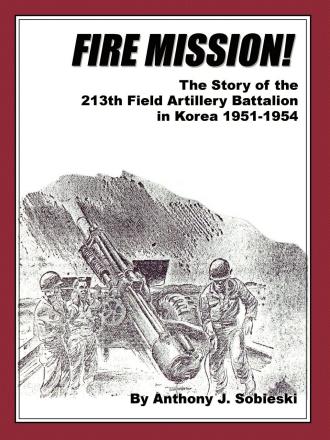
Fire Mission!
The Story of the 213th Field Artillery Battalion in Korea 1951-1954
by
Book Cover & Preview Text
"Immediately after the Kumsong Salient Battle, I was ordered to man O.P. Blaster, our Observation Post in Kumhwa. Rumors had it that the war would end soon but everyone was still shooting. A couple of days before the truce, F-84 fighter-bombers were hitting positions in front of us on Mortar Ridge, that was a show! That week, I remember one particular fire mission, when I suspected enemy movement to the left of Papasan and called for artillery fire. It was at one of the reference points, and I had a suspicion that something was right behind the hill that the reference point was at. There was some sort of activity going on back there, and there were no spotter planes flying that day, and figured that I would drop a few rounds behind there and see what happens. So I fired on it, and after zeroing in and firing for effect we got a secondary explosion going almost straight up in the air. I radioed Battalion to cease fire, end of mission, secondary explosion. Baker Battery did very well with a 240 fire mission. If we started from scratch, it took about eight or nine rounds to completely destroy a target. Some cases, it was only three or four rounds, but it wasn’t always that easy. We had reference points, and I think one of ‘em was a Chinese bunker, an observation post, and every day, a couple times a day, I would swing my BC scope to each one of the reference points to be prepared in case there was an attack from any one of those areas. You could call a fire mission by saying ‘Fire Mission Reference point such and such, two hundred yards right, drop four hundred’ And a day or two right before the armistice, I was traversing my scope, and I went to this one Chinese bunker, and I said ‘Where the hell did that one go?’ During the night, they closed it up and moved it! One day it was there, and the next it was gone! My CO, ‘Dutch’ Rehm, who by now was a captain, called the O.P. early in the day on the 27th to tell us that the war would end on that evening, July 27th. All firing was to cease by 10pm of July 27th. During that last day, there was sporadic fire, but after sunset and darkness began to set in, all hell broke loose. Tracers were flying and bouncing all over and the unmistakable blasts of artillery and tank fire were there. It was like the fireworks on the 4th of July. It seemed to me that it lasted for hours. I gathered we were using up our ammunition so that we would not have to cart it back, and so were they. It was a magnificent spectacle. As time for the cease-fire came, things began to slow down, and finally it stopped but not completely. There were no more explosions, but an occasional rifle or pistol round went off until one or two in the morning. With that, the O.P. Blaster team stood down. In the early morning it was strangely quiet. We looked through our bunker slit and could see many Chinese standing on the ridgeline in front of us. We got out and stood too. So did the 3rd U.S. Infantry. Many more Chinese and U.S. soldiers came out of their holes, and we all stood there looking at each other. They in their off-white quilted uniforms and us in our combat fatigues. Just looking and staring at each other. Occasionally someone on their side and someone on our side would go back into a bunker. I was amazed how many of them were there. Hundreds. And Mortar Ridge, which we plastered. They even came out of there. Their tunnel system must have been deep, intricate and protective. The first couple of days, we did nothing except look at each other. Then, orders came from Battalion to report a count on how many we saw. A live body count. And so every hour on the hour, we called in our count, until we were relieved a week later in August. I don't know how long this practice continued, but I understand other follow on teams had to do it. With my relief, the war ended for me."
Formats

Book Details
About the Book
FIRE MISSION!
With the motto ‘Confidence in Calibre’, the 213th set the standard for artillery in Korea, firing over 10,986 Tons of artillery shells at the enemy in 893 days of combat. From when the 213th was a National Guard unit in 1950 to the final climactic battles of June and July 1953, the record of the 213th stands heads above the rest.
This unit history is written not only from a large scale, unit type perspective, but it also shows the personal side of the war from the perspective of the everyday life and hazards of the artilleryman. Read how the 213th played a major role in such battles as The Kapyong Perimeter, White Horse Mountain, and Outpost Harry, and many smaller incidents that occurred weekly that history and time have almost forgotten.
About the Author
Tony Sobieski is a Master Sergeant with the U.S. Air Force Phoenix Ravens, force protection and anti-terrorism specialists who protect U.S. aircrew and aircraft around the world. Tony’s love for his Dad, a Korean War Veteran, and the respect he has for his Dad’s service to our country became an odyssey of discovery and knowledge about the Korean War and the artillerymen who served there. Using his military background to better understand the life of an artilleryman in Korea, Tony has been able to bridge the gap of fifty years between what happened to U.S. Servicemen in Korea and now to present a work giving the reader an excellent ‘what was it like?’ feeling for those reading it. This is his first book.